“I have compassion on the crowd, because they have been with me now three days and have nothing to eat. And if I send them away hungry to their homes, they will faint on the way. And some of them have come from far away.”
Mark 8:2-3, (context, vv. 1-8)
This one differs from the other miracle of feeding found in entry#42, “The Feeding of the Five Thousand,” (Luke 9.)
In that first instance, (see my most very humble entry, #42) the miracle comes as a surprise, more of a reaction to the moment. This second one though, is a tad more ‘contrived’–it’s designed by the Maker to be a lesson for all prospective disciples. It’s not that the first is a complete surprise, rather, it seems anyway, the other is more expected.
He watches over me, and He does keep me. He’s aware of my every need. This must be understood.
I believe everything he does, he does it out of compassion. That’s how His mind operates, that’s what makes him tick, He always acts this way. He is predictable, and you can trust Him, He will never intentionally hurt you. He will lead you through all this crap.
“No matter how low down you are; no matter what your disposition has been; you may be low in your thoughts, words, and actions; you may be selfish; your heart may be overflowing with corruption and wickedness; yet Jesus will have compassion upon you. He will speak comforting words to you; not treat you coldly or spurn you, as perhaps those of earth would, but will speak tender words, and words of love and affection and kindness. Just come at once. He is a faithful friend – a friend that sticketh closer than a brother.”
“Then Jesus answered her, “O woman, great is your faith! Be it done for you as you desire.”
And her daughter was healed instantly.”
Matthew 15:28, (context, vv. 21-28)
Negotiating with God is not for the timid. It takes spiritual guts, and very few do it right. This chapter begins with a strong teaching on Jewish tradition and moral purity. The scribes and the Pharisee’s have cornered the market on social and religious correctness, and they have a solid grip on the Jewish faith. You must do what they say.
Suddenly there’s a noisy commotion, up jumps a Gentile woman who is terribly loud and terribly desperate, she’s caught somewhere between rudeness and hysteria. She has a disturbing need for her daughter to be released from a demon’s control–there’s a satanic oppression that wants to destroy her. Only Jesus can stop it.
The Judaism of Jesus’ day was not doing its job. Israel was meant to be a “light to the Gentiles,” and a source of healing and truth to the nations of the earth. Clearly it had become confused–its traditions and ceremonies that had nothing to do with the salvation of the world.
Perhaps the failure of the Jewish people to reach the world parallels the failure of the Church to carry out Jesus’ Great Commission? Religion has always stood in the way of God’s heart and His plan to bring salvation to everyone. I think this is the main reason Jesus hated it so.
This woman has a need that only Jesus could meet. She embarrasses herself insisting that Jesus take action. She seems almost rude to the point of being obnoxious. She is repeatedly told to be quiet, that her daughter’s deliverance was not in the plan of God. But that’s an answer she will not accept.
How honest are my conversations with God? Do I say what I really think? Do I intercede for others?
This is one of more unsettling verses in the New Testament–at least for me anyway. Everyone in this passage seems somewhat rude, even a bit boorish to me–even Jesus seems off, which really does unsettle me. There’s a stilted awkwardness in this passage that makes me want to apologize about Jesus’ attitude to all my unbelieving friends. I just don’t get all the national, racial, and social issues that are involved here.
An addendum though: Not every scripture is ever grasped once, and for all time understood. I’ve learned there are verses that reveal their layers years later. Onion-like. I think that this is probably true–for me anyway. The same verse will speak to me over and over again.
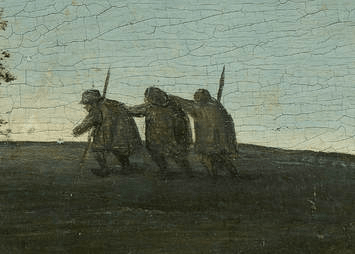
“Let them alone; they are blind guides. And if the blind lead the blind, both will fall into a pit.”
Matthew 15:14, (context, vv. 1-20)
One of the most descriptive issues of a cult is how much emphasis is based on conforming to the teachings and example of the leader. They’re to be obeyed, without any question or reservation. There can only be following, and how well you do that determines your “faithfulness” to what they are teaching as truth.
A religious walk will often emphasize conformity to a certain leader. He is the one who now directs our path. When we follow him we think we’re walking in truth. But Jesus warns us that there is a blindness that becomes dangerous to our spirits.
Jesus didn’t come to make you conform, He came to “transform.” We follow Him with our eyes wide open–we’re seeing for the first time. We’re finally perceive things as they really are, we no longer are wearing blindfolds, we no longer stumble over the bumps and pits in our path.
He makes us see. Jesus gives us spiritual sight that transforms us. We’re no longer following blind men, who only guide us into deep ditches, rather we now see where we’re going. We now walk in the day, and not in the dark night. This new sight is His gift to you.
Even when it’s dark out, we understand our path and where it’s leading us. The believer relies on the Word, it’s now his real source of understanding, it is now his light. We have the Holy Spirit which is our guide–He leads us into all truth. We no longer follow men, we follow Jesus!
“For at one time you were darkness, but now you are light in the Lord. Walk as children of light.”
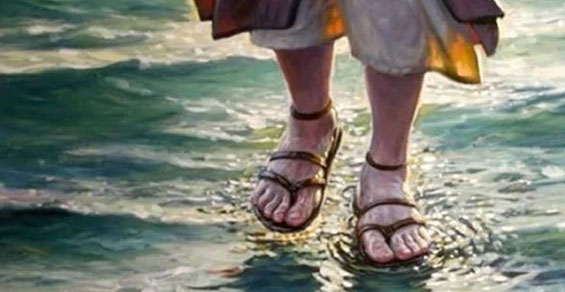
28 And Peter answered him, “Lord, if it is you, command me to come to you on the water.” 29 He said, “Come.” So Peter got out of the boat and walked on the water and came to Jesus.”
Matthew 14:27-29, (context, vv. 22-33)
Jesus is full of surprises! You can never guess the things He will do next. He is Lord after all. To walk on water is totally impossible. But Jesus does it. He walks on it as if it were a concrete sidewalk. He totally scares His disciples sitting in the boat. When they see Him they freak out. They couldn’t believe their eyes.
Jesus wants to reveal to His disciples His true nature. They had just seen Him multiply fish and loaves, He fed five thousand plus just a few hours ago. Wasn’t that a miracle enough? It seems that Jesus doesn’t think so. We now see Him strolling on the water like it was solid ground.
For some inexplicable reason, Peter wants to insert himself into Jesus’ miracle. Oddly, he has decided he’ll join Jesus, and leave behind the security of the boat–for the insecurity of the impossible! He truly believes that Jesus can hold him up somehow. Perhaps this alone is the most amazing part of this passage. Can a man duplicate the walk of Jesus? Can we walk like Him?
Peter really wants to leave the security of the boat, for the insecurity of the impossible.
It seems to me that we’re constantly doing the “Peter thing.” It’s true our walk of faith really is intensely supernatural, and yet we somehow forget this. Face it, we will never generate the “fruits of the Holy Spirit” on our own. Our most sincere effort simply will never turn water into something solid. We will never walk the disciple’s path without a faith in the Master who calls us to come to Him.
I think Jesus wants us to join Him. Our faith in Him is the key. We believe that we can walk with Him, we believe we will see the impossible. Without question it’s Jesus’ power that holds us up. Our faith in Him is the ignition point in all of this. Our mustard seed faith, combined with Jesus’ power. becomes the true walk of the disciple.
We must bravely launch ourselves into the purposes of God. To merely sit in the boat is hardly faith. When Peter steps over the gunwales, he steps into the world of the amazing. The water holds him, and his trust in Jesus solidifies like the water he walks on. He is now doing the impossible. He is now becoming very much like Jesus.
Our walk seems terribly weak at times, we can easily list our sin and weaknesses, our spiritual ugliness. We’re not quite convinced that the blood of Jesus covers all our sin–and we can’t step out of the boat. I think it’s Peter’s faith in Jesus’ power that holds him up. When his faith falters, he does the “rock thing,” There is something about his circumstances–the wind, and the waves that begin to frighten him. (But I must believe Jesus was pleased.)
Just let him sink, and teach the 11 who sit in the boat about the perils of unbelief? Nope.
Fear trumps faith. Adversity always frightens. We sink when our flawed faith can no longer hold us up. The amazing thing though, Jesus doesn’t change His mind or heart, He is still in the business of doing miracles. He calls His disciples to believe in Him–to have faith in His power. To really understand, to step out in faith, and to see miracles happen.
“Christ will always accept the faith the puts its trust in Him.”
“A prophet has little honor in his hometown, among his relatives, on the streets he played in as a child.”
Jesus wasn’t able to do much of anything there—he laid hands on a few sick people and healed them, that’s all.”
Mark 6:4, the Message
“For some reason, they hate me.” There’s a real pain that we give each other, especially when it’s on the level of friends and our close family. It seems those relationships are vulnerable, and have the most exposure. When somebody close to us has an issue with us, that pain is deep and lasting. Others well, not so much.
Those closest to us have seen our issues. They’ve seen us at our best, and definitely at our worst. Other relationships are briefer, and they see us, and only subjectively. The salacious details never come out into the open, and we certainly won’t reveal them.
Jesus, the sinless one, faces the same problem in His hometown, the village of Nazareth where He was raised. He has already worked incredible miracles, things that absolutely stagger the imagination. He has raised the dead, healed lepers and cured the paralyzed. He has walked in the light of God unlike anyone who preceded him.
And His teaching? Oh my, no one was ever listen to such marvelous words that describe the Father’s kingdom so well. His words do astonish, and bring absolute light into some pretty dark darkness. The things He says, are astonishing. There has never been anyone like Him.
When Jesus returns to His hometown He discovers an insidious resistance to His words and miracles. People think they ‘know’ Him. A few remember Him playing with their own children–kicking the can, or riding around on the neighbor’s donkey. They ‘think’ they know Him. They really do. But they’re very much mistaken.
But what about our own misconceptions?
There are lessons in this passage we need to learn. Does my idea of Jesus limit or restrict His work? Perhaps we should realize that His miracles often stop when our unbelief begins. Since we think we know Him so well, we think we determine what He can, and cannot do. But seriously, do we truly grasp who Jesus really is?
“Unbelief is not a misfortune to be pitied; it is a sin to be deplored. It’s sinfulness lies in the fact that it contradicts the word of the one true God and thus attributes falsehood to Him.”
The blind men came to him, and Jesus said to them, “Do you believe that I am able to do this?” They said to him, “Yes, Lord.” Then he touched their eyes, saying, “According to your faith be it done to you.”
And their eyes were opened.
Matthew 9:28-30, (context vv. 27-31)
I remember reading a story; more like a sanctified fable but maybe containing a bit of truth? The story (possibly from a French poem?) was that wherever Jesus would walk flowers would bloom in His footprints. I suppose the idea was that wherever Jesus went–life, healing and wholeness happened. It was His footprints; His presence that brought out the very essence of the Kingdom of God.
The love Jesus has for us is that wonderful. His grace–a grace that heals and forgives, a grace that’s now flourishing in the heart of a every real disciple. His mere presence brings us flowers even in the hard times.
Without Him, it seems we’re stuck with plastic roses that really don’t impress anyone. They aren’t real.
Jesus heals these blind men. They are completely without sight. They have understood nothing but blackness, but that is about to be instantly changed, it will come like a switch is flipped. Pop! Instant sight. Suddenly everything floods in. They “see” everything for the first time. Imagine, to be sightless, and then to suddenly see. Colors, trees, flowers, faces, and Jesus all at once. Can you imagine what that must be like?
These men had to have faith–that ‘spiritual ability’ to step out and grasp a healing that hasn’t come yet. They first need to trust the man (Jesus) before the healing can ever be received. “Do you believe I can do this…” I suppose the issue here is identity, the Lord Jesus Christ declaring His authority over this blindness. He intends to heal. It’s His nature to heal.
Wherever Jesus chooses to walk, supernatural things happen. We’re called to trust the person of Jesus, to simply believe Him, and expect Him to keep His word; but whatever happens, happens. Believers will choose to continue to believe, no matter what. They know the difference between real and plastic flowers.
I believe in Jesus’ character–His absolute love for me, and His power over everything. I love Him, and I look for His presence, and suddenly amazing miracles happen. But it’s Him–it’s all Him, and I must put my faith in Him. He does all the work, I’m the lazy guy leaning on my shovel.
But He wants to heal us, that’s His nature. My feeble faith can move things. My mustard seed faith can elevate mountains. It makes wonderful things happen. But that faith has to be fortified, cemented into His heart– we must tell of Jesus’ kindness and mercy and love for those still lost. We must believe in Him to touch others, and then whatever might happen after that will always be His decision. He will always be the Lord either way.
“When human reason has exhausted every possibility, the children can go to their Father and receive all they need. … For only when you have become utterly dependent upon prayer and faith, only when all human possibilities have been exhausted, can you begin to reckon that God will intervene and work His miracles.”
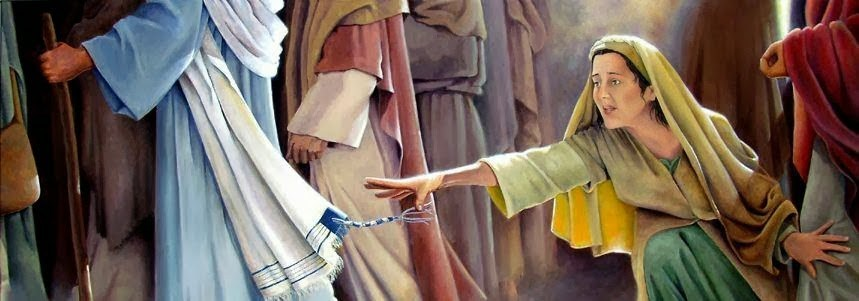
“Just then a woman who had been subject to bleeding for twelve years came up behind him and touched the edge of his cloak. 21 She said to herself, “If I only touch his cloak, I will be healed.”
22 “Jesus turned and saw her.
“Take heart, daughter,” he said, “your faith has healed you.” And the woman was healed at that moment.”
Matthew 9:20-22
I really don’t have a faint idea of her sickness. But I think to bleed constantly must’ve been tiring. Physically, and emotionally–exhausting. She had to ‘plan’ her days carefully to accommodate all of this. Things were never easy for this woman. It truly crippled her life; it would’ve consumed her.
This Jewish woman was suffering with an issue of blood for 12 long years. She had sought help from one physician after another, and spent all her money paying doctor’s bills. But she had not been helped. In fact, her problem got worse. And we need to remember, that she’d be completely ostracized socially–a total write-off, a reject.
Leviticus 15 explains this:
“Anything she lies on during her period will be unclean, and anything she sits on will be unclean. 21 Anyone who touches her bed will be unclean; they must wash their clothes and bathe with water, and they will be unclean till evening. 22 Anyone who touches anything she sits on will be unclean; they must wash their clothes and bathe with water, and they will be unclean till evening. 23 Whether it is the bed or anything she was sitting on, when anyone touches it, they will be unclean till evening.“
(vv. 19-23)
Fourteen years of being unclean; it seems like a half of a lifetime. She was cut off from any solace of the Temple–that would’ve denied her a sacrifice for her sin. Not only was 14 years a long time, her physical disease had powerful implications spiritually as well. She would have carried around her sin like a heavy coat. She would never know the peace that infuses grace.
Her only hope was Jesus, plain and simple. His reputation as a healer and a teacher had spread like crazy through the country (even King Herod followed His ministry!)
She had one overriding desire. Nothing but a healing would be acceptable.
Perhaps Jesus had already passed by her? After all, He was on His way to a simple resurrection! But in her thinking, she could still touch Him, perhaps she just stretch out and grab the tassel of His robe. And guess what; she was healed, completely. A lightening strike!
We don’t bleed, but we sin all the time.
All of us are like this woman. We don’t bleed, but we sin all the time. Romans states, “we all have sinned, we all have fallen short of the glory of God.” Isaiah graphically describes all of us “to be like and unclean thing.” The Hebrew word for those two words is “menstrual cloth.” All the good we do amounts to something less than zero.
Each of us have definitely sinned. We’re very much ‘defiled’ even at our very best. Sin has completely ruined us. We are foul.
We must reach out, and keep reaching out, grabbing a hold of Jesus. We must seize Him, even if it’s a tiny tassel of His robe. We must snatch it and never let go; until He heals us and restores our lives. We know He can.
“Christ is the Good Physician. There is no disease He cannot heal; no sin He cannot remove; no trouble He cannot help. He is the Balm of Gilead, the Great Physician who has never yet failed to heal all the spiritual maladies of every soul that has come unto Him in faith and prayer.”
He said to them, “Why are you so afraid? Have you still no faith?”
Mark 4:40 (context vv. 35-41)
Often fear rules the human heart. Quite suddenly the waves seem too high, and the wind starts to really howl. We look at our circumstances and we freak out by what we see. Things look grim, and often we imagine the worse is going to happen. Fear has its sharp hooks in us; and everything is starting to get really crazy.
Jesus often zaps us at times like this. When our boat is pitching violently in open seas, we’ve lost our anchor and the sails are useless, it’s then we start looking around to find where we put our life-jackets. We choose this approach rather than calling out to Him.
It seems that becomes our last option–to beg Him to come and save us. (We can get so stiff-necked sometimes. I think it really is a pride/humility issue.)
Faith is probably the most significant part of this verse. It’s faith in Him that screams out of our storm. When faith shows up, fear leaves. We get one or another. I suppose it’s always going to come to this–will it be fear or faith? We must grasp this lesson, hopefully sooner rather than later. The storm is how the Kingdom of God gets worked into the human heart.
“Faith expects from God what is beyond all expectation.”
-Andrew Murray
“Have you no faith?” That’s Jesus’ interesting question to His believers who are about die. Crazy! But know this, these tempests will never be random or capricious. His love has absolute control over each of them. All He wants is that His disciples will see a truly powerful love, that really does save.
Calling on Him must become our first reaction, and not the fifteenth.
We’ll learn to do this first eventually, even if it means repeating the lesson over and over and over, until faith becomes our first response. Jesus often uses a bad storm to put the Kingdom even deeper inside of people. “Have you no faith” isn’t so much as an indictment of you, as it’s a deep and concerned observation. And only the storm can reveal your faith.
49 And stretching out his hand toward his disciples, he said,
“Here are my mother and my brothers! “
“For whoever does the will of my Father in heaven is my brother and sister and mother.”
Matthew 12:49-50, (context, vv. 46-50)
His family is spiritual. Earthly connections aren’t what really matters, Jesus expresses an important understanding of the Kingdom of God. Things are not evaluated by physical relationships anymore. Life is different now.
I don’t think Jesus has gone out of His way to alienate His earthly or physical connections to His family. I don’t think He is being rude or uncaring. That isn’t part of His thinking. And yet He does seem to point to something that’s more permanent and everlasting.
It isn’t enough to be His brother, or cousin or uncle. These things really don’t matter. What does matter is being part of His spiritual family. To be painfully honest, it seems to me anyway, that the spiritual relationship is what truly counts. Being Jesus’ disciple, and doing the Father’s will for us transforms us and lifts us up to family ‘status.’
But it doesn’t strictly matter “how” you relate to Jesus so much, but how you do the will of God. That is what impresses Jesus. That’s what He communicates to those who are standing around Him. Do you really understand what is family? Can you grasp the idea that doing the will of God now makes you authentic?
They say “blood is thicker than water.’ Jesus’ blood unites us to Him and each other! Doing the Father’s will turns us into His family.
We must reach out and grab this concept–we are family if we do the will of God, believe in His sacrificial work and immerse ourselves into His purposes. We become His family, spiritually anyway, when we start to do what He wants for us. Am I doing what He wants for me at this moment, or the next, or the next?
Are we really part of His family, or is someone else our father?
“The purpose of the Bible is simply to proclaim God’s plan to save His children. It asserts that man is lost and needs to be saved. And it communicates the message that Jesus is the God in the flesh sent to save His children.”
This has to be one of my favorite passages of scripture. Simon, who is a Pharisee, has invited Jesus for dinner. I suppose he intends to impress Him, or at the very least he wants to Jesus to look more favorably on his religious sect. It’s simple PR work for him. (Maybe even tax deductible?)
But in comes this woman, and she spoils everything. The ESV translation describes her as a “sinner” and a “woman of the city,” (whatever that means?) She bursts into the dining room wielding an alabaster flask of ointment. She kneels and weeps, and uses the locks of her hair to rub the perfume on the dirty feet of Jesus.
She is crying, and I have to believe she’s very aware of her sin–nobody has to tell her that she has wasted her life. Simon, on the other hand, finds her behavior with Jesus quite objectionable. He’s obviously disturbed by her presence, and he only can only see her outside actions, his vision never really extends to see her broken heart.
And yet Jesus is quite aware of the tension that’s now developing. He’s spiritually sensitive to all that’s swirling around Him, and we see Him jumping at the chance to teach Simon (the Pharisee) a lesson on true forgiveness.
It seems that a certain moneylender had two men that owed him money. One was indebted with just a modest sum; the other was bound by a huge debt. It seems that both men couldn’t repay what they had borrowed. So inexplicably, the lender cancelled the debt of both of them, the little and the big. These men were now free. They owed nothing–not a red cent.
OK now. Who will “love him more?”
Jesus compares the responses of these ‘ex-debtors’ and takes it to a very logical conclusion. “Who will love him more?” Simon obviously understands this line of reasoning, and we hear him responding correctly to Jesus’ lesson on mercy and grace.
Simon realizes there are those out there who are terrible sinners, they are wicked and have walked in sin and darkness for a very long time. They’re irrevocably stained by their sin, it has shaped them to the point that their personalities have been altered. Sadly, they know all of this, and it breaks their heart in two. They tell no one, but God knows.
The schooling Simon receives is the Kingdom logic that corrects his definition of God’s mercy. The kindness that God bestows on us is proportional, those who “owe” much are forgiven much. And as a result they love much.
When you see a person weeping at the altar, overcome by their sense of sin and they seem terribly broken, you’ll understand the love they now have for Jesus. A tremendous debt has been forgiven, and they get up and walk away as free men and women. They now finally understand how to love. They have been forgiven.
“The truth is that there are such things as Christian tears, and too few of us ever weep them.”








 The Red Letters of Jesus