Peter Tells the Truth, #49

“And I tell you, you are Peter, and on this rock I will build my church, and the gates of hell shall not prevail against it.”

Matthew 16:18, (context, vv. 13-20)

Peter was only stating what was now quite obvious– “You are the Christ, the Son of the living God.” I can only imagine that when Jesus heard him say this, the switch got flipped, and the lights of the universe turned on–all of a sudden it was all ‘angels-on -tiptoe,’ and all that convoluted theology made perfect sense.

The tumblers in the lock fall into place at last. Jesus is the key. He always has been.

The origination came from God (v. 17.) Peter knew it was the truth. He believed it and spoke it. But God made it.

Jesus is in the building business. He intends to construct a building that will handle all of the attacks of the enemy. In spite of what you heard, the Kingdom of God is advancing–Satan’s best last hope is his gates, and even that can never manage muster.

“And this is the victory that has defeated the world: our faith.”

1 John 5:4, CEB


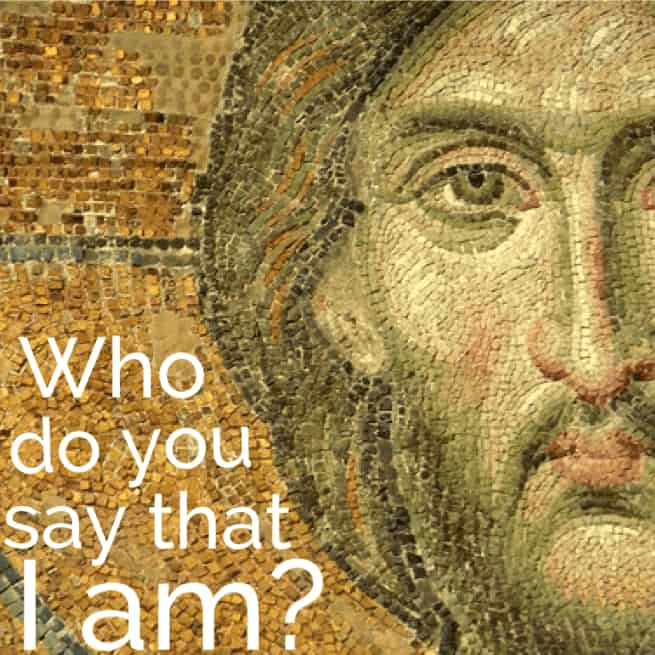
Who Do You Think I Am? #48

“Who do the crowds say I am?”

“But who do you say that I am?”

Luke 9:18, 20 (context, vv. 18-20)

The question is significant; and it’s never been fully answered. Perhaps each of us must be asked this exact same thing. And perhaps it’s the crucial question that every human being who has ever drawn breath must ask themselves. Who is Jesus? Who is He really?

The crowds had witnessed Jesus feed them with a little boy’s lunch. They saw miracles and heard teaching, and yet maybe they were a bit confused. They could only put Jesus in the context of what they knew was “allowable” by the Pharisees. He definitely was some kind of prophet. Jesus was being evaluated by a very curious crowd.

Jesus isn’t distressed by this, He’s not full of self-doubt or second thoughts. He’s not looking around for our support–or accolades, palms or laurels. He knows exactly who He is. He is the only Son of God, the second person of the Trinity. He is fully and completely God; and He is now wearing a robe and walking around in sandals.

There exists a “crowd faith,” something more or less aware that God cares, and miracles do happen in this life. This is all well and good. But it seems there is a “personal faith,” which Peter now announces out loud. “You’re the Messiah, come from God.”

What Peter declares in front of everyone changes everything.

We must always draw our own conclusions, of course. We must look at Him, and decide for ourselves what He claims to be. There is no question it’s scary, and it’s hard. But you, and you alone, must decide. Crowd faith is almost always good, I suppose; but Peter’s bold declaration is what He really is waiting for. Are you convinced yet?

Water, Like Concrete, #43

27 “But immediately Jesus spoke to them, saying, 

“Take heart; it is I. Do not be afraid.”

28 And Peter answered him, “Lord, if it is you, command me to come to you on the water.” 29 He said, “Come.” So Peter got out of the boat and walked on the water and came to Jesus.”

Matthew 14:27-29, (context, vv. 22-33) 

Jesus is full of surprises! You can never guess the things He will do next. He is Lord after all. To walk on water is totally impossible. But Jesus does it. He walks on it as if it were a concrete sidewalk. He totally scares His disciples sitting in the boat. When they see Him they freak out. They couldn’t believe their eyes.

Jesus wants to reveal to His disciples His true nature. They had just seen Him multiply fish and loaves, He fed five thousand plus just a few hours ago. Wasn’t that a miracle enough? It seems that Jesus doesn’t think so. We now see Him strolling on the water like it was solid ground.

For some inexplicable reason, Peter wants to insert himself into Jesus’ miracle. Oddly, he has decided he’ll join Jesus, and leave behind the security of the boat–for the insecurity of the impossible! He truly believes that Jesus can hold him up somehow. Perhaps this alone is the most amazing part of this passage. Can a man duplicate the walk of Jesus? Can we walk like Him?

Peter really wants to leave the security of the boat, for the insecurity of the impossible.

It seems to me that we’re constantly doing the “Peter thing.” It’s true our walk of faith really is intensely supernatural, and yet we somehow forget this. Face it, we will never generate the “fruits of the Holy Spirit” on our own. Our most sincere effort simply will never turn water into something solid. We will never walk the disciple’s path without a faith in the Master who calls us to come to Him.

I think Jesus wants us to join Him. Our faith in Him is the key. We believe that we can walk with Him, we believe we will see the impossible. Without question it’s Jesus’ power that holds us up. Our faith in Him is the ignition point in all of this. Our mustard seed faith, combined with Jesus’ power. becomes the true walk of the disciple.

We must bravely launch ourselves into the purposes of God. To merely sit in the boat is hardly faith. When Peter steps over the gunwales, he steps into the world of the amazing. The water holds him, and his trust in Jesus solidifies like the water he walks on. He is now doing the impossible. He is now becoming very much like Jesus.

Our walk seems terribly weak at times, we can easily list our sin and weaknesses, our spiritual ugliness. We’re not quite convinced that the blood of Jesus covers all our sin–and we can’t step out of the boat. I think it’s Peter’s faith in Jesus’ power that holds him up. When his faith falters, he does the “rock thing,” There is something about his circumstances–the wind, and the waves that begin to frighten him. (But I must believe Jesus was pleased.)

Just let him sink, and teach the 11 who sit in the boat about the perils of unbelief? Nope.

Fear trumps faith. Adversity always frightens. We sink when our flawed faith can no longer hold us up. The amazing thing though, Jesus doesn’t change His mind or heart, He is still in the business of doing miracles. He calls His disciples to believe in Him–to have faith in His power. To really understand, to step out in faith, and to see miracles happen.

“Christ will always accept the faith the puts its trust in Him.”

-Andrew Murray
   

Given Very Little Honor, Entry #41

“Jesus told them,

“A prophet has little honor in his hometown, among his relatives, on the streets he played in as a child.”

Jesus wasn’t able to do much of anything there—he laid hands on a few sick people and healed them, that’s all.”

Mark 6:4, the Message

“For some reason, they hate me.” There’s a real pain that we give each other, especially when it’s on the level of friends and our close family. It seems those relationships are vulnerable, and have the most exposure. When somebody close to us has an issue with us, that pain is deep and lasting. Others well, not so much.

Those closest to us have seen our issues. They’ve seen us at our best, and definitely at our worst. Other relationships are briefer, and they see us, and only subjectively. The salacious details never come out into the open, and we certainly won’t reveal them.

Jesus, the sinless one, faces the same problem in His hometown, the village of Nazareth where He was raised. He has already worked incredible miracles, things that absolutely stagger the imagination. He has raised the dead, healed lepers and cured the paralyzed. He has walked in the light of God unlike anyone who preceded him.

And His teaching? Oh my, no one was ever listen to such marvelous words that describe the Father’s kingdom so well. His words do astonish, and bring absolute light into some pretty dark darkness. The things He says, are astonishing. There has never been anyone like Him.

When Jesus returns to His hometown He discovers an insidious resistance to His words and miracles. People think they ‘know’ Him. A few remember Him playing with their own children–kicking the can, or riding around on the neighbor’s donkey. They ‘think’ they know Him. They really do. But they’re very much mistaken.

But what about our own misconceptions?

There are lessons in this passage we need to learn. Does my idea of Jesus limit or restrict His work? Perhaps we should realize that His miracles often stop when our unbelief begins. Since we think we know Him so well, we think we determine what He can, and cannot do. But seriously, do we truly grasp who Jesus really is?

“Unbelief is not a misfortune to be pitied; it is a sin to be deplored. It’s sinfulness lies in the fact that it contradicts the word of the one true God and thus attributes falsehood to Him.”

-John Stott

Mark 6:4

Two Blind Men, Entry #40

The blind men came to him, and Jesus said to them, “Do you believe that I am able to do this?” They said to him, “Yes, Lord.” Then he touched their eyes, saying, “According to your faith be it done to you.” 

And their eyes were opened. 

Matthew 9:28-30, (context vv. 27-31)

I remember reading a story; more like a sanctified fable but maybe containing a bit of truth? The story (possibly from a French poem?) was that wherever Jesus would walk flowers would bloom in His footprints. I suppose the idea was that wherever Jesus went–life, healing and wholeness happened. It was His footprints; His presence that brought out the very essence of the Kingdom of God.

The love Jesus has for us is that wonderful. His grace–a grace that heals and forgives, a grace that’s now flourishing in the heart of a every real disciple. His mere presence brings us flowers even in the hard times.

Without Him, it seems we’re stuck with plastic roses that really don’t impress anyone. They aren’t real.

Jesus heals these blind men. They are completely without sight. They have understood nothing but blackness, but that is about to be instantly changed, it will come like a switch is flipped. Pop! Instant sight. Suddenly everything floods in. They “see” everything for the first time. Imagine, to be sightless, and then to suddenly see. Colors, trees, flowers, faces, and Jesus all at once. Can you imagine what that must be like?

These men had to have faith–that ‘spiritual ability’ to step out and grasp a healing that hasn’t come yet. They first need to trust the man (Jesus) before the healing can ever be received. “Do you believe I can do this…” I suppose the issue here is identity, the Lord Jesus Christ declaring His authority over this blindness. He intends to heal. It’s His nature to heal.

Wherever Jesus chooses to walk, supernatural things happen. We’re called to trust the person of Jesus, to simply believe Him, and expect Him to keep His word; but whatever happens, happens. Believers will choose to continue to believe, no matter what. They know the difference between real and plastic flowers.

I believe in Jesus’ character–His absolute love for me, and His power over everything. I love Him, and I look for His presence, and suddenly amazing miracles happen. But it’s Him–it’s all Him, and I must put my faith in Him. He does all the work, I’m the lazy guy leaning on my shovel.

But He wants to heal us, that’s His nature. My feeble faith can move things. My mustard seed faith can elevate mountains. It makes wonderful things happen. But that faith has to be fortified, cemented into His heart– we must tell of Jesus’ kindness and mercy and love for those still lost. We must believe in Him to touch others, and then whatever might happen after that will always be His decision. He will always be the Lord either way.

“When human reason has exhausted every possibility, the children can go to their Father and receive all they need. … For only when you have become utterly dependent upon prayer and faith, only when all human possibilities have been exhausted, can you begin to reckon that God will intervene and work His miracles.”

-Basilea Schlink


Please, Don’t Be Offended, Entry #33

“And blessed is the one who is not offended by me.”

Matthew 11:6, (context, vv. 2-6)

Being “blessed” is much more than having lots of money, a nice home or a fancy new car. First and foremost being blessed must be a spiritual word–it seems sometimes we have to rescue the true definition and then bring back its real meaning. The old hymn exhorts the enriched Christian to “count your many blessings, name them one by one.” Singing this will work something inside us.

We become spiritually prosperous when we begin to embrace the reality of Jesus–His words, actions, even His very person becomes the dearest thing we could ever dream of possessing. We’re also blessed when we receive deep inside us the many challenging things He says. We really must absorb these harder words without any reservations. It seems that He doles these things out very carefully.

We have to admit that being scandalized over Him is always a possibility. It can happened to a pastor, or a ‘newbie’ in the faith. No matter who we are, we’re always in the arena, being watched, and our faith in Jesus will be tested. Is it real? Will we be insulted or affronted by the presence of the Lord Jesus Christ? That dear one, it a very real possibility.

Jesus still offends people. There were those who embraced Him, and yet it seems to me that most ended up resisting and rejecting Him. He was a ‘wrench in their machinery,’ an obstacle in their theology. He was constantly doing things that didn’t seem right or proper.

Does Jesus offend you?

“When Jesus came to earth, demons recognized him, the sick flocked to him, and sinners doused his feet and head with perfume. Meanwhile he offended pious Jews with their strict preconceptions of what God should be like. Their rejection makes me wonder, could religious types be doing just the reverse now? Could we be perpetuating an image of Jesus that fits our pious expectations but does not match the person portrayed so vividly in the Gospels?”

-Philip Yancey, “The Jesus I Never Knew”

He Touched the Coffin, #26

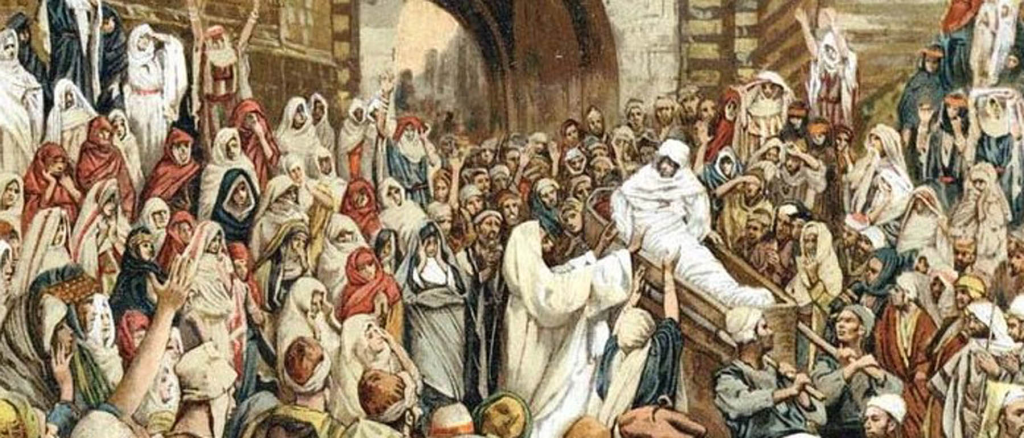
And when the Lord saw her, he had compassion on her and said to her, 

“Do not weep.” 

Then he came up and touched the coffin, and the bearers stood still. And he said, 

“Young man, I say to you, arise.”

Luke 7:13-14 (context, vv. 11-17)

Widows who had no family to support them had it rough. This woman’s husband had died and now her only son was gone. A widow was forced to rely on relatives to meet their needs, but now she had no one. She was all alone and faced a very difficult life. She was vulnerable. And now she saw her only son being carried out of the city to be buried.

The two groups came together. Jesus and His group of disciples were going into Nain and met the funeral procession coming out. Jesus came to the woman as she led the crowd. She was weeping as she walked. I have to believe that His heart met hers.

Jesus response to her was mercy and compassion.

I really think His heart was broken for her. He immediately stopped the funeral march and went straight to her to comfort and console. Apparently no one else took up this. Yet Jesus went to her. That really encourages me.

The body had been washed and rubbed with aromatic spices. His hair had been combed and his fingernails had been clipped. He had been carefully wrapped in linen according to Jewish custom. He had been placed in an open funeral bier, to be carried to the grave site.

Nain was an interesting place. Just a few miles away the prophet Elisha had raised the dead by laying on the corpse repeatedly, 2 Kings 4:32-35. Jesus however, raises the dead with a simple sentence. I think that is interesting. It shows that the power of God that resides in the person of Jesus.

God cares for people.

Obviously Jesus is a full and complete member of the Trinity. He possesses all power and strength. He is the Word and the Creator of everything in the universe. And yet we see that this all powerful one is full of mercy and compassion. He loves widows and orphans. He loves people, and understands their needs. He rolls up His sleeves and enters into their pain and misery.

I suppose the compassion that Jesus has is the most intriguing part of Matthew 7. God loves people intensely. He intervenes in their lives. He meets needs that no one else can understand. He possesses all power and has an infinite amount of love. He can be trusted to meet every need. After all, He can raise the dead with a few simple words.

“His is a loving, tender hand, full of sympathy and compassion.”

-D.L. Moody

“Centurion” Faith, #25

Jesus said to him, “I come and heal him.”

Matthew 8:7 (context, vv. 5-13)

See the remarkable faith of a Roman centurion. Can we really fathom the deep depth of such belief? He comes to Jesus with a desire for the healing of a servant. He was doing something that a Gentile would never stoop to do. He sought the healing from a homeless itinerant teacher who happened to be a Jew.

This Roman soldier was an enemy. They occupied the land of Israel. If Jesus decided to withhold a healing (to make a point) this was the time! I’m guessing that His refusal would be a good lesson to the disciples, and the watching crowds.

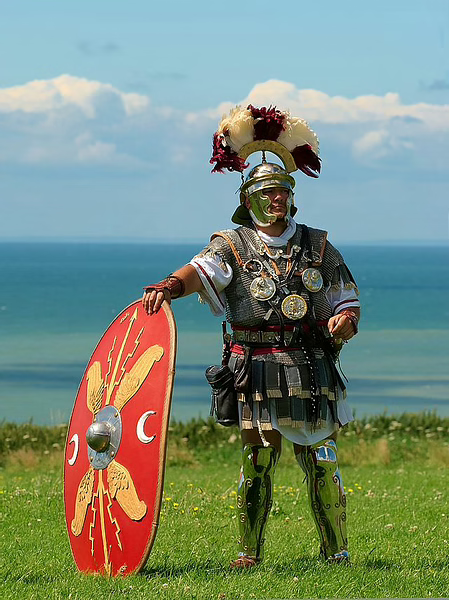
Although the numbers under the command of the centurion varied, he commonly oversaw up to 6,000 men. In battle, they took position in the very front, they were expected to be the first over a wall or through a breach. The centurion was responsible for every aspect of his men. Every centurion of Rome was expected to display ultimate courage on the battlefield.

Typically it took 15-20 hard years to become a centurion. Service was very difficult, living conditions were rough at best. The centurion was not married, he had no family. To be a centurion’s servant you would be responsible for every aspect of his master’s needs. But most of all, the servants became the centurion’s only family. They stayed with him for the duration of his service.

I suppose this explains much. The servant was paralyzed. The text in Matthew says that he was suffering terribly. No doubt the centurion sought out doctors and treatments, but apparently this didn’t help. He was at wit’s end and really didn’t know what to do. I suppose being helpless will often turn people to Jesus.

Jesus seems to have developed a reputation. Those in need, the desperate, sought out His healing power. It seems like that He was now becoming famous for His ability to heal diseases. It’s interesting but scripture clearly shows that Jesus really didn’t want to be this famous. He repeatedly told people not to tell anyone about their healing.

We can see the centurion’s respect for rank and authority.

He explains his own authority over his own soldiers. When he commands he is obeyed without question. He recognizes command and leadership. This man fully understands, and he clearly acknowledges the ultimate authority of Jesus Christ.

When Jesus heard this, he was amazed and said to those following him,” 

“Truly I tell you, I have not found anyone in Israel with such great faith.”

Matthew 8:10

Emulating this man’s faith is the true task of every believer. We must continually put ourselves under the authority of Jesus. His lordship is to be supreme. His rule over us should never be questioned. He commands everything, and we must obey without any reservation. This new depth of faith must now become our true calling.

A couple of observations. 1) There exists a “quality” kind of faith in comparison to a weaker faith. There seems to be degrees of faith. 2) Quality faith recognizes the true authority and supreme lordship of Jesus. 3) Quality faith can be seen in very strange places. 4) This quality faith is meant to be sought and imitated. It is meant to be recognized by every disciple.

“Just as a servant knows that he must first obey his master in all things, so the surrender to an implicit and unquestionable obedience must become the essential characteristic of our lives.”

-Andrew Murray   

Show Me the Mercy, Entry #24

“I tell you, something greater than the temple is here. And if you had known what this means, 

‘I desire mercy, and not sacrifice,’

you would not have condemned the guiltless. For the Son of Man is lord of the Sabbath.”

Matthew 12:6-8 (context, vv. 1-8)

Do we honestly want to see mercy? To give it is much harder than making a sacrifice. Mercy often entails forgiving or helping someone, and that’s usually difficult. We do better by making a religious offering, than having to reach out in love and touch someone we really don’t like. To let someone “off-the-hook” grates us.

Mercy is commonly defined “as compassion or forgiveness shown toward someone whom it is within one’s power to punish or harm.”

Wow. Isn’t this hard sometimes? We really do excel when we try to “punish” those who hurt us, we are experts at this. We ‘automatically’ lash out at those who we feel defy or somehow cross us. I find that I can get quite defensive very fast. And usually that thing is very trivial.

Jesus said to him,

“I do not say to you seven times, but seventy times seven.”

(Matthew 18:22.)

On our own, it seems we just can’t be as compassionate or forgiving like Jesus. We vastly prefer religious duties over forgiveness. Jesus told Peter to forgive 70 x 7, whenever a ‘sinning’ brother asks for leniency, we have to give it. If we forgive, then we’ll be forgiven!

But if you do not forgive others their sins, your Father will not forgive your sins.

Matthew 6:15

He wants to see our mercy. That outweighs any spiritual sacrifice we might make. One of Jesus’ own beatitudes hits the nail on the head,

“Blessed are the merciful, for they shall receive mercy.

Matthew 5:7

We can’t evade this. We may try but He will keep bringing us back to it until we can pass this test, and even then we can anticipate “surprise” tests. That typically kicks us out of a false sense of maturity, and our ‘spiritual’ arrival.

We think we’ve got mercy down pat, and yet He wants to take it deeper still. Mercy for us will always be a spiritual action to a physical situation. And He brings these situations to us, to see what we do, and to reveal what is truly in our hearts at the time.

Sacrifice was a critical definition in the Pharisee’s dictionary, and Jesus more or less destroyed that entire religious concept. Sacrificing without real love, can never be part of a believer’s vocabulary. Jesus wants every disciple to show an outrageous mercy to everyone they meet.

The most miserable prison in the world is the prison we make for ourselves when we refuse to show mercy.

-Warren Wiersbe

Leaving the Mat Behind, Entry #23

“When Jesus saw him lying there and knew that he had already been there a long time, he said to him, 

“Do you want to be healed?”

John 5:6 (context, vv. 2-9)

He’d been sick for 38 very long years. On this day he was laying like usual in his spot by the pool of Bethesda. He doesn’t realize it, but he was about to encounter Jesus. His life, as he knows it, is about to be turned upside down.

The question Jesus asks is pointed, and it savagely confronts him–“Do you really want to be healed?” Sometimes the sick, the injured, the handicapped become so aware of their issues that they can’t see any life beyond them. Perhaps Jesus wanted to jolt this man with this very odd question; of course he wants to be healed– doesn’t he?

Jesus clearly knew what was happening.

The Lord knew that this man must make a decision, and healing would only come if he could leave his mat behind. Before we get too hard on him though, we should consider that 38 years is a long, long time to be sick. One thing he had learned over time was that having any kind of hope was a very dangerous thing. In these many years he had worn out lots of mats.

Apparently, an angel would come and stir the waters; the first one who somehow jumped in would be healed. Over time the pool became the gathering place where there laid “a multitude of invalids—blind, lame, and paralyzed” (v. 3.) Someone once said that ‘misery loves company.’ The odds for healing however, were definitely not in their favor.

I’m somewhat curious, not so much with the ‘angel/pool’ thing, but with the Lord passing by a crowd of sick people. Jesus didn’t stop and just wholesale heal them, but instead He makes a bee-line to where this man lay. Why did He do this? Perhaps an encounter with Jesus was far too radical for the crowds; perhaps they weren’t ready. IDK.

The question Jesus asks does seem strange– “Of course he wants to be healed.” And yet the Lord (and this man) had to know for sure. It really isn’t a question of Jesus’ healing power–it is however, an issue with one’s desire to be made whole, and then to leave his mat behind.

A disclaimer though.

People will often talk about having enough faith to be healed, and that’s well and good, but what about having faith to continue to be sick; day after endless day? Will we continue to believe in Him no matter what happens to us? I do wonder about this sometimes.

“How sweet the name of Jesus sounds, In a believer’s ear! It soothes his sorrows, heals his wounds, And drives away his fear.”

-John Newton