Two Sparrows and a Head of Hair, Entry #30

“Are not two sparrows sold for a penny? And not one of them will fall to the ground apart from your Father.  But even the hairs of your head are all numbered. Fear not, therefore; you are of more value than many sparrows.”

Matthew 10:29-31, (context, vv. 26-3).

Jesus communicates this promise to disciples facing the harsh reality of persecution. These verses are embedded in the context of abuse and mistreatment. They are meant to comfort believers when things are wicked and dark. The world does not love the Christian, it really does hate us, and the persecution ranges from a simple ostracism to outright murder.

Sparrows and hair.

God is a wonderful mathematician. He constantly keeps track of all that concerns us. Sparrows are fairly insignificant. They really don’t amount to much of anything, their value works out to a measly penny. And when it comes to the hair on our heads, we can rest assured that He has His abacus out.

But the real issue is of the person who is being persecuted. Sparrows and hair become present reminders of the intense concern of the Father. He is deeply aware with the details, those intricate facets of our very modest lives. Everything about us is counted and analyzed. Truly the believer is under God’s microscope, (Psalm 139:1-18). That is a good thing.

These wonderful words, vv. 29-31, are often applied to ‘general’ living. Seldom do we realize that the context is that of persecution. That is their truest use. These simple promises fit quite well when they’re understood from that idea, and it seems that’s when they make the most sense; they comfort us in the deepest part of our spirit when we need it the most.

Sparrows and hair.

These are fairly common things, things that we can understand, things that are easily embedded into our thinking. Jesus promises the simple believer mysteries that are truly powerful–ideas that come out of the deep heart of God Himself. These assurances become profound intricacies that directly impact our lives.

So there we have it. There exists a holy math that surrounds the simplest believer. These are straightforward sureties that even children can understand and trust. We discover verses that carry out the “fear not” thought that is part of scripture– promises that are quite wonderful for those who are being pummeled by the darkness.

“So do not fear, I am with you, do not be dismayed, for I am your God, I will strengthen you and help you, I will uphold you with my righteous right hand.”

Isaiah 41:10

 

Serpents and Doves, Entry #29

“Behold, I am sending you out as sheep in the midst of wolves, so be wise as serpents and innocent as doves. Beware of men, for they will deliver you over to courts and flog you in their synagogues. 

Matthew 10:16-17 (context, vv. 16-24)

We are being sent into a dangerous place. There will be those who hate us, they take us and lead us into courts and they will bring out a whip. The world is not a kind place for believers in Jesus. He warns the disciples of a definite persecution that they face as His disciples. This deep darkness has teeth.

The servant of Jesus will never be “above His master.” Since they called Jesus, “Beelzebul,” they’ll certainly “malign those of His household” (Matthew 10:24-25). We must accept this. At best they will criticize, and at worst they will kill us. We are facing a hostile world who hates our faith.

If a Christian is not having tribulation in the world, there’s something wrong!

And yet Jesus still sends us. We dare not step away from this viciousness. It’s part of the package He gives. We should expect to be treated this way. Jesus warns us honestly of the terrible things we can expect, He does not sugarcoat things. The Lord is well-acquainted with what the world is capable of.

When sheep and wolves meet each other it becomes a slaughter house. And yet there is another side to all of this. We are called to think like a serpent, to have a definite wisdom of all that must be faced, and what we must do to faithfully survive this persecution.

It troubles me somewhat that believers are called to be snakes. Somehow, that doesn’t seem to equate to an innocent faith in Jesus. (Snakes are bad, at least in my thinking). And yet Jesus clearly welds this holy innocence with a wisdom that is very much aware. I suppose that there is a thoughtful balance here, we must find it, and then live it out.

He calls us to vulnerability, most certainly, but mixed into this we need a grasp of being aware; a holy shrewdness (but never a naïvety) that knows how to face the darkness without becoming apostate. We need to use our brains, but be led by our hearts. We are His witnesses, but we must never become His victims.

“It has become a settled principle that nothing which is good and true can be destroyed by persecution, but that the effect ultimately is to establish more firmly, and to spread more widely, that which it was designed to overthrow. It has long since passed into a proverb that “the blood of the martyrs is the seed of the church.”

-Albert Barnes


Doing Jesus’ Work, #28

“And proclaim as you go, saying, ‘The kingdom of heaven is at hand.’ Heal the sick, raise the dead, cleanse lepers, cast out demons.”

Matthew 10:7-8, (context vv. 5-15)

Heal. Raise. Cleanse. Cast out. What a job description for Jesus’ disciples! He truly believes that those who follow Him are ready, and it’s time for them to go to work. I suppose they could keep sitting at Jesus’ feet, just soaking up His teaching, and watching Him do His miracles. But this isn’t what they’re called to do. They’ve sat long enough.

Don’t get me wrong. It’s vital that we absorb His words to us. It’s absolutely critical that we hear His voice and really do find our rest in Him. We must intimately listen to Jesus and be filled with His Spirit. Yet it strikes me that far too many disciples think their life is an inward one; a concentration on personal growth and one’s own spiritual attainment. But I don’t think this is the case.

The disciples must go to work.

Jesus ‘commissions’ them to go out and proclaim the ‘Kingdom come.’ The labors of Jesus must be done by these inadequate (and sinful) men. Heal. Raise. Cleanse. Cast out. It’s time for them to go out and meet the desperate needs of the world. But stepping out can be a scary thing.

The works that these disciples are to do are truly marvelous. They now have an ability and an anointing to do remarkable things. Jesus is comfortable that His disciples are ready, and yet knows that when they return they will have much to learn from Him. It seems however, that we are waiting for a certain amount of “perfection” before we step out.

Most of us, I suppose, are ‘hamstrung’ by our own sin. We see know our inadequacies and deep weaknesses. Most of the time we feel completely unworthy. Seldom do we think we’re ready to spread the Kingdom news to a needy world. Our own sin, we believe, disqualifies us from ministry to others. It seems Satan is very quick to neutralize us, and to annul the “work” of the Father. He accuses us, and we listen.

We’re overwhelmed by what we see within us, and as a result we seldom see the needs around us.

It seems we shelf His work and replace our faith into some sort of personal rehabilitation program. “When we are finally holy enough, we will hit the streets.” Until then, we will try to get enough personal purity to work His miracles. Commendable I suppose, but I don’t think this is what Jesus intends. I’m convinced the work itself is a vital part of our sanctification.

“Have thy tools ready. God will find thee work.”

-Charles Kingsley

Laborers Wanted, # 27

Then he said to his disciples, 

“The harvest is plentiful, but the laborers are few; therefore pray earnestly to the Lord of the harvest to send out laborers into his harvest.”

Matthew 9:37-38, (context, vv. 35-38)

The issue here is laborers–this is our work, plain and simple. The fact is that there isn’t enough workers. It’s funny, it seems God is constrained by our prayers–earnest prayers for a harvest to be brought into the barns. But there aren’t enough hands. The harvest will be ruined if help doesn’t come soon.

God must have our help if it’s going to get done.

The harvest seems contingent on our prayer life. We decide what is going to happen. Prayer is the work of the authentic believer and our hearts must be for the fields. We are the people who work, who sweat, and get tired. That is our call. That is the true work of discipleship.

Mother Teresa once commented that what we see in front of us is our “Calcutta.” We have got to open our eyes and look, we must see the incredible needs of desperate people that surround us. We must have eternal eyes–God’s eyes. We do our work on behalf of others. I really do believe that it will be ‘sweaty’ prayers that will move the hand of God.

I think ‘prayer’ is the real work in evangelism.

Prayer is our effort that gets combined with the Holy Spirit’s great passion of lost souls. Our “earnest” prayer for the harvest will call workers to the fields. Every generation is responsible for their own part of the field.

For some reason God has chosen to limit Himself by our decision to pray. He patiently waits for us to intercede. Everything seems contingent on us, we can point no finger at God, or accuse Him of ignoring the work that must be done. We must make the decision. Evangelism, and missions, is God’s intense passion. He now shares with us this responsibility.

All of Heaven is standing on its tiptoes, waiting to hear our pleas for the lost.

“Pray as though everything depended on God. Work as though everything depended on you.”

-St. Augustine


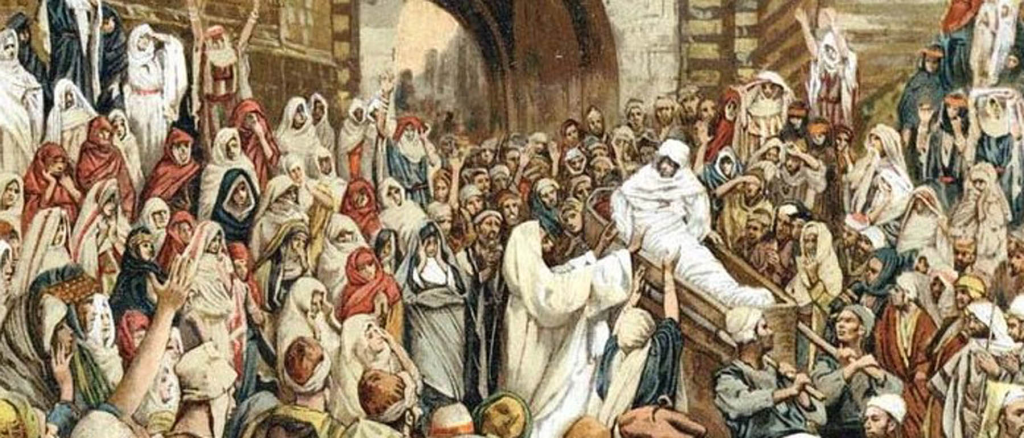
He Touched the Coffin, #26

And when the Lord saw her, he had compassion on her and said to her, 

“Do not weep.” 

Then he came up and touched the coffin, and the bearers stood still. And he said, 

“Young man, I say to you, arise.”

Luke 7:13-14 (context, vv. 11-17)

Widows who had no family to support them had it rough. This woman’s husband had died and now her only son was gone. A widow was forced to rely on relatives to meet their needs, but now she had no one. She was all alone and faced a very difficult life. She was vulnerable. And now she saw her only son being carried out of the city to be buried.

The two groups came together. Jesus and His group of disciples were going into Nain and met the funeral procession coming out. Jesus came to the woman as she led the crowd. She was weeping as she walked. I have to believe that His heart met hers.

Jesus response to her was mercy and compassion.

I really think His heart was broken for her. He immediately stopped the funeral march and went straight to her to comfort and console. Apparently no one else took up this. Yet Jesus went to her. That really encourages me.

The body had been washed and rubbed with aromatic spices. His hair had been combed and his fingernails had been clipped. He had been carefully wrapped in linen according to Jewish custom. He had been placed in an open funeral bier, to be carried to the grave site.

Nain was an interesting place. Just a few miles away the prophet Elisha had raised the dead by laying on the corpse repeatedly, 2 Kings 4:32-35. Jesus however, raises the dead with a simple sentence. I think that is interesting. It shows that the power of God that resides in the person of Jesus.

God cares for people.

Obviously Jesus is a full and complete member of the Trinity. He possesses all power and strength. He is the Word and the Creator of everything in the universe. And yet we see that this all powerful one is full of mercy and compassion. He loves widows and orphans. He loves people, and understands their needs. He rolls up His sleeves and enters into their pain and misery.

I suppose the compassion that Jesus has is the most intriguing part of Matthew 7. God loves people intensely. He intervenes in their lives. He meets needs that no one else can understand. He possesses all power and has an infinite amount of love. He can be trusted to meet every need. After all, He can raise the dead with a few simple words.

“His is a loving, tender hand, full of sympathy and compassion.”

-D.L. Moody

“Centurion” Faith, #25

Jesus said to him, “I come and heal him.”

Matthew 8:7 (context, vv. 5-13)

See the remarkable faith of a Roman centurion. Can we really fathom the deep depth of such belief? He comes to Jesus with a desire for the healing of a servant. He was doing something that a Gentile would never stoop to do. He sought the healing from a homeless itinerant teacher who happened to be a Jew.

This Roman soldier was an enemy. They occupied the land of Israel. If Jesus decided to withhold a healing (to make a point) this was the time! I’m guessing that His refusal would be a good lesson to the disciples, and the watching crowds.

Although the numbers under the command of the centurion varied, he commonly oversaw up to 6,000 men. In battle, they took position in the very front, they were expected to be the first over a wall or through a breach. The centurion was responsible for every aspect of his men. Every centurion of Rome was expected to display ultimate courage on the battlefield.

Typically it took 15-20 hard years to become a centurion. Service was very difficult, living conditions were rough at best. The centurion was not married, he had no family. To be a centurion’s servant you would be responsible for every aspect of his master’s needs. But most of all, the servants became the centurion’s only family. They stayed with him for the duration of his service.

I suppose this explains much. The servant was paralyzed. The text in Matthew says that he was suffering terribly. No doubt the centurion sought out doctors and treatments, but apparently this didn’t help. He was at wit’s end and really didn’t know what to do. I suppose being helpless will often turn people to Jesus.

Jesus seems to have developed a reputation. Those in need, the desperate, sought out His healing power. It seems like that He was now becoming famous for His ability to heal diseases. It’s interesting but scripture clearly shows that Jesus really didn’t want to be this famous. He repeatedly told people not to tell anyone about their healing.

We can see the centurion’s respect for rank and authority.

He explains his own authority over his own soldiers. When he commands he is obeyed without question. He recognizes command and leadership. This man fully understands, and he clearly acknowledges the ultimate authority of Jesus Christ.

When Jesus heard this, he was amazed and said to those following him,” 

“Truly I tell you, I have not found anyone in Israel with such great faith.”

Matthew 8:10

Emulating this man’s faith is the true task of every believer. We must continually put ourselves under the authority of Jesus. His lordship is to be supreme. His rule over us should never be questioned. He commands everything, and we must obey without any reservation. This new depth of faith must now become our true calling.

A couple of observations. 1) There exists a “quality” kind of faith in comparison to a weaker faith. There seems to be degrees of faith. 2) Quality faith recognizes the true authority and supreme lordship of Jesus. 3) Quality faith can be seen in very strange places. 4) This quality faith is meant to be sought and imitated. It is meant to be recognized by every disciple.

“Just as a servant knows that he must first obey his master in all things, so the surrender to an implicit and unquestionable obedience must become the essential characteristic of our lives.”

-Andrew Murray   

Show Me the Mercy, Entry #24

“I tell you, something greater than the temple is here. And if you had known what this means, 

‘I desire mercy, and not sacrifice,’

you would not have condemned the guiltless. For the Son of Man is lord of the Sabbath.”

Matthew 12:6-8 (context, vv. 1-8)

Do we honestly want to see mercy? To give it is much harder than making a sacrifice. Mercy often entails forgiving or helping someone, and that’s usually difficult. We do better by making a religious offering, than having to reach out in love and touch someone we really don’t like. To let someone “off-the-hook” grates us.

Mercy is commonly defined “as compassion or forgiveness shown toward someone whom it is within one’s power to punish or harm.”

Wow. Isn’t this hard sometimes? We really do excel when we try to “punish” those who hurt us, we are experts at this. We ‘automatically’ lash out at those who we feel defy or somehow cross us. I find that I can get quite defensive very fast. And usually that thing is very trivial.

Jesus said to him,

“I do not say to you seven times, but seventy times seven.”

(Matthew 18:22.)

On our own, it seems we just can’t be as compassionate or forgiving like Jesus. We vastly prefer religious duties over forgiveness. Jesus told Peter to forgive 70 x 7, whenever a ‘sinning’ brother asks for leniency, we have to give it. If we forgive, then we’ll be forgiven!

But if you do not forgive others their sins, your Father will not forgive your sins.

Matthew 6:15

He wants to see our mercy. That outweighs any spiritual sacrifice we might make. One of Jesus’ own beatitudes hits the nail on the head,

“Blessed are the merciful, for they shall receive mercy.

Matthew 5:7

We can’t evade this. We may try but He will keep bringing us back to it until we can pass this test, and even then we can anticipate “surprise” tests. That typically kicks us out of a false sense of maturity, and our ‘spiritual’ arrival.

We think we’ve got mercy down pat, and yet He wants to take it deeper still. Mercy for us will always be a spiritual action to a physical situation. And He brings these situations to us, to see what we do, and to reveal what is truly in our hearts at the time.

Sacrifice was a critical definition in the Pharisee’s dictionary, and Jesus more or less destroyed that entire religious concept. Sacrificing without real love, can never be part of a believer’s vocabulary. Jesus wants every disciple to show an outrageous mercy to everyone they meet.

The most miserable prison in the world is the prison we make for ourselves when we refuse to show mercy.

-Warren Wiersbe

Leaving the Mat Behind, Entry #23

“When Jesus saw him lying there and knew that he had already been there a long time, he said to him, 

“Do you want to be healed?”

John 5:6 (context, vv. 2-9)

He’d been sick for 38 very long years. On this day he was laying like usual in his spot by the pool of Bethesda. He doesn’t realize it, but he was about to encounter Jesus. His life, as he knows it, is about to be turned upside down.

The question Jesus asks is pointed, and it savagely confronts him–“Do you really want to be healed?” Sometimes the sick, the injured, the handicapped become so aware of their issues that they can’t see any life beyond them. Perhaps Jesus wanted to jolt this man with this very odd question; of course he wants to be healed– doesn’t he?

Jesus clearly knew what was happening.

The Lord knew that this man must make a decision, and healing would only come if he could leave his mat behind. Before we get too hard on him though, we should consider that 38 years is a long, long time to be sick. One thing he had learned over time was that having any kind of hope was a very dangerous thing. In these many years he had worn out lots of mats.

Apparently, an angel would come and stir the waters; the first one who somehow jumped in would be healed. Over time the pool became the gathering place where there laid “a multitude of invalids—blind, lame, and paralyzed” (v. 3.) Someone once said that ‘misery loves company.’ The odds for healing however, were definitely not in their favor.

I’m somewhat curious, not so much with the ‘angel/pool’ thing, but with the Lord passing by a crowd of sick people. Jesus didn’t stop and just wholesale heal them, but instead He makes a bee-line to where this man lay. Why did He do this? Perhaps an encounter with Jesus was far too radical for the crowds; perhaps they weren’t ready. IDK.

The question Jesus asks does seem strange– “Of course he wants to be healed.” And yet the Lord (and this man) had to know for sure. It really isn’t a question of Jesus’ healing power–it is however, an issue with one’s desire to be made whole, and then to leave his mat behind.

A disclaimer though.

People will often talk about having enough faith to be healed, and that’s well and good, but what about having faith to continue to be sick; day after endless day? Will we continue to believe in Him no matter what happens to us? I do wonder about this sometimes.

“How sweet the name of Jesus sounds, In a believer’s ear! It soothes his sorrows, heals his wounds, And drives away his fear.”

-John Newton


Waiting for Our Bridegroom, Entry #22

“The days will come when the bridegroom is taken away from them, and then they will fast.”

Matthew 9:15 (context vv. 14-17)

I detest fasting, I really do. I blame this spiritual deficiency on the fact I’m quite slender and tall and need all the calories I can get. I don’t think that this passes muster though. But I do it anyway. God forgives me but I suppose I’m missing out on something quite wonderful though. (I hope you’re different.)

Jesus makes an announcement. He intends to leave them behind. The disciples will ‘fast’ instead of partying. They will begin to do this with the understanding that He will return for them.

True fasting will clarify the spiritual.

We begin to understand things that we have missed up to now. When we discipline ourselves like this we begin to see and discern the real and the eternal. Fasting is much like a ‘telegraph line’ to a future glory. We are learning to communicate with the throne room and it teaches us to ‘listen.’

We are being prepared for something quite grand. If we start to see this particular discipline as a way of bringing us clarity, we’ll find it much easier and more rewarding. Fasting is hard for most of us, and maybe we need a refresher course. (Just writing about fasting is easier than doing it, trust me.)

When we start to fast we’ll begin to see reality. We can visualize the return of the true King, who is now setting up our future home. We’ll begin to walk, knowing beyond a shadow of a doubt, that the Bible world is the real world.

“And I saw the holy city, new Jerusalem, coming down out of heaven from God, prepared as a bride adorned for her husband.”

Revelation 21:2


Let’s Follow the Master, Entry # 21

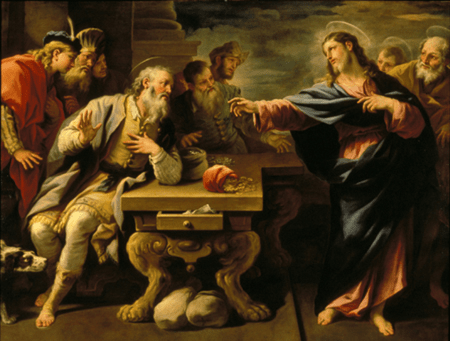
Luca Giordano
Naples; 1634-1705
The Calling of St. Matthew, c. 1685
oil on canvas; 78.5 x 100.5 inches

As Jesus passed on from there, he saw a man called Matthew sitting at the tax booth, and he said to him, 

“Follow me.” 

And he rose and followed him.”

Matthew 9:9

Another “tax collector.” (Why won’t Jesus ever learn?) It really does seem that He has a definite preference for the scum and the outcast. For some very odd reason that’s the sort of person He likes. But really, do we dare question His wisdom in this? Do we think we have a right to pass judgement on Jesus’ choices?

I have to think that Jesus is showing us His deep fondness for the ‘ungodly.’ Tax-collectors, egads!!!! I don’t really understand, until I consider my own ‘wretched’ life. Until Jesus comes to me, calling me, I will continue to set in my dreary booth, taking money from other dreary people.

So what does it really mean to really follow Jesus?

I think of Matthew, a wicked man who has no qualms about betraying his people for money. It’s always been odd to me, that Matthew’s name meant “pure.” (What were his parents thinking? Maybe they grasped his future destiny as an apostle? IDK.) But I am certain that Matthew’s call to follow meant he had to leave something ‘behind.’

We follow Jesus. We’ve accepted the call that we must turn away from our past life. We’ve left behind all the money and just walked away from our table. We understand that we can’t bring it along; we have renounced its claim on us.

Following Him means taking up our “cross,” and everything that it might entail. We really do need to leave it all behind. What a deal, huh?

“And calling the crowd to him with his disciples, he said to them, “If anyone would come after me, let him deny himself and take up his cross and follow me.”

Mark 8:34