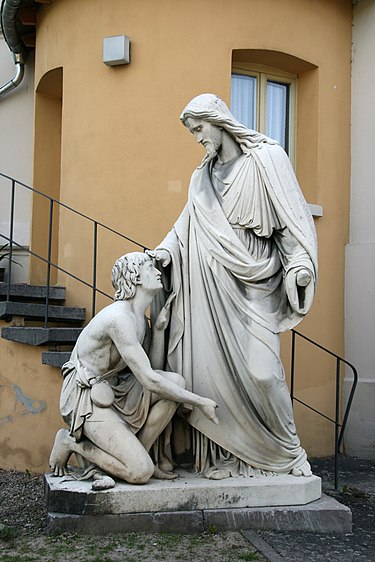
The Rooster of God, #94

 “Lord,” Peter asked, “Why can’t I follow you now? I will lay down my life for you.

38 Jesus replied, “Will you lay down your life for me? Truly I tell you, a rooster will not crow until you have denied me three times.”

John 13:37-38, CSV

He knew. And he still loved him anyway. Can you really quantify the depth of this? Verse 37 claimed Peter’s willingness to follow, and even die if he had to. I believe with all my heart that Peter was sincere. He would follow, and Peter was willing to die.

But Jesus bought none of it, he knew. He poses a question to Peter–the type of question that penetrated Peter’s interior bravado. It’s said that “the spirit is willing, but the flesh is weak.” Perhaps this is true here. Maybe Jesus knew?

What about you? And me? Does he really know us to this degree and depth? When he looks at us, I believe he knows the weakness and faltering steps we take, and yet his love for us is unconditional. It doesn’t hinge on our misplaced zeal or faltering commitment. His love for us overrides our weakness. That comforts and disturbs me, and I don’t really understand how he does it.

Have you heard the rooster? Maybe that’s his way to teach us the depths of his love.

“God has paid us the intolerable compliment of loving us, in the deepest, most tragic, most inexorable sense.”

    C.S. Lewis, The Problem of Pain

Love Like a Disciple, #93

“A new commandment I give to you, that you love one another: just as I have loved you, you also are to love one another. 35 By this all people will know that you are my disciples, if you have love for one another.”

John 13:34-35

The believers in Jesus must carry the credentials of Jesus. To be authentically his demands evidence–proof that you’re really are real. It never comes by one’s own words, personal declarations, or by affiliations or preferences. Jesus is crystal clear on what is true and what is not. To him, it’s black or it’s white.

“Where’s the beef?”

A few years ago that was the ad line of a particular fast food chain. It was catchy, and soon everyone smiled. The company only did it because it worked. Three old ladies looked at a competitor’s hamburger and made the announcement that something was terribly wrong.

Jesus made it clear that there would be evidence that everyone would see. “Love one another” is used three times in two verses–not only that, but in verse 35 we hear him tell us that “all people will know” what disciples would look like. To follow Jesus you must love like Jesus–to be like him, you must love like him.

We dare not minimize this. It’s now the believer’s credentials, the proof that they were real, and not just posers. We’re called to be more than religious exhibitionists, who somehow have an affinity for nice sounding words that only touch the outward. Jesus states that our love is now the true declaration of something super authentic–and very tangible.

So where’s the love?

The word used is ἀγαπάω, agape. It’s the ultimate kind of love–the love that God himself has for lost people: it’s not the love one has another sexually, that word is eros. It’s not the love we have for our brother, that word is philo. But it is agape, a love that has no limits, and the best and clearest definition is found in 1 Corinthians 13.

Maybe a better grasp of the verses in John 13 can be had by reading the Message translation:

“Let me give you a new command: Love one another. In the same way I loved you, you love one another. This is how everyone will recognize that you are my disciples—when they see the love you have for each other.”

(vv. 34-35)

“Our love to God is measured by our everyday fellowship with others and the love it displays.”

   Andrew Murray

Celebrity Servants? #92

drsunil.com, art by Takla

“He came to Simon Peter, who said to him, “Lord, do you wash my feet?” Jesus answered him, “What I am doing you do not understand now, but afterward you will understand.” Peter said to him, “You shall never wash my feet.” Jesus answered him, “If I do not wash you, you have no share with me.”

John 13:6-8 (context vv. 3-17)

Chapter 13 always rocks my world. I visualize this, I’m like a fly on-the-wall, watching it happen–and then I replay it over, and over in my mind. It always unravels me. Why does this have to happen? What does this passage tell me about Jesus, and his kingdom? (John 13). Why can’t I just walk away from it, and leave it be?

Jesus made himself a slave (or perhaps he was always a slave all along, and we just didn’t realize it?) Foot-washers were pretty much regarded as sub-human, mindless drones who mechanically performed a necessary duty. The lowest of the low, the very least of the least. Today they’re the burger flippers and the pool cleaners.

But Jesus took that role on himself, he laid aside his garments, and his Godhood. (They landed in a pile in the corner of the room). When he knelt down to scrub feet (making sure he got between the toes), it was deity serving man. This God/rabbi intentionally did this, not reluctantly or halfheartedly–but carefully.

He was their teacher, and custom demanded he enjoy the prerogatives of that position. But he wouldn’t, and didn’t. He mustn’t. As I stress over this, I must conclude he really was their “teacher,” but not in the way I expect. What he was doing on his knees, was instructing them in the art of loving each other. He showed us a leader in action.

And isn’t making disciples all about loving someone else more than ourselves? We get things turned around sometimes–we think that spiritual authority is moving up, when it’s all about going down. We elevate our pastors and elders, maybe subconsciously–and human nature lets it happen; and then we’re amazed why our leaders struggle so.

Leaders function best when they wash between the toes.

There was a point in Jewish history when the people actually demanded that God would give them a king, instead of a judge (1 Samuel 8:5-9). God warned them that this wasn’t in his plans–but they insisted. They had to have one, everyone else did. We still must have celebrities, and then we wonder why they short circuit on us. Who can resist the privilege, and the limelight?

The Church was never meant to operate like this. That’s what Jesus said. Instead it’s we who’ve turned it upside down. It’s we who insist on turning our pastors into minor celebrities. We assert that they take on the role of a “king” (albeit, a little one maybe). Perhaps leaders who stumble and fall do so because we want them to be front and center? Who can handle the privilege, and the adulation? I know I can’t.

Peter was classic Peter. It seems that whenever he resists, he gets rebuked. He makes it quite clear that Jesus will never wash feet–that Jesus will never use a basin or towel and serve him like this. It was outrageous. Unacceptable. It didn’t fit in Peter’s personal theology. He had no room for Jesus the slave. (Perhaps he knew that to follow meant he would have to do the same thing? IDK).

Jesus still washes his people. He sits us down and takes off our shoes and socks, and scrubs us clean. And we hate it. But to be washed by him is a condition of our discipleship. Every follower must be clean, and he continues his work to this day. We sin daily, even as his own, and he cleans us up–and somehow that really bothers us.

The gifts of leadership are one way of washing feet. At least that’s what our leaders were designed to do. That’s Jesus’ way of doing things. But it seems we’ve adopted Peter’s attitude, and embraced the ‘pre-king’ thinking of Israel. We need our celebrities, we want our kings. We simply can’t imagine it any other way.

“The very first thing which needs to be said about Christian ministers of all kinds is that they are “under” people as their servants rather than “over” them (as their leaders, let alone their lords). Jesus made this absolutely plain. The chief characteristic of Christian leaders, he insisted, is humility not authority, and gentleness not power.”

 John Stott

The Grapes of Wrath, #91

Warning: This is a hard one!

“Everyone who falls on that stone will be broken to pieces, but on whomever it falls, it will shatter him.””

Luke 20:18 (context. 9-16)

Who wants to fall? Not me. This very blunt declaration has to be understood by that which immediately proceeds it: the “Parable of the Vineyard Owner.” This isn’t one of your nice ‘run-of-the-mill’ parables either. It’s got some real teeth.

It really is a potent stuff. The authorities–over, and over have rejected God’s prophets–everyone that he has sent. They do this continuously–history really does repeat itself. Finally, God finally sends his Son, and they decide (quite coldly) to kill him, and take the vineyard over for themselves.

Disobeying the voice of the Holy Spirit is a terrible thing.

And I’m afraid it’s done fairly consistently. He speaks over and over to us, but we’ve disobeyed him so often we can’t hear him anymore. His voice is often a quiet one, and we no longer really look or listen for it. Dear one, I’ve been in ministry for over 35 years, I’ve seen it up close, I’ve seen it in myself.

When we repeatedly ignore his voice, we’ll find ourselves in spiritual silence. We’ve now become spiritually deaf.

And guess what, we won’t even know it. We think we’re doing okay spiritually. But we really don’t hear him anymore. And that’s precisely what the leadership of Israel has done. They no longer hear him. Read their response. They don’t believe this parable, (maybe they think it’s funny?)

“When the chief priests, the scribes, and the elders heard this, they said, “May it never be!” 

(verse 16b)

That really should disturb us–and it’s frightening. But you must understand, it’s not confined to them–it’s launched at us as well. His parable travels through the centuries, and nails us. The translation of that particular “promise” in verse 18 might help clarify any ambiguity we might have:

 “Anyone falling over that stone will break every bone in his body; if the stone falls on anyone, he’ll be smashed to smithereens.”

(v. 18, the Message)

It’s a promise. We’ve got this tendency to think of God’s promises as wonderfully positive. But this promise is scary. The price of ignoring Jesus has consequences, and these “chosen” people are about to discover judgement. They have ignored him for the last time.

The nation of Israel will be destroyed by the emperor Titus. The ancient historian Josephus wrote that he killed 1,100,000 Jews and they carried 97,000 as slaves to Rome. 

At this particular moment in time, it’s critical that you learn to hear what the Spirit is speaking to you.

You’ll need to learn to distinguish his voice through the world’s static. But we much rather keep the status quo, and simply ignore this dark moment. We don’t want to listen that close. Maybe we’ll become “weird.”

Perhaps you’re afraid of what he might say. Maybe you’ll need to turn away from something that is causing you to go deaf? But I must tell you, hearing him is a joy. I guarantee it’s worth it. It’s what you were created for!

“One of two things you must do; you must either receive Him or reject Him. You receive Him here and He will receive you there; you reject Him here and He will reject you there.”

    D.L. Moody

Member of Faithful Bloggers

Just a Kernel, #90

A Kernel Becomes Bread

23 “Jesus replied, “The hour has come for the Son of Man to be glorified. 24 Very truly I tell you, unless a kernel of wheat falls to the ground and dies, it remains only a single seed. But if it dies, it produces many seeds.”

John 12:23-24, (context vv. 23-29)

Almost 1/2 of John’s gospel is dedicated to Jesus’ last week. Verse 24 seems to sum up Jesus’ understanding of things, which he now communicates to his disciples. The issue at the center seems to hit on the very core of God’s incredible idea of the Kingdom–death and resurrection.

Perhaps that’s the solid principle behind his way of conducting business. He doesn’t want us to be afraid, and honestly, isn’t the fear of death the most frightening and darkest terror of all? Jesus now turns it around and proceeds to pound it to pieces, and we shouldn’t pick it up and try to glue it back together. Let’s leave it there, and walk away.

Death becomes life. Crazy, huh? And yet he’s explaining how the Father does it. Jesus completely understands this, and it’s his death that will bring life to millions and millions. Oh my, the pain will be real for him. But it’s not really the end of it all. “It’s Friday, but Sunday’s Coming!”

Grasping this becomes the incredible idea that energizes the obedient disciple. It isn’t a ‘Jesus-only’ concept. It’s not exclusively unique to him. I suppose to a degree it is–but isn’t it really part of the economy of God? Isn’t it his particular way of doing things–to extract life out of dead things? (I think he gets a kick out of doing this?)

Brother, don’t be afraid. Sister, he does see your fear and misgivings about dying. In our natural way of thinking, dying is dark and perhaps it might be painful. IDK. But to the person who was been given ‘spirit-eyes’ it now is the way we are to live and bring life. In a weird sense, we’re all Lazarus, and when we hear his voice calling us–we’ll get up and shake off our grave clothes.

“They, then, who are destined to die, need not be careful to inquire what death they are to die, but into what place death will usher them.”

   Augustine

Pouring Out Your Oil, #88

“Jesus said, “Let her alone. She’s anticipating and honoring the day of my burial. You always have the poor with you. You don’t always have me.”

John 12:7-8, (context vv. 1-8)

She came and poured perfumed oil on Jesus feet. She massaged it in with her hair. What she did was out of love, and maybe concern? She knew and understood. Many of us deeply understand with what she did–Mary has become a person that we identify and engage. She is doing what we would have done. (At least we hope.)

That perfume was a concentrate–it was the source for smaller vials. The oil Mary used was undiluted and not weakened in any way. It was not diminished or thinned, it was powerful stuff. What she did was an extremely costly act. Notice that it was a whole pound–and the text states that the entire house was filled with the scent.

When Jesus was being scourged and crucified, the odor of that perfume would’ve been present. That smell was still there, and most likely it sustained, and even encouraged him. Perhaps our acts of love–of sacrifice, of deep worship mean far more than we realize?

But there will always the ones who are practical.

All they see is the incredible waste. Judas had a pragmatic, reasonable and more sensible position. The other 11 felt the same. As they analyzed Mary’s actions all they could see was the terrible waste. There came a point when Judas, who controlled the finances, just had to speak:

“Judas Iscariot (who was about to betray him), said, “Why wasn’t this perfume sold for three hundred denarii and given to the poor?” (vv. 4-5).

“He didn’t say this because he cared about the poor but because he was a thief. He was in charge of the money-bag and would steal part of what was put in it.” (v. 6).

So dear one, who was right? The other Gospel accounts tell us that the disciples also felt this way, (Matthew 26:6-13). The general consensus was that Mary was far too excessive. After all, 300 denarii was a lot of money–a denarii was a day’s wage. It was probably more money they had ever seen!

It’s interesting that Mary unbound her hair. That was anathema in Jewish culture. It was the clear evidence of an immoral woman, a prostitute. But yet she did it. Mary did not stop to calculate public reaction. She knew deep down that it was the only thing she could do for him.

What exactly is worship? What part of it do we not understand yet? Does it matter what is in our heart?

It is interesting that was immediately afterward this that Judas Iscariot left, and set up an agreement to betray Jesus.

“Is anything wasted which is all for Jesus? It might rather seem as if all would be wasted which was not given to him.”

C.H. Spurgeon

“Redletterstudy is a member of Faithful Bloggers

To Seek and to Save, #87

9 “And Jesus said to him, “Today salvation has come to this house, since he also is a son of Abraham. 10 For the Son of Man came to seek and to save the lost.””

Luke 19:9-10 (context, vv. 1-10)

The Jewish people regarded salvation simply as being a child of Abraham. Faith was not necessary, but being saved was simply genealogical. It was the exclusive privilege of every Jewish man and woman. It was the sole position of anyone who was descended from Abraham.

There were exceptions however. If an Israelite lived outside of the Law, they forfeited their salvation. If they cooperated with the Gentiles, or if they committed some heinous crime, they couldn’t be a true Israelite. You were saved, just because you had descended from Abraham.

Zacchaeus couldn’t be saved. He had essentially had renounced his salvation when he cooperated with the Romans as a tax-collector. He had made the choice of a living his life outside of what was acceptable to the religious norms. In short he chose to be damned. He had decided to walk the highway to hell, but that was his decision.

When Jesus called up the tree to Zacchaeus, and invited himself to dinner, Jesus was committing a forbidden act. You must understand that Zacchaeus was unclean, a sinner, and any contact with was regarded as a grossly evil action. In short, Jesus had allied himself with an unclean man. Thus Jesus must be unclean as well.

The “righteous” Jew would never ever have anything to do with Zacchaeus. That is why they had such an issue with Jesus’ decision to eat with him. And that’s why Zacchaeus was thrilled to have such an eminent teacher as his guest.

Jesus was seeking to save the lost.

Zacchaeus invited all of his “evil” friends to come and come to join in the feast. It’s funny, when it came to “evangelism,” he did all the work!

Zacchaeus would prove himself as a “child of Abraham” by his amazing repentance. The presence of Jesus in his home sparked life in his heart. Zachaeus’ repentance was remarkable and truly spontaneous. And probably more astonishing was Jesus declaring that Zacchaeus was now a true child of Abraham.

When we finally decide we can mingle with the lost, just like Jesus did, we can expect to see miraculous things. We won’t contaminate ourselves–it doesn’t work that way. When we reach out, we can count on the “Jesus” who now lives inside of us to touch the outcast. He wants to, and all he needs is for us to find the lost, and be with them.

I must implore you to “seek and save” those who are outside the norm. Ask Jesus to lead you to them–and quit worrying about what other Christians might say and think.

“The church is not a select circle of the immaculate, but a home where the outcast may come in. It is not a palace with gate attendants and challenging sentinels along the entrance-ways holding off at arm’s-length the stranger, but rather a hospital where the broken-hearted may be healed, and where all the weary and troubled may find rest and take counsel together.”

   James H. Aughey

Being Short of Stature, #86

“When Jesus reached the spot, he looked up and said to him, “Zacchaeus, come down immediately. I must stay at your house today.” So he came down at once and welcomed him gladly.”

Luke 19:5-6, (context, vv. 1-9)

I see no problem with assigning this story to a Sunday school lesson. It’s imaginative, witty and seriously funny. Kids enjoy the story, especially when the teacher decides to use flannelgraphs. If the teacher is any good at all it can verge on the hilarious. I must admit I enjoy it far more than Leviticus or Numbers.

Just moments before, Jesus–who was travelling the road from Jericho to Jerusalem, had just healed a blind man (Luke 18:35-43), who was wildly enthusiastic about receiving his sight–a crowd had stopped to watch and wonder. The road was a busy one to begin with, so the clog of people was definitely unusual.

Then there was Zacchaeus, “a head tax man and quite rich. He wanted desperately to see Jesus, but the crowd was in his way—he was a short man and couldn’t see over the crowd. So he ran on ahead and climbed up in a sycamore tree so he could see Jesus when he came by.” (Luke 19:2-4, Message).

There something funny here. First–he’s so short that he looks for a way to see Jesus. That tells me that he’s a true seeker, and he’s resourceful. Second–he climbs the tree in a robe, which is a bit challenging I suppose. It does seem he’s lacking in the dignity department. But he really doesn’t care what others think of him.

For years I’ve thought about this story. I’ve come to see some things that have blessed me, and I hope they will somehow help you to climb the tree of discipleship.

There are many branches on a sycamore tree, which made it easy to climb. I would suggest something to you. I’d like to think of these as the ways we see Jesus. The different disciplines are attached to a singular trunk, perhaps that’s obvious.

Perhaps that trunk is our prayer life. It seems that each of the list below will have that in common. In all of these branches that make-up our discipleship, prayer is truly our definite beginning point. Below are the branches we can climb out on, but remember, they’re all attached to prayer:

  • Meditation
  • Fasting
  • Fellowship
  • Chastity
  • Submission/Obedience
  • Evangelism
  • Solitude
  • Self-Examination
  • Silence

Let’s be very clear. Zacchaeus climbed the tree only to see Jesus. These disciplines are not the Christian’s life. Zacc. only climbed to see Jesus; he didn’t get attached, or find a comfortable spot up there. He didn’t build a tree fort. He only used the branches to see Jesus.

Fasting, or prayer or meditation are incredibly useful. But they’re only ways that we can see him. There comes a point where we come down to be with Jesus, and have a feast with our Lord. When he calls our name, it’s time to climb down. (Luke 19:5-6).

“I wish there were more of us who did not mind being laughed at if only what we did helped us to see Jesus.”

(Maclaren’s comments)

Blind and Desperate, #85

Jesus healing blind Bartimaeus, by Johann Heinrich Stöver, 1861

“Jesus stopped and ordered the man to be brought to him. When he came near, Jesus asked him, 41 “What do you want me to do for you?”

“Lord, I want to see,” he replied.”

42 “Jesus said to him, “Receive your sight; your faith has healed you.” 43 Immediately he received his sight and followed Jesus, praising God. When all the people saw it, they also praised God.”

Luke 18:40-43

Tradition tells us that his name is Bartimaeus. This man, led by others, plopped on a mat by a curb, that’s where he will hold out a basket to collect coins. Hopefully, he would do well, and if not–well there will always be tomorrow–another black and meaningless day. Is this is as good as it’ll ever get?

The crowd around him starts to get more and more excited, and this man, who is very much attuned to the noise of the things around him, tries to pick out conversations, he wants to understand. He keeps listening, and the voices get louder and louder, and he finally pieces together what’s happening.

He finally hears one of them shout out, “It’s the Messiah! It’s him–he has come!” At that moment he too stands up, and begins to shout himself. But his shouting gets louder, and it turns into screams. Within seconds he’s out-of-control, and wild and insane. He releases years of pent up anger and frustration.

The crowd, who was once preoccupied by Jesus’ interesting entourage, now tries hard to quiet this wild dervish down. But he quite mad by now, completely out-of-control. His deranged screams are those of man pushed totally beyond reason.

The original Greek text describes two different words in the New Testament.

The first word used by the crowd is used as a cry for assistance, and deliverance. It’s basically a “respectable” kind of a shout for help. Loud, but still within reason. Earsplitting maybe, but still aware of itself and yet somewhat respectable.

But the second kind of scream, isn’t the regular ‘run-of-the-mill’ kind, rather it’s the scream of someone extremely disturbed. It is wild, primal–something animalistic, shrieking, unearthly, something that’s very disturbing. It’s the cry when an animal goes berserk and in pain, chews off its leg that’s caught in a steel trap. It’s much more than loud, it’s a scream from someone that’s completely out of control.

Dear friend, this is not a human scream. He’s far, far past that point.

Jesus is completely in control. He’s not disturbed, shocked or offended–he’s not fazed by this awful darkness of this desperate man. He orders that he be brought to him. At that moment, all eyes are glued to Jesus and this blind man. I have to believe a hush fell over everyone, quiet enough for them to hear the conversation.

“What do you want me to do for you?”

Jesus asks that question, and it seems an unreal thing to ask. And yet Jesus speaks it into this man’s wild, raving, out-of-control pain. It was Jesus who calmed the turbulent seas; he is now reaching into this man’s incredible darkness. “What do you want?” It’s a question that must be asked.

“Lord, I want to see,” he replied.”

Jesus calmly announces to the man that his faith has saved him. At that instant Bartimaeus sees. That’s all that was needed.

I really need to ask you this–How far will you go, how loud will you get? How many people will you ignore to reach your Savior and your Healer? How insistent will you become? How outrageous will you get to see Jesus reach in and touch your need?

“Heartache forces us to embrace God out of desperate, urgent need. God is never closer than when your heart is aching.”

Joni Eareckson Tada

Disheartened, #83

“And Jesus, looking at him, loved him, and said to him, “You lack one thing: go, sell all that you have and give to the poor, and you will have treasure in heaven; and come, follow me.” 22 Disheartened by the saying, he went away sorrowful, for he had great possessions.”

Mark 10:21-22, ESV

Let’s be clear–Jesus really did love him, and that explains a whole lot. In verse 17, we see this man running to Jesus, and he kneels right in front of him. I suppose that this man desperately wanted the Lord’s full attention. He had to know–he must understand. He was a driven man with some very deep questions.

To be wealthy was the clear evidence that God really did love you. If you were rich, you must have God’s approval, and if you happened to be richer than rich–he must love you even more than that. That big bank account was the proof that you were set apart, and completely accepted by God. (Not a whole lot has changed, has it?)

All of this must be understood before we can go any further.

The rich young ruler was suddenly jolted by Jesus’ words–he simply had to give away all his money–and then, to start to follow him. I don’t think anyone had ever dared to confront him like this. Jesus spoke so clearly–and so concisely. The things that came out of Jesus’ mouth cut him like a knife, and then, smashed him like a hammer–they wallopped him hard, and quite honestly, nothing had ever hurt so much.

But dear one, remember this; Jesus always uses a rubber hammer.

The passage told us earlier that Jesus, “loved him” (10:21). Jesus lists five of the 10 commandments, but interestingly enough, the ones that Jesus spoke were the ones written on the second tablet–the ones that dealt with how we treat each other.

Did this man really keep them? Perhaps he may have–maybe yes, maybe no. But knowing human nature, and looking through the lens of God’s word, it was clearly impossible. He may have been seriously conscientious, and maybe he really tried his best to live righteously, but scripture is clear, “all have sinned, all have fallen short of the glory of God” (Romans 3:23).

The text tells us that when Jesus spoke to this man, he issued an invitation, but it also doubled as a command, “come, follow me.” I don’t think that following was as simple as it sounds–and it seems it was the one thing that the rich young ruler couldn’t, or wouldn’t do.

He’d certainly made a valiant effort to be holy, no one could dispute that. But he had to know he was really saved, and he was desperately afraid he wasn’t. This man had a questions that weighed him down–but he must know for sure–he was tied by a golden rope to a heavy treasure chest, and that was something he couldn’t leave behind.

“The fellow that has no money is poor. The fellow that has nothing but money is poorer still.”

Billy Sunday

This man seems to have been ruled by fear. And that is something wealth will do to people. The richest people seem to be the most afraid, and although I admit that seems strange, and perhaps even a bit judgmental, scripture tells us that having possessions often leads one into mortal danger–it’s just the cheese in the mousetrap, (Psalm 49:5).

He ended up “disheartened.” A simple definition of that word means “having lost determination or confidence; dispirited and afraid.” That pretty much describes this man’s state of mind. Jesus had issued a command, and the rich young ruler couldn’t, or wouldn’t, ever meet the terms of Christian discipleship.

Money can be a useful servant, but it’s really a terrible master. That false god–Mammon is an idol, and a deadly one. And that evil god intends to destroy you, if you can’t release your wealth to God. and to others.

“He also did not choose to love God more than his wealth, even though Jesus specifically promised him treasure in heaven. The man was more interested in the earthly treasure of men than in God’s heavenly treasures. This man was essentially an idolater. Wealth was his god instead of the true God of the Bible. He put money first.”

David Guzak

“Most people fail to realize that money is both a test and a trust from God.”

Rick Warren