Jupiter vs. Jesus, #54

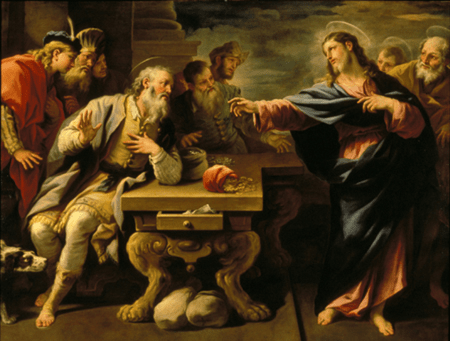
Jupiter, Creator: Hulton Archive | Credit: Getty Images

“However, not to give offense to them, go to the sea and cast a hook and take the first fish that comes up, and when you open its mouth you will find a shekel. Take that and give it to them for me and for yourself.”

Matthew 17:25 (context vv. 24-27)

Jupiter was the king of the gods in the Roman empire; it was believed that he ruled the sky and thunder, he made the rain to fall. His temple in Rome was built on the highest hill (naturally) in 294 B.C. He was the head honcho of the Roman pantheon, and his cult following could be somewhat fanatical.

A tax was collected from Israel to support his temple, which caused hard issues among the Jewish leaders. They obviously didn’t want to support Jupiter, “no ifs, ands, or buts.” Not only were there spiritual reasons, but they had real patriotic issues too. Rome could be pretty insistent though.

Not completely sure about this. But apparently rabbis and priests were exempt from paying this. This is the setting for “Jesus-Peter-and-the-fish” in Matthew 17. Everyone’s eyes were now on Jesus: “Would He pay the tax, or not?”

Jesus specifically uses the word, “skandelion” for offense. We should know that this is the root word for scandal, or scandalize. That might bring us much needed clarity.

Jesus didn’t seem to bat an eye. There doesn’t seem to be any hesitation. Peter is dispatched to go catch a fish, the very first one, and when he reels it in he’s going to find in it’s mouth a coin, a drachma–that coin will pay the tax. This is a miracle, albeit a strange one.

Why? In the light of the spiritual implications did Jesus, and Peter, find themselves “indirectly” supporting Jupiter’s temple in Rome? Wouldn’t taking a stand against this religious cult be loyalty to God and declare a commitment to the nation of Israel?

Was Jesus ‘selling out’ and compromising His faith?

There’re lot’s of things we should say. First, how do we look at our government and its evil issues? How do we determine the steps we should take to be holy and separate from the world and its anti-christ system? What about the Old Testament stance of Daniel, or “the three Hebrew children” warming themselves in the king’s furnace?

I have lots of questions.

“Everything except God has some natural superior; everything except unformed matter has some natural inferior.”

-C.S. Lewis

   

A Really Hard Reality, #53

30 “They went on from there and passed through Galilee. And he did not want anyone to know, 31 for he was teaching his disciples, saying to them,” 

“The Son of Man is going to be delivered into the hands of men, and they will kill him. And when he is killed, after three days he will rise.” 

32 But they did not understand the saying, and were afraid to ask him.”

Mark 9:30-32

There are no illusions found in these verses. This passage is painfully practical, and whenever I read it I’m forced to take another slug of reality–Jesus will die. Evil men will kill Him. I don’t want to see His ministry end like this. Deep inside, I want to His ministry to continue. I need to hear more parables, and see more miracles.

But thinking squarely isn’t always my best point. I sometimes like illusions. They seem like necessary padding for the stark rigors of living. They’re nice to have around. But I do know that gripping reality is needed. It’s harsh and rude, and some of us avoid it like vampires dodge picnics.

The disciples must get real and extend their thinking about the Kingdom. They’ve been witnesses to all those supernatural things that the Messiah is doing. It’s all been very good. But now they must think deeper, and even more redemptively. Jesus will-must die, and He will rise. Why?

The Holy Spirit is always pouring love on us. I know that all that He does is done by love. Whether it’s touching a leper or feeding 5000, it’s love that is Jesus’ reason and clearest motive. Easily seen in these amazing miracles, and somewhat harder to picture when it comes as betrayal and murder. (God help us adjust.)

Jesus will (must) die. That is His accurate prediction. The disciples must clear the decks and assimilate this fresh information. They’re needed to grab this and make it part of their understanding. They are now witnesses, completely and wholly grasping the deepest realities of the Kingdom.

The gospel of the Kingdom up to this point is indeed a wonder. Teachings and healings, miracles and resurrections are becoming the norm. We all want to see them continue. We are shocked when Jesus takes this morbid perspective! How perfectly awful. (NOT the way to win disciples!)

The death of Jesus Christ, and His resurrection, is the next necessary miracle. It is needed to redeem and ‘heal’ the entire world. Oh yes, Jesus touched a leper, forgave the whore and raised the dead–but these are miracles that primarily touched individuals. He intends to kick it up a notch.

Jesus is going to die for us all. Isn’t that outrageous?

Who Do You Think I Am? #48

“Who do the crowds say I am?”

“But who do you say that I am?”

Luke 9:18, 20 (context, vv. 18-20)

The question is significant; and it’s never been fully answered. Perhaps each of us must be asked this exact same thing. And perhaps it’s the crucial question that every human being who has ever drawn breath must ask themselves. Who is Jesus? Who is He really?

The crowds had witnessed Jesus feed them with a little boy’s lunch. They saw miracles and heard teaching, and yet maybe they were a bit confused. They could only put Jesus in the context of what they knew was “allowable” by the Pharisees. He definitely was some kind of prophet. Jesus was being evaluated by a very curious crowd.

Jesus isn’t distressed by this, He’s not full of self-doubt or second thoughts. He’s not looking around for our support–or accolades, palms or laurels. He knows exactly who He is. He is the only Son of God, the second person of the Trinity. He is fully and completely God; and He is now wearing a robe and walking around in sandals.

There exists a “crowd faith,” something more or less aware that God cares, and miracles do happen in this life. This is all well and good. But it seems there is a “personal faith,” which Peter now announces out loud. “You’re the Messiah, come from God.”

What Peter declares in front of everyone changes everything.

We must always draw our own conclusions, of course. We must look at Him, and decide for ourselves what He claims to be. There is no question it’s scary, and it’s hard. But you, and you alone, must decide. Crowd faith is almost always good, I suppose; but Peter’s bold declaration is what He really is waiting for. Are you convinced yet?

The Easy Yoke, Entry #35

“Come to me, all who labor and are heavy laden, and I will give you rest. Take my yoke upon you, and learn from me, for I am gentle and lowly in heart, and you will find rest for your souls. For my yoke is easy, and my burden is light.”

Matthew 11:28-30, (context, vv. 25-30)

I have thought some on these two verses; I’ve come to the conclusion that it really must be understood as a holy ‘invite.’ A gracious bidding to come to Him, to find much needed rest, and discover meaningful work. This is a gentle summons to blend both rest and work and then live it out in our lives.

Jesus is aware of my weak and faltering steps. I stumble a lot, I weave and trip often. Yet He never criticizes me, He finds no fault, but matches His steps to mine. On His own, Jesus could do the work much faster. But He insists we stay yoked, connected with each other. This amazes me.

The moment we do this we’ll understand that the combination of these two will always balance and correct us. It will pour out of us love, grace and gentleness. The fruits of the Spirit can be seen, and we become salt of the earth.

He invites us to come and be yoked, and to enter into true rest, and true work.

“Thou hast created us for Thyself, and our heart is not quiet until it rests in Thee.”

-St. Augustine

Please, Don’t Be Offended, Entry #33

“And blessed is the one who is not offended by me.”

Matthew 11:6, (context, vv. 2-6)

Being “blessed” is much more than having lots of money, a nice home or a fancy new car. First and foremost being blessed must be a spiritual word–it seems sometimes we have to rescue the true definition and then bring back its real meaning. The old hymn exhorts the enriched Christian to “count your many blessings, name them one by one.” Singing this will work something inside us.

We become spiritually prosperous when we begin to embrace the reality of Jesus–His words, actions, even His very person becomes the dearest thing we could ever dream of possessing. We’re also blessed when we receive deep inside us the many challenging things He says. We really must absorb these harder words without any reservations. It seems that He doles these things out very carefully.

We have to admit that being scandalized over Him is always a possibility. It can happened to a pastor, or a ‘newbie’ in the faith. No matter who we are, we’re always in the arena, being watched, and our faith in Jesus will be tested. Is it real? Will we be insulted or affronted by the presence of the Lord Jesus Christ? That dear one, it a very real possibility.

Jesus still offends people. There were those who embraced Him, and yet it seems to me that most ended up resisting and rejecting Him. He was a ‘wrench in their machinery,’ an obstacle in their theology. He was constantly doing things that didn’t seem right or proper.

Does Jesus offend you?

“When Jesus came to earth, demons recognized him, the sick flocked to him, and sinners doused his feet and head with perfume. Meanwhile he offended pious Jews with their strict preconceptions of what God should be like. Their rejection makes me wonder, could religious types be doing just the reverse now? Could we be perpetuating an image of Jesus that fits our pious expectations but does not match the person portrayed so vividly in the Gospels?”

-Philip Yancey, “The Jesus I Never Knew”

Being Worthy of Jesus, Entry #31

“Whoever loves father or mother more than me is not worthy of me, and whoever loves son or daughter more than me is not worthy of me. 38 And whoever does not take his cross and follow me is not worthy of me.”

Matthew 10:37-38 (context, vv. 34-38)

It’s funny, but we never realize that the challenges of following Jesus are never more than the cost of not following Him. The cross leads to death, most certainly. But let’s never forget that there is a resurrection that does happen after that death. We’ll never live unless we die first.

The problem is that we don’t want to die!

We cling to our lives with the intensity of a drowning man clinging to a ‘life ring.’ We dare not let go. We dare not simply give up and really call out to Jesus. We hang on to the old life, and as a result, will never, ever experience the new. We believe that we will really drown. We are afraid.

Jesus is demanding from us a preeminent love for Him. A love that ‘nullifies’ anything earthly; a love that surpasses anything “good and proper.” He wants it all! There will be no competition, no contesting our love for Him. Jesus is either all, or He will be nothing.

Yes, there is a “cross.”

There will be a awful terrible death to everything we think brings us life. The “disciples” understood crucifixion. A Roman general once did it to the members of a Jewish rebellion. He lined the highways with 2000 crosses, to declare the iron-clad sovereignty of Rome.

Yes, the disciples knew. They remembered the horrifying deaths of so many. They undoubtedly passed by these insurrectionists who hung on these crosses and died. They vividly understood that a cross wasn’t a piece of jewelry, but it meant an awful bloody death of a human being. They knew. The cross was gruesome.

Following Jesus means this kind of death.

It ends everything dear to us. It irrevocably ends life as we know it. Life now consists of having a first love, a renouncing everything else that we hold dear. The relationships we thought were good, are now stumbling blocks to the path to our cross.

Yes, there is always a resurrection. Life will be given back to us. But death comes first, and it is incredibly painful. Sometimes we preach and teach, we embrace a “resurrection” life that excludes a cross. We jump right into a Christianity that has circumvented a terrible death. We are now officially, “cross-less Christians.”

“Unless he obeys, a man cannot believe.”

-Dietrich Bonhoeffer


Laborers Wanted, # 27

Then he said to his disciples, 

“The harvest is plentiful, but the laborers are few; therefore pray earnestly to the Lord of the harvest to send out laborers into his harvest.”

Matthew 9:37-38, (context, vv. 35-38)

The issue here is laborers–this is our work, plain and simple. The fact is that there isn’t enough workers. It’s funny, it seems God is constrained by our prayers–earnest prayers for a harvest to be brought into the barns. But there aren’t enough hands. The harvest will be ruined if help doesn’t come soon.

God must have our help if it’s going to get done.

The harvest seems contingent on our prayer life. We decide what is going to happen. Prayer is the work of the authentic believer and our hearts must be for the fields. We are the people who work, who sweat, and get tired. That is our call. That is the true work of discipleship.

Mother Teresa once commented that what we see in front of us is our “Calcutta.” We have got to open our eyes and look, we must see the incredible needs of desperate people that surround us. We must have eternal eyes–God’s eyes. We do our work on behalf of others. I really do believe that it will be ‘sweaty’ prayers that will move the hand of God.

I think ‘prayer’ is the real work in evangelism.

Prayer is our effort that gets combined with the Holy Spirit’s great passion of lost souls. Our “earnest” prayer for the harvest will call workers to the fields. Every generation is responsible for their own part of the field.

For some reason God has chosen to limit Himself by our decision to pray. He patiently waits for us to intercede. Everything seems contingent on us, we can point no finger at God, or accuse Him of ignoring the work that must be done. We must make the decision. Evangelism, and missions, is God’s intense passion. He now shares with us this responsibility.

All of Heaven is standing on its tiptoes, waiting to hear our pleas for the lost.

“Pray as though everything depended on God. Work as though everything depended on you.”

-St. Augustine


Let’s Follow the Master, Entry # 21

Luca Giordano
Naples; 1634-1705
The Calling of St. Matthew, c. 1685
oil on canvas; 78.5 x 100.5 inches

As Jesus passed on from there, he saw a man called Matthew sitting at the tax booth, and he said to him, 

“Follow me.” 

And he rose and followed him.”

Matthew 9:9

Another “tax collector.” (Why won’t Jesus ever learn?) It really does seem that He has a definite preference for the scum and the outcast. For some very odd reason that’s the sort of person He likes. But really, do we dare question His wisdom in this? Do we think we have a right to pass judgement on Jesus’ choices?

I have to think that Jesus is showing us His deep fondness for the ‘ungodly.’ Tax-collectors, egads!!!! I don’t really understand, until I consider my own ‘wretched’ life. Until Jesus comes to me, calling me, I will continue to set in my dreary booth, taking money from other dreary people.

So what does it really mean to really follow Jesus?

I think of Matthew, a wicked man who has no qualms about betraying his people for money. It’s always been odd to me, that Matthew’s name meant “pure.” (What were his parents thinking? Maybe they grasped his future destiny as an apostle? IDK.) But I am certain that Matthew’s call to follow meant he had to leave something ‘behind.’

We follow Jesus. We’ve accepted the call that we must turn away from our past life. We’ve left behind all the money and just walked away from our table. We understand that we can’t bring it along; we have renounced its claim on us.

Following Him means taking up our “cross,” and everything that it might entail. We really do need to leave it all behind. What a deal, huh?

“And calling the crowd to him with his disciples, he said to them, “If anyone would come after me, let him deny himself and take up his cross and follow me.”

Mark 8:34


Preaching With a Purpose, Entry #17

“But he said to them, 

“I must preach the good news of the kingdom of God to the other towns as well; for I was sent for this purpose.”

Luke 4:43 (context, vv. 42-44)

God directed preaching extends the Kingdom of Heaven. Jesus understands this and embraces a calling from the Father to communicate God’s rule in the heart and souls of people. He publicly acknowledges that this was now His ministry and purpose. This was the reason He came for us. He was sent!

Jesus understands that when the Gospel is combined with the Father’s intentional purpose it develops into a true understanding of what He is looking for in our lives. Perhaps it’s the only thing that can. He obeys and the world is completely changed.

Anointed preaching accomplishes Kingdom purposes.

Understanding the Kingdom takes humility and repentance. The message of Jesus is not a ‘given,’ It requires a solid reaction that will take the listener deeper than he has ever gone before. The gospel message must be understood through a ‘broken’ life. It has zero impact when the heart is hard. We are teflon.

Preaching this “good news” is the only thing that can pierce the hard shell of the human heart. I believe that His purpose requires a commitment on the preacher as well as the listener. It demands obedience. It requires a repentant faith.

Jesus seems to agree.

“Go into all the world and preach the gospel, and if necessary, use words.”

― Francis of Assisi


Quenching Our Thirst, Entry #13

“Jesus answered her, 

“If you knew the gift of God, and who it is that is saying to you, ‘Give me a drink,’ you would have asked him, and he would have given you living water.”

John 4:10, (context 4:7-42)

A rusty pail and a very old well. A woman comes to draw out some water from a well dug by Jacob, a patriarch from the pages of Genesis. I believe she was a ‘scarred’ person, she had been married to five men, and she really hadn’t decided to marry #6.

Noon wasn’t the norm, it seems she purposefully waited until the coast was clear. She avoided any contact with others. She would go in the heat of the day. But really deep down, she was ashamed of herself, and grieved over how she had destroyed her life.

She didn’t count on meeting someone at the well, much less a Jewish man who was tired and weary and waiting for a cool drink. She was even more surprised when Jesus spoke to her, that wasn’t proper. A Samaritan woman with a checkered past conversing with a holy Jewish teacher. On heard of.

Jesus waited for her to come, she has an appointment to keep with the second person of the Trinity who was waiting by this well.

“Living water,” how quickly we zoom through this phrase. We seldom stop to consider that what Jesus was offering her was ‘alive.’ It was water infused with life itself. It was water with eternal vitality over sickness, sin or death. When He talks about “living water,” Jesus is referring to Himself.

This particular incident with the woman at the well became the entry point for the ‘good news’ to come to the entire village. Living water would quench the thirst of this backwater Samaritan town.

“People pay attention when they see that God actually changes persons and sets them free. When a new Christian stands up and tells how God has revolutionized his or her life, no one dozes off. When someone is healed or released from a life-controlling bondage, everyone takes notice.”

-Jim Cymbala