He is Solid, #106

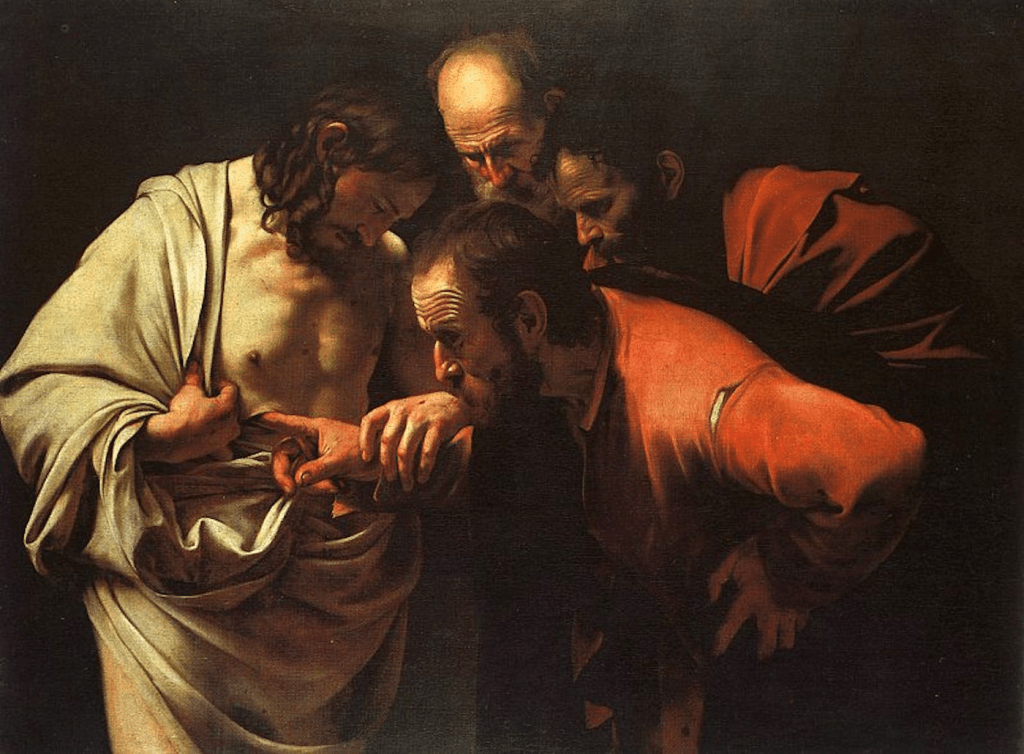
38 “Why are you troubled?” he asked them. “And why do doubts arise in your hearts? 39 Look at my hands and my feet, that it is I myself! Touch me and see, because a ghost does not have flesh and bones as you can see I have.” 40 Having said this, he showed them his hands and feet. 41 But while they still were amazed and in disbelief because of their joy, he asked them, “Do you have anything here to eat?”

Luke 24:38-41, CSB, (context vv. 36-43)

He isn’t a ghost, a hallucination or some sort of fabrication of hopeful desires. He’s real! As real as you or I–solid, flesh and blood, and real bones. That may seem like a small thing, but it reveals to the disciples (and us) so much. When his resurrection happened, it didn’t alter him, or change his physical attributes. The disciples were floored when the solid Jesus showed up to be with them.

It was a late Sunday evening.

The doors were shut tight, and the eleven were hiding out there–scared and wallowing in doubt. That’s a lousy mixture. Jesus doesn’t knock on the door, he just pops right in their gathering. That must of been a bit of a shake-up in itself. I know I would of freaked. (And I would’ve taken a serious look at that door.)

At the core, they couldn’t believe that he was real. Maybe a ghost, or his spirit or something else? I’m fairly certain that even if this “man” was really Jesus, it would, maybe be something mystical or ethereal. He wouldn’t be flesh anyway. That was a real stretch for them–and me too.

If it was really true, it meant that physical things are really spiritual.

What I mean by that earth was now combined with heaven. Jesus, the King of the known universe–the One who sits on the throne–is solidly human. Concrete and quite tangible. He’s not a vague kind of spirit, but he’s just like like us. Finally, something physical!

Let’s not get confused about this; I think it’s a critical point. Eternity will not be a vague and misty reality–nebulous and celestial. It’s now quite relatable. When Jesus walks with you on the golden paths of his heaven, you’ll not be walking with a ghost. He’ll be as you and I are right now. He’ll be real. You’ll be real.

You’ll be able to touch him. And if you really want to you can stick your finger into his wounds (verse 40.) I love what this solid Jesus told Thomas in John 20:27:

“Then he said to Thomas, “Put your finger here and look at my hands. Reach out your hand and put it into my side. Don’t be faithless, but believe.

This should shatter any misconceptions you might have. Thomas had real doubts, and instead of getting rebuked, Jesus invites Thomas to discover the reality of himself. This is really quite profound when you think of it. I’m so glad that this happened, I needed to hear it for myself.

I maybe a very silly preacher and writer, but that’s the way I see it.

A light shining in this heart of darkness
A new beginning and a miracle
Day by day the integration
Of the concrete and the spiritual

Bob Bennett, “Heart of the Matter

A Member of Faithful Bloggers

Go to My Brothers, #105

“Don’t cling to me,” Jesus told her, “since I have not yet ascended to the Father. But go to my brothers and tell them that I am ascending to my Father and your Father, to my God and your God.”

“Mary Magdalene went and announced to the disciples, “I have seen the Lord!”

John 20:17-18, (context, vv. 11-18)

Some believe that somehow this ties into the holiness of Jesus and his need to ascend with God. This thought is that somehow Mary would defile him. I don’t believe this for a second. A much better idea is that Mary was so excited to see Jesus alive that she grabbed a hold of him and simply wouldn’t let go.

The risen Jesus was not a ghost, or a spirit.

He was solid, just like you and me. And he wasn’t Mary’s hallucination, delusion or some sort of wish-fulfillment. It was him–it’s Jesus. Yes, he was buried, everyone knew that. But now he was actually standing before her–very much alive.

“Go to my brothers” is quite profound when you think about it. There’s no superiority or condescending attitude to speak of. Rather he’s relating to his cowering and foolish followers who are hiding out as his brothers. They maybe in hiding, but he’s telling them that they needn’t be afraid.

“My Father and your Father, to my God and your God,” is wonderfully aware.

It’s funny, but this is the first time that he refers to them as his brothers, and the resurrection from the dead has changed everything. It’s interesting, but a brother relationship is even closer than a friend relationship. The disciple are now relating to Jesus in a new capacity. They’re now brothers–family.

Mary has been “commissioned” by Jesus.

She is now the first one to carry the Good News that the Lord has risen from the dead. The Jews didn’t recognize the testimony of a woman in their courts, but Jesus chose her. She’s been given the responsibility to carry the news to his followers. This is no small thing.

We see Mary announcing this to the disciples. The word “announcing” means she simply declared to them what she had just experienced. Perhaps that’s the essence of witnessing to others–we simply communicate what Jesus has done for us. Our testimony is a very powerful thing, (Rev. 12:11).

“Christ the Lord is risen today, Sons of men and angels say. Raise your joys and triumphs high; Sing, ye heavens, and earth reply.”

    Charles Wesley

We belong to Faithful Bloggers

What is Truth?, #101

 “Pilate said, “So you are a king!”

“Jesus answered, “You are the one saying I am a king. This is why I was born and came into the world: to tell people the truth. And everyone who belongs to the truth listens to me.””

“Pilate said, “What is truth?” After he said this, he went out to the crowd again and said to them, “I find nothing against this man.”

John 18:37-38, NCV

Not only was Jesus on trial, but it seems the truth was too. “Truth” is mention three times in just two verses (again, for emphasis). Pontius Pilate who was the Roman governor of Judea, meets with Jesus to make the determination if Jesus would be executed.

Truth seems to be a focus here. Jesus understands that he was sent to declare the truth to the people. He also states that those were called would be listeners, and these would respond positively to all the Jesus had been saying. Jesus clearly understood what he must do, it was the reason he was born.

Pilate is cynical, “What is truth.” He asks the question that even today is being considered. He thinks that truth has many variations, and none of them could be understood.

But Jesus pronounces that he is the King of truth, and to Pilate that was foolish. No one person, in his mind anyway, could be the sole source. He dismisses Jesus’ statements with a philosophical idea that things are relative, nothing can be understood with any degree of certainity.

Pilate very obviously believes in unbelief.

He seems to want to set Jesus free–from his balcony he points out Jesus’ innocence. He finds no reason that Jesus should die for these statements. We see him negotiating with the Jewish people. But the Pharisees have decided that Jesus must die, we see them stirring up the crowd.

To Pilate’s credit he tells them that Jesus is no revolutionary. He presents no danger to either Rome’s empire or Judea. Being pressured, he orders Jesus to be whipped. It was also the place where a crown of thorns was put on Jesus’ head (John 19:1-5).

He tries to negotiate once more.

But the people won’t listen. It was Passover, and there would be pilgrims in the city. Scripture tells us that they’re on the verge of rioting. They declare that anyone who supports Jesus must be an enemy of Caesar (John 19:12-16). Pilate finally acquiesces and orders Jesus to be executed. C.H. Spurgeon makes the following observation about Pilate:

“Oh, the daring of Pilate thus in the sight of God to commit murder and disclaim it. There is a strange mingling of cowardliness and courage about many men; they are afraid of a man, but not afraid of the eternal God who can destroy both body and soul in hell.”

Pilate ceremoniously washes his hands over the whole thing. He seems disturbed by the whole incident (Matthew 27:24).

“Looking to Jesus, the founder and perfecter of our faith, who for the joy that was set before him endured the cross, despising the shame, and is seated at the right hand of the throne of God” (Hebrews 12:2).

This is our calling–and this verse exhorts us to do this in order to learn holiness, and to follow him with a complete heart.

Tradition has it that Pilate does become a believer in Jesus some years later. He is martyred for his faith by being beheaded on orders by the emperor Caligula.

A Member of Faithful Bloggers

The Interrogation, #100

friarmusings.com

“If You are the Christ, tell us.” But He said to them, “If I tell you, you will not believe; 68 and if I ask a question, you will not answer. 69 But from now on the Son of Man will be seated at the right hand of the power of God.” 70 And they all said, “So You are the Son of God?” And He said to them, “You say correctly that I am.” 71 And then they said, “What further need do we have of testimony? For we have heard it ourselves from His own mouth!”

Luke 22:67-71, NASB

The Sanhedrin thought they had him. Jesus mounts no defense in this particular trial. He is serene, quiet and very much in control. The interrogators tried 5-6 different questions, each purposefully designed to reveal Jesus’ guilt. We should remember, he was regarded as guilty until proven innocent.

This was regarded as a capital crime–a death penalty could be given. But the Law declares that a trial could only be held in the daylight. It was to be public, open to all Jewish men. And in cases like Jesus’, the evidence was to be offered on one day, and a verdict the following. It couldn’t be a “rush” to judgement.

They got there licks in even before the official arraignment before the high priest. Jesus is blindfolded, mocked and beaten, even before the trial began (Luke 22:63-65). All of this took place as soon as he was brought in from the Garden, even before he was charged with a crime!

The deck was definitely stacked against him. The blindfold seems to be a test of sorts, it was believed that the real Messiah would have the supernatural ability to discern his attackers, even while blindfolded. That explains much if it’s true. The spitting was pretty evil though (Mark 14:65).

In this passage Jesus carefully turns the tables on his interrogators. His reply is perfect–they are forced to examine their own hearts. When you put the Son of God on trial, you can expect to see things like this.

“Jesus warned them that though they sat in judgment of Him now, He would one day sit in judgment of them – and with a far more binding judgment.”

David Guzik’s Biblical Commentary

Jesus reply of “I am” carries significant meaning, and we see the impact it has on his captors. In verse 71, they now have the answer they’re looking for, and we sense that they’ve got the evidence in that response. It’s the breakthrough they’ve been waiting for.

The patience and endurance of Jesus amazes me.

He stands alone in the middle of accusations and after being mocked and beaten. In the Garden he states that at his word he can have “twelve legions of angels” ready to protect him (Matthew 26:53). This is profound–I consider not only his restraint, but also his steadfastness, his ability to press on no matter what.

He doesn’t crack or break under the pressure. He goes the distance. He patiently endures it all, and he did this for you and me. Now dear ones, that’s a very good thing.

“For consider him who endured such hostility from sinners against himself, so that you won’t grow weary and give up.”

Hebrews 12:3

My Kingdom, #98

 “Jesus answered, “My kingdom is not of this world. If my kingdom were of this world, my servants would have been fighting, that I might not be delivered over to the Jews. But my kingdom is not from the world.”

John 18:36

Jesus perfectly understood his kingdom. Three times in this one verse, Jesus uses the statement, “My kingdom.” Three times. Perhaps there is something here we should look at closer? Maybe?

First, Jesus tells Pilate that, yes, he was a king. Second, that this kingdom was not a political rival kingdom. Its boundaries were not physical ones–they’re spiritual, and Pilate and the emperor were not in the equation. King Jesus’ kingdom was not “of this world,” which also by the way, is repeated three times in this single verse.

These 40 words declare to Pilate that he shouldn’t be worried.

Those who look to King Jesus have renounced the tenets of this world’s ideas–force, pride, public image and power. The kingdom of God comes to us in the Red Letters of Jesus–the Beatitudes and the parables.

“Romans thought they knew about kingdoms and their might; that armies, navies, swords, and battles measured the strength of kingdoms. What Jesus knew was that His kingdom – though not of this world – was mightier than Rome and would continue to expand and influence when Rome passed away.”

David Guzik

Brokenness, humility, love, servanthood and sacrifice are the ways his kingdom comes to people. The world’s methods of doing things–even religious and “moral” approaches, are never the way things work under his authority. At times even, they may seem very noble and right; but that isn’t the way Jesus’ rule truly comes.

Interesting. I believe the church, especially here in the West, understands Jesus as a Savior, but not as the King. The idea of a king and lord aren’t automatics for us. We have senators and constitutions, media outlets and freedom of speech–but that somehow never prepares us for the rule of a true sovereign.

Jesus is calling us to live out his rule in our lives, and to embrace him as King. He’s much more than our Savior, and we must understand that. If we want to really grow in him, we must understand his lordship.

The lordship of Jesus is not simply a hope of Christians that someday might be realized; it is a truth that has already taken place.

R.C. Sproul

Love Like a Disciple, #93

“A new commandment I give to you, that you love one another: just as I have loved you, you also are to love one another. 35 By this all people will know that you are my disciples, if you have love for one another.”

John 13:34-35

The believers in Jesus must carry the credentials of Jesus. To be authentically his demands evidence–proof that you’re really are real. It never comes by one’s own words, personal declarations, or by affiliations or preferences. Jesus is crystal clear on what is true and what is not. To him, it’s black or it’s white.

“Where’s the beef?”

A few years ago that was the ad line of a particular fast food chain. It was catchy, and soon everyone smiled. The company only did it because it worked. Three old ladies looked at a competitor’s hamburger and made the announcement that something was terribly wrong.

Jesus made it clear that there would be evidence that everyone would see. “Love one another” is used three times in two verses–not only that, but in verse 35 we hear him tell us that “all people will know” what disciples would look like. To follow Jesus you must love like Jesus–to be like him, you must love like him.

We dare not minimize this. It’s now the believer’s credentials, the proof that they were real, and not just posers. We’re called to be more than religious exhibitionists, who somehow have an affinity for nice sounding words that only touch the outward. Jesus states that our love is now the true declaration of something super authentic–and very tangible.

So where’s the love?

The word used is ἀγαπάω, agape. It’s the ultimate kind of love–the love that God himself has for lost people: it’s not the love one has another sexually, that word is eros. It’s not the love we have for our brother, that word is philo. But it is agape, a love that has no limits, and the best and clearest definition is found in 1 Corinthians 13.

Maybe a better grasp of the verses in John 13 can be had by reading the Message translation:

“Let me give you a new command: Love one another. In the same way I loved you, you love one another. This is how everyone will recognize that you are my disciples—when they see the love you have for each other.”

(vv. 34-35)

“Our love to God is measured by our everyday fellowship with others and the love it displays.”

   Andrew Murray

Celebrity Servants? #92

drsunil.com, art by Takla

“He came to Simon Peter, who said to him, “Lord, do you wash my feet?” Jesus answered him, “What I am doing you do not understand now, but afterward you will understand.” Peter said to him, “You shall never wash my feet.” Jesus answered him, “If I do not wash you, you have no share with me.”

John 13:6-8 (context vv. 3-17)

Chapter 13 always rocks my world. I visualize this, I’m like a fly on-the-wall, watching it happen–and then I replay it over, and over in my mind. It always unravels me. Why does this have to happen? What does this passage tell me about Jesus, and his kingdom? (John 13). Why can’t I just walk away from it, and leave it be?

Jesus made himself a slave (or perhaps he was always a slave all along, and we just didn’t realize it?) Foot-washers were pretty much regarded as sub-human, mindless drones who mechanically performed a necessary duty. The lowest of the low, the very least of the least. Today they’re the burger flippers and the pool cleaners.

But Jesus took that role on himself, he laid aside his garments, and his Godhood. (They landed in a pile in the corner of the room). When he knelt down to scrub feet (making sure he got between the toes), it was deity serving man. This God/rabbi intentionally did this, not reluctantly or halfheartedly–but carefully.

He was their teacher, and custom demanded he enjoy the prerogatives of that position. But he wouldn’t, and didn’t. He mustn’t. As I stress over this, I must conclude he really was their “teacher,” but not in the way I expect. What he was doing on his knees, was instructing them in the art of loving each other. He showed us a leader in action.

And isn’t making disciples all about loving someone else more than ourselves? We get things turned around sometimes–we think that spiritual authority is moving up, when it’s all about going down. We elevate our pastors and elders, maybe subconsciously–and human nature lets it happen; and then we’re amazed why our leaders struggle so.

Leaders function best when they wash between the toes.

There was a point in Jewish history when the people actually demanded that God would give them a king, instead of a judge (1 Samuel 8:5-9). God warned them that this wasn’t in his plans–but they insisted. They had to have one, everyone else did. We still must have celebrities, and then we wonder why they short circuit on us. Who can resist the privilege, and the limelight?

The Church was never meant to operate like this. That’s what Jesus said. Instead it’s we who’ve turned it upside down. It’s we who insist on turning our pastors into minor celebrities. We assert that they take on the role of a “king” (albeit, a little one maybe). Perhaps leaders who stumble and fall do so because we want them to be front and center? Who can handle the privilege, and the adulation? I know I can’t.

Peter was classic Peter. It seems that whenever he resists, he gets rebuked. He makes it quite clear that Jesus will never wash feet–that Jesus will never use a basin or towel and serve him like this. It was outrageous. Unacceptable. It didn’t fit in Peter’s personal theology. He had no room for Jesus the slave. (Perhaps he knew that to follow meant he would have to do the same thing? IDK).

Jesus still washes his people. He sits us down and takes off our shoes and socks, and scrubs us clean. And we hate it. But to be washed by him is a condition of our discipleship. Every follower must be clean, and he continues his work to this day. We sin daily, even as his own, and he cleans us up–and somehow that really bothers us.

The gifts of leadership are one way of washing feet. At least that’s what our leaders were designed to do. That’s Jesus’ way of doing things. But it seems we’ve adopted Peter’s attitude, and embraced the ‘pre-king’ thinking of Israel. We need our celebrities, we want our kings. We simply can’t imagine it any other way.

“The very first thing which needs to be said about Christian ministers of all kinds is that they are “under” people as their servants rather than “over” them (as their leaders, let alone their lords). Jesus made this absolutely plain. The chief characteristic of Christian leaders, he insisted, is humility not authority, and gentleness not power.”

 John Stott

The Grapes of Wrath, #91

Warning: This is a hard one!

“Everyone who falls on that stone will be broken to pieces, but on whomever it falls, it will shatter him.””

Luke 20:18 (context. 9-16)

Who wants to fall? Not me. This very blunt declaration has to be understood by that which immediately proceeds it: the “Parable of the Vineyard Owner.” This isn’t one of your nice ‘run-of-the-mill’ parables either. It’s got some real teeth.

It really is a potent stuff. The authorities–over, and over have rejected God’s prophets–everyone that he has sent. They do this continuously–history really does repeat itself. Finally, God finally sends his Son, and they decide (quite coldly) to kill him, and take the vineyard over for themselves.

Disobeying the voice of the Holy Spirit is a terrible thing.

And I’m afraid it’s done fairly consistently. He speaks over and over to us, but we’ve disobeyed him so often we can’t hear him anymore. His voice is often a quiet one, and we no longer really look or listen for it. Dear one, I’ve been in ministry for over 35 years, I’ve seen it up close, I’ve seen it in myself.

When we repeatedly ignore his voice, we’ll find ourselves in spiritual silence. We’ve now become spiritually deaf.

And guess what, we won’t even know it. We think we’re doing okay spiritually. But we really don’t hear him anymore. And that’s precisely what the leadership of Israel has done. They no longer hear him. Read their response. They don’t believe this parable, (maybe they think it’s funny?)

“When the chief priests, the scribes, and the elders heard this, they said, “May it never be!” 

(verse 16b)

That really should disturb us–and it’s frightening. But you must understand, it’s not confined to them–it’s launched at us as well. His parable travels through the centuries, and nails us. The translation of that particular “promise” in verse 18 might help clarify any ambiguity we might have:

 “Anyone falling over that stone will break every bone in his body; if the stone falls on anyone, he’ll be smashed to smithereens.”

(v. 18, the Message)

It’s a promise. We’ve got this tendency to think of God’s promises as wonderfully positive. But this promise is scary. The price of ignoring Jesus has consequences, and these “chosen” people are about to discover judgement. They have ignored him for the last time.

The nation of Israel will be destroyed by the emperor Titus. The ancient historian Josephus wrote that he killed 1,100,000 Jews and they carried 97,000 as slaves to Rome. 

At this particular moment in time, it’s critical that you learn to hear what the Spirit is speaking to you.

You’ll need to learn to distinguish his voice through the world’s static. But we much rather keep the status quo, and simply ignore this dark moment. We don’t want to listen that close. Maybe we’ll become “weird.”

Perhaps you’re afraid of what he might say. Maybe you’ll need to turn away from something that is causing you to go deaf? But I must tell you, hearing him is a joy. I guarantee it’s worth it. It’s what you were created for!

“One of two things you must do; you must either receive Him or reject Him. You receive Him here and He will receive you there; you reject Him here and He will reject you there.”

    D.L. Moody

Member of Faithful Bloggers

Crooks and Robbers, #89

“Jesus Cleansing the Temple,” Jeffrey Weston

45 And he entered the temple and began to drive out those who sold, 46 saying to them, “It is written, ‘My house shall be a house of prayer,’ but you have made it a den of robbers.”

Luke 19:45-46

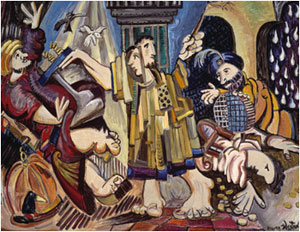
People detest hypocrisy. I’ve discovered that no matter who they are–pagan or devout believer, there is an awareness of this kind of religious evil. As I considered art for this post, I came across dozens, and dozens of different takes on this passage. One could open up a large gallery simply on “Jesus Cleansing the Temple.”

The priests and the merchants had a corner on the market. There was a need for pilgrim to have animals for sacrifices. But it was said that you could buy a pair of doves for 5 cents outside the temple, but once you entered they sold for 75 cents. The pilgrims also needed to change over their native currency to the temple money. That too, made a tidy little profit.

Jesus had visited the temple numerous times. He was dedicated there, and as a boy he taught the elders and priests. On his own pilgrimages 4 times a year, he witnessed the steady commerce that was done. Since the temple work went on 24 hours a day, the tables had to be constantly manned.

The issue here was authenticity. Keep in mind that this would be Jesus’ last visit. In a few days the authorities would publicly beat and then execute him. In some sense, Jesus was making a clear statement. Being fully God he had the right to declare the validity of what was going on. And it wasn’t good.

The temple was there for prayer. It was the place where God and man could meet each other. Every block laid, every pillar set, was a declaration of this idea. God and man reunited, with a sacrifice for sin. It was to be the official place where this would happen. And it would require a sacrifice for sin to open up a way to worship and pray.

“Of all bad men religious bad men are the worst.”

C.S. Lewis

Faith was hijacked by men who really didn’t believe. A flourishing industry had developed–religious language and ideas became the way to fleece those who really did believe. The greed of certain men had compromised real worship. Evil had worked its ugly way into the very core of the faith. It was an terrible thing.

The tables were located in the outer courts. These courts were as far as Gentiles could go–it was for them who wanted to pray. Jesus understood Isaiah, and quotes it in his rebuke, (Isa. 56:7). The religious evil that developed there was truly an abomination–and it had to stop.

We need to be aware that we’re definitely attracted to this kind of hypocrisy. We dare not point the finger too quickly –yes, we need to see it–not to pass judgement, but to understand the hatred God has for this sin. The temple of our bodies belong to him. He will enter our lives–he will flip our tables if he has to, he won’t tolerate our hypocrisy.

To Seek and to Save, #87

9 “And Jesus said to him, “Today salvation has come to this house, since he also is a son of Abraham. 10 For the Son of Man came to seek and to save the lost.””

Luke 19:9-10 (context, vv. 1-10)

The Jewish people regarded salvation simply as being a child of Abraham. Faith was not necessary, but being saved was simply genealogical. It was the exclusive privilege of every Jewish man and woman. It was the sole position of anyone who was descended from Abraham.

There were exceptions however. If an Israelite lived outside of the Law, they forfeited their salvation. If they cooperated with the Gentiles, or if they committed some heinous crime, they couldn’t be a true Israelite. You were saved, just because you had descended from Abraham.

Zacchaeus couldn’t be saved. He had essentially had renounced his salvation when he cooperated with the Romans as a tax-collector. He had made the choice of a living his life outside of what was acceptable to the religious norms. In short he chose to be damned. He had decided to walk the highway to hell, but that was his decision.

When Jesus called up the tree to Zacchaeus, and invited himself to dinner, Jesus was committing a forbidden act. You must understand that Zacchaeus was unclean, a sinner, and any contact with was regarded as a grossly evil action. In short, Jesus had allied himself with an unclean man. Thus Jesus must be unclean as well.

The “righteous” Jew would never ever have anything to do with Zacchaeus. That is why they had such an issue with Jesus’ decision to eat with him. And that’s why Zacchaeus was thrilled to have such an eminent teacher as his guest.

Jesus was seeking to save the lost.

Zacchaeus invited all of his “evil” friends to come and come to join in the feast. It’s funny, when it came to “evangelism,” he did all the work!

Zacchaeus would prove himself as a “child of Abraham” by his amazing repentance. The presence of Jesus in his home sparked life in his heart. Zachaeus’ repentance was remarkable and truly spontaneous. And probably more astonishing was Jesus declaring that Zacchaeus was now a true child of Abraham.

When we finally decide we can mingle with the lost, just like Jesus did, we can expect to see miraculous things. We won’t contaminate ourselves–it doesn’t work that way. When we reach out, we can count on the “Jesus” who now lives inside of us to touch the outcast. He wants to, and all he needs is for us to find the lost, and be with them.

I must implore you to “seek and save” those who are outside the norm. Ask Jesus to lead you to them–and quit worrying about what other Christians might say and think.

“The church is not a select circle of the immaculate, but a home where the outcast may come in. It is not a palace with gate attendants and challenging sentinels along the entrance-ways holding off at arm’s-length the stranger, but rather a hospital where the broken-hearted may be healed, and where all the weary and troubled may find rest and take counsel together.”

   James H. Aughey