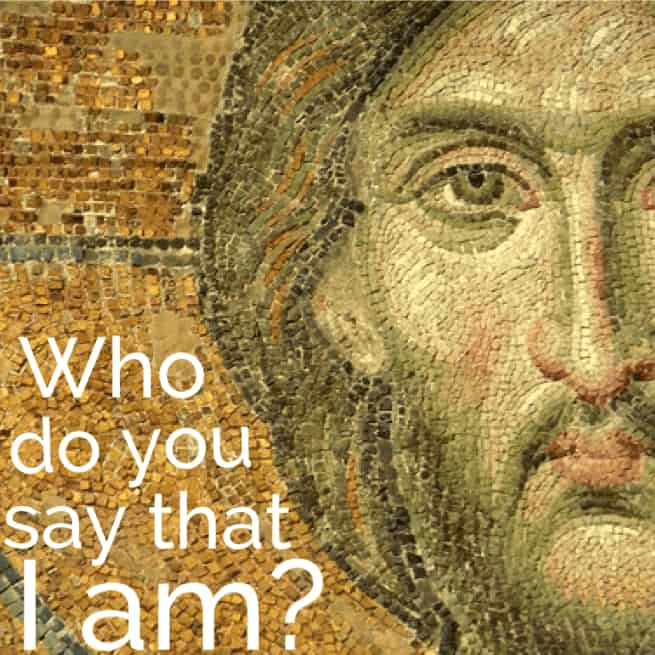
Jesus Knew Who He Was, #61

“So Jesus proclaimed, as he taught in the temple, 

“You know me, and you know where I come from. But I have not come of my own accord. He who sent me is true, and him you do not know. 29 I know him, for I come from him, and he sent me.”

John 7:28-29 (context, vv. 25-31)

Jesus was sure of himself–he fully understood his identity. There was not an iota of self-doubt or awkwardness. He was sure and steady, not at all like us. He spoke like a man who is totally confident about who he was. He walked out an awareness of who he was, and what he must speak.

Jesus had concrete knowledge of who he was, and now is proclaiming it to the people and priests. No one could stop him, he was like a spiritual locomotive. He spoke with total love, wisdom and authority. He spoke as a man who was not bound by religious definitions or ritual.

The temple was the special place were people met God–and God met people. And it’s in this certain place that Jesus now speaks to the crowds.

The issue here is one of identity, Jesus reveals who he really is, but also declares the awesome gap that exists between God and man. “Him you do not know” is the terrible analysis of our heart condition. We are separated and we’re walking in the dark. Romans 3:10-12 explains it like this,

“None is righteous, no, not one;
11  no one understands;
    no one seeks for God.
12 All have turned aside; together they have become worthless;
    no one does good,
    not even one.”

“He sent me,” explains the concentrated effort of God to get our attention. It seems that the Father has gone to extraordinary effort to bring us home to him. Jesus is God’s greatest effort. Jesus Christ was sent to find us, and return us to God.

“Christians believe that Jesus Christ is the son of God because He said so.”

C.S. Lewis

Seeing the Inside, #59

“Do not judge by appearances, but judge with right judgment.”

John 7:24 (context vv. 14-24)

We need to admit that what we see isn’t always the way things really are. Some of our issues come from basic human ignorance, and yet, we need to admit there can be a satanic element. He darkens our perception, so we can’t see reality.

Judging “by appearances” is a thread in our DNA. We see the outside, and we imagine the insides. We’re limited by our failure to see the interior, and our vision is never clear. I suppose this is how it works, we can’t see the inside of things (1 Cor. 13:12.)

“It is the unseen and the spiritual in people that determines the outward and the actual.”

-Oswald Chambers

We must admit our vision is often deceitful. Jesus tells the Pharisees that their analysis isn’t real, they aren’t making holy decisions. They won’t accept him, they rather debate instead believe. The Pharisees’ never could understand Jesus.

But Jesus suggests that there is a real discernment that must be used, but it’ll require bypassing what seems real, or at least what everyone thinks is real. Discerning the difference isn’t always easy, as people are never what they seem. A beggar sleeping under the overpass can have the heart of a king.

Making distinctions is necessary, but typically we evaluate superficially–we see the outside, and the interior goes unseen. With this shallow assessment, the Pharisees’ can’t see beyond anything Jesus taught. They had already decided.

We must have the gift of discernment; the world is confusing and we’ve lost our north star. We’re to be a people of perception, and we need to understand the times and seasons. We must learn prayer, and pray hard. God’s gift of discernment is always given to us for intercession, and never ever for fault-finding.

Me, on a good day.

The World’s Hate, #57

“The world cannot hate you, but it hates me because I testify about it that its works are evil.”

John 7:7 (context, vv. 1-8.)

Forty years of following Jesus has taught me many things. Lumped up in my top-ten is the hard lesson, “people dislike truth.” We are all fallen, and the fig leaves we find don’t cover much–they’re always wilting. And yet we avoid the light, and make up things that are really illusions (or delusions.) We find a mask and wield it to prevent the truth from penetrating our hearts.

Darkness is everywhere it seems. We see it in politics, religion and the media. We see it in our self, and others. It’s grim and sad and proud. And it’s disturbing that it actually turns into a solid hatred. And as believers, and part of the Church, we catch levels of flack from different levels of darkness.

“If you belonged to the world, the world would treat you with affection and would love you as its own. But because you are not of the world [no longer one with it], but I have chosen (selected) you out of the world, the world hates (detests) you.”

John 15:19, Amplified

Jesus knows every heart, He evaluates and can’t find anything good. “The works are evil,” and every place He looks it is night, spiritual darkness. When you’re dark spiritually, you’re in a very bad place–you are still lost in your sins (Luke 19:10.) I’m sorry, but I am telling the truth.

The world system still hates Jesus, and we’re despised by association. We must be aware. As believers, we’ll never fit in. Much of persecution is satanic, the devil originates much of it. There are countries today that blast believers with dark attacks. I’ve read that more Christians have been killed in the last century than all the others, combined.

“Princes, kings, and other rulers of the world have used all their strength and cunning against the Church, yet it continues to endure and hold its own.”

-John Foxe, “Foxe’s Book of Martyrs 

Foxes Have Holes, #55

“Foxes have holes, and birds of the air have nests, but the Son of Man has nowhere to lay his head.”

Matthew 8:20 (context, vv. 18-22)

A scribe wants to become a disciple–but he really hasn’t the slightest of what following means. This passage (vv. 18-22) is radical. We find a perspective that stretches and corrects our understanding of life itself. We’re forced to see things from a completely different point of view.

“I wonder if this man thought, ‘Well, now, I am a scribe. If I join that company, I shall be a leader. I perceive that they are only fishermen, the bulk of them; and if I come in amongst them, I shall be a great acquisition to that little band. I shall no doubt be the secretary.’ Perhaps he may have thought that there was something to be made out of such a position; there was one who thought so.” 

-Charles Spurgeon

We find something disturbing here. Jesus and the twelve are living day-to-day without the security of a home. They are homeless. And if we seriously think about the ramifications of following, we are left with this strange idea of a radical renunciation. The Lord Jesus makes it very clear that this is His plan for everyone who asks permission to follow.

“Jesus didn’t tell the man “No, you can’t follow Me.” But He told him the truth, without painting a glamorized version of what it was like to follow Him. This is the opposite of techniques used by many evangelists today, but Jesus wanted the man to know what it would really be like.”

-David Guzik

Sometimes we try hard to understand exactly what this means in the 21st century. But we can never reduce or minimize scripture. If we discover that something grates us the wrong way, that typically means that the scripture has special meaning for us. I have learned that the truth is almost always negative when we first hear it–and I don’t know why this is so.

“All that is gold does not glitter,
Not all those who wander are lost.”

-J.R.R. Tolkien

A Really Hard Reality, #53

30 “They went on from there and passed through Galilee. And he did not want anyone to know, 31 for he was teaching his disciples, saying to them,” 

“The Son of Man is going to be delivered into the hands of men, and they will kill him. And when he is killed, after three days he will rise.” 

32 But they did not understand the saying, and were afraid to ask him.”

Mark 9:30-32

There are no illusions found in these verses. This passage is painfully practical, and whenever I read it I’m forced to take another slug of reality–Jesus will die. Evil men will kill Him. I don’t want to see His ministry end like this. Deep inside, I want to His ministry to continue. I need to hear more parables, and see more miracles.

But thinking squarely isn’t always my best point. I sometimes like illusions. They seem like necessary padding for the stark rigors of living. They’re nice to have around. But I do know that gripping reality is needed. It’s harsh and rude, and some of us avoid it like vampires dodge picnics.

The disciples must get real and extend their thinking about the Kingdom. They’ve been witnesses to all those supernatural things that the Messiah is doing. It’s all been very good. But now they must think deeper, and even more redemptively. Jesus will-must die, and He will rise. Why?

The Holy Spirit is always pouring love on us. I know that all that He does is done by love. Whether it’s touching a leper or feeding 5000, it’s love that is Jesus’ reason and clearest motive. Easily seen in these amazing miracles, and somewhat harder to picture when it comes as betrayal and murder. (God help us adjust.)

Jesus will (must) die. That is His accurate prediction. The disciples must clear the decks and assimilate this fresh information. They’re needed to grab this and make it part of their understanding. They are now witnesses, completely and wholly grasping the deepest realities of the Kingdom.

The gospel of the Kingdom up to this point is indeed a wonder. Teachings and healings, miracles and resurrections are becoming the norm. We all want to see them continue. We are shocked when Jesus takes this morbid perspective! How perfectly awful. (NOT the way to win disciples!)

The death of Jesus Christ, and His resurrection, is the next necessary miracle. It is needed to redeem and ‘heal’ the entire world. Oh yes, Jesus touched a leper, forgave the whore and raised the dead–but these are miracles that primarily touched individuals. He intends to kick it up a notch.

Jesus is going to die for us all. Isn’t that outrageous?

Mustard Seed, #52

“For truly, I say to you, if you have faith like a grain of mustard seed, you will say to this mountain, ‘Move from here to there,’ and it will move, and nothing will be impossible for you.”

Matthew 17:20-21, (context, vv. 14-21)

Ever wonder how cool it would be to read minds? On this certain day Peter’s brain has been a real doozy. He’s been chosen to follow Jesus with both James and John (they don’t know where or why, they just follow.)

And what a day it turned out to be! They see Jesus turn into light, and meet Moses and Elijah. But then they heard the Voice. It was the voice that scrambled them. We know for certain of how hearing that altered him, (2 Peter 1:17-18.)

Coming off the mountain they’re sworn to secrecy. They can tell no one what just happened! How curious is Peter now?

They round an outcrop of rocks and slide right into a crowd—and then a man, on his knees pleading for help, mercy or both. Things are pretty desperate for the man, for sure, but Jesus is apparently frustrated by the whole scene, (v. 17.) A slender rebuke is truly necessary here.

But what a crazy spiritual day for Peter. From those wonderful mountain peaks of spiritual beauty to a crowd of very stressed people. But that’s the walk of a disciple who is becoming like his Master. It’s always a bit interesting when the Spirit teaches us. Following Jesus was never meant to bore a person.

Obviously this passage deals with both the nature and uses of faith. Issues of “quality” are considered, and the subject of proportions comes up. “A little goes a long way” might be homespun spirituality to some, but it’s a truism of simple spirituality. I suppose there is an economy and coherency to what needs to be understood.

I tend to see Jesus grieved by the satanic system that destroys fallen humans. Perhaps this was another painful reminder for Him. In the past He used the metaphor of sheep without a Shepherd faced by wolves. This seems to be His take.

Just a wee bit of consideration–turning to Him in my humble rendition of belief somehow moves His heart. Mountains are stumbling for the exits, and faith does really impossible things! I have walked with God 35+ years–I really have seen the Holy Spirit do the astonishing over and over.

“No faith is required to do the possible; actually only a morsel of this atom-powered stuff is needed to do the impossible, for a piece as large as a mustard seed will do more than we have ever dreamed of.”

–Leonard Ravenhill


Peter Tells the Truth, #49

“And I tell you, you are Peter, and on this rock I will build my church, and the gates of hell shall not prevail against it.”

Matthew 16:18, (context, vv. 13-20)

Peter was only stating what was now quite obvious– “You are the Christ, the Son of the living God.” I can only imagine that when Jesus heard him say this, the switch got flipped, and the lights of the universe turned on–all of a sudden it was all ‘angels-on -tiptoe,’ and all that convoluted theology made perfect sense.

The tumblers in the lock fall into place at last. Jesus is the key. He always has been.

The origination came from God (v. 17.) Peter knew it was the truth. He believed it and spoke it. But God made it.

Jesus is in the building business. He intends to construct a building that will handle all of the attacks of the enemy. In spite of what you heard, the Kingdom of God is advancing–Satan’s best last hope is his gates, and even that can never manage muster.

“And this is the victory that has defeated the world: our faith.”

1 John 5:4, CEB


God’s Sign Language, #47

“You know how to interpret the appearance of the sky, but you cannot interpret the signs of the times.”

Matthew 16:3, (context, vv. 1-12)

This disturbing union of Pharisee and Sadducee was telling–they were polar opposites. One group was ultra-conservative, and the other flaming liberal, the yin and the yang. They detested each other. To somehow unite these hated enemies must have taken someone with some flair!

Leadership could no longer discern between what was right and what was wrong. These men had gravitated into high office for selfish reasons. They were hypocrites; they loved the praise of men immensely, and would never dream of giving up the power and prestige.

Hypocrisy becomes my way of ensuring that I can retain all that honor. When our positions of oversight, direction and wisdom are taken over by confused leaders who haven’t the slightest idea of what God is speaking we are in critical danger. We need those who can interpret these things to us without caving into either the fear or praise of men.

The Jews of Jesus’ day had a saying that if all the hypocrites in the world were divided into ten parts, Jerusalem would contain nine of the ten parts. Jesus wasn’t the first one who saw the religious lies of His day. It was more or less understood by everyone.

Jesus the Messiah had truly come. He preached, taught and healed. He revealed Himself over and over to the Jewish people. He explained the Kingdom of God. The Jewish “leaders,” didn’t recognize Him, they refused to see. They were the hypocrites who gravitated to ministry for the prestige that was given; never for the responsibility of the office.

Truth is as critical to a church as love is.

We are to be known by our love, but we’re also to be understood as being people of truth. We must understand the difference between black and white. We need leadership who will look at these sticky issues and explain it to us. We need them to decipher the moment.

I don’t know what the future holds for the Church. Whatever it is, I’m sure it will be an adventure. Let’s keep listening to Jesus, reading the Word, and hearing each other. Let’s avoid hypocrisy as if it were the smallpox. Let’s pray for leadership that understands the moment, and that knows the dark evil of the praise of men.

“For not only does sound reason direct us to refuse the guidance of those who do or teach anything wrong, but it is by all means vital for the lover of truth, regardless of the threat of death, to choose to do and say what is right even before saving his own life.”

A.W. Tozer


When the Blind Lead, #44

BRUEGEL’S ‘THE BLIND LEADING THE BLIND’

“Let them alone; they are blind guides. And if the blind lead the blind, both will fall into a pit.”

Matthew 15:14, (context, vv. 1-20)

One of the most descriptive issues of a cult is how much emphasis is based on conforming to the teachings and example of the leader. They’re to be obeyed, without any question or reservation. There can only be following, and how well you do that determines your “faithfulness” to what they are teaching as truth.

A religious walk will often emphasize conformity to a certain leader. He is the one who now directs our path. When we follow him we think we’re walking in truth. But Jesus warns us that there is a blindness that becomes dangerous to our spirits.

Jesus didn’t come to make you conform, He came to “transform.” We follow Him with our eyes wide open–we’re seeing for the first time. We’re finally perceive things as they really are, we no longer are wearing blindfolds, we no longer stumble over the bumps and pits in our path.

He makes us see. Jesus gives us spiritual sight that transforms us. We’re no longer following blind men, who only guide us into deep ditches, rather we now see where we’re going. We now walk in the day, and not in the dark night. This new sight is His gift to you.

Even when it’s dark out, we understand our path and where it’s leading us. The believer relies on the Word, it’s now his real source of understanding, it is now his light. We have the Holy Spirit which is our guide–He leads us into all truth. We no longer follow men, we follow Jesus!

“For at one time you were darkness, but now you are light in the Lord. Walk as children of light.”

Ephesians 5:8

Given Very Little Honor, Entry #41

“Jesus told them,

“A prophet has little honor in his hometown, among his relatives, on the streets he played in as a child.”

Jesus wasn’t able to do much of anything there—he laid hands on a few sick people and healed them, that’s all.”

Mark 6:4, the Message

“For some reason, they hate me.” There’s a real pain that we give each other, especially when it’s on the level of friends and our close family. It seems those relationships are vulnerable, and have the most exposure. When somebody close to us has an issue with us, that pain is deep and lasting. Others well, not so much.

Those closest to us have seen our issues. They’ve seen us at our best, and definitely at our worst. Other relationships are briefer, and they see us, and only subjectively. The salacious details never come out into the open, and we certainly won’t reveal them.

Jesus, the sinless one, faces the same problem in His hometown, the village of Nazareth where He was raised. He has already worked incredible miracles, things that absolutely stagger the imagination. He has raised the dead, healed lepers and cured the paralyzed. He has walked in the light of God unlike anyone who preceded him.

And His teaching? Oh my, no one was ever listen to such marvelous words that describe the Father’s kingdom so well. His words do astonish, and bring absolute light into some pretty dark darkness. The things He says, are astonishing. There has never been anyone like Him.

When Jesus returns to His hometown He discovers an insidious resistance to His words and miracles. People think they ‘know’ Him. A few remember Him playing with their own children–kicking the can, or riding around on the neighbor’s donkey. They ‘think’ they know Him. They really do. But they’re very much mistaken.

But what about our own misconceptions?

There are lessons in this passage we need to learn. Does my idea of Jesus limit or restrict His work? Perhaps we should realize that His miracles often stop when our unbelief begins. Since we think we know Him so well, we think we determine what He can, and cannot do. But seriously, do we truly grasp who Jesus really is?

“Unbelief is not a misfortune to be pitied; it is a sin to be deplored. It’s sinfulness lies in the fact that it contradicts the word of the one true God and thus attributes falsehood to Him.”

-John Stott

Mark 6:4