Peter Tells the Truth, #49

“And I tell you, you are Peter, and on this rock I will build my church, and the gates of hell shall not prevail against it.”

Matthew 16:18, (context, vv. 13-20)

Peter was only stating what was now quite obvious– “You are the Christ, the Son of the living God.” I can only imagine that when Jesus heard him say this, the switch got flipped, and the lights of the universe turned on–all of a sudden it was all ‘angels-on -tiptoe,’ and all that convoluted theology made perfect sense.

The tumblers in the lock fall into place at last. Jesus is the key. He always has been.

The origination came from God (v. 17.) Peter knew it was the truth. He believed it and spoke it. But God made it.

Jesus is in the building business. He intends to construct a building that will handle all of the attacks of the enemy. In spite of what you heard, the Kingdom of God is advancing–Satan’s best last hope is his gates, and even that can never manage muster.

“And this is the victory that has defeated the world: our faith.”

1 John 5:4, CEB


Who Do You Think I Am? #48

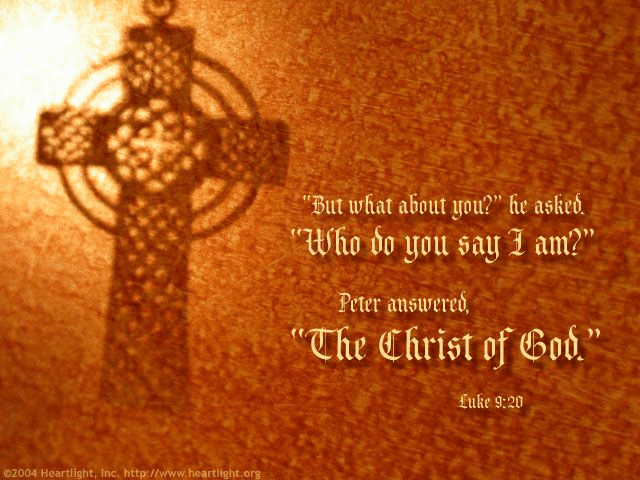
“Who do the crowds say I am?”

“But who do you say that I am?”

Luke 9:18, 20 (context, vv. 18-20)

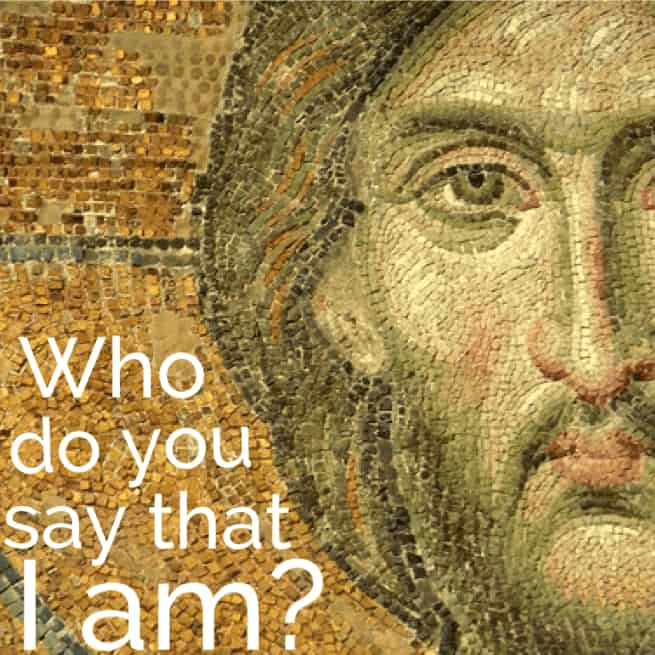
The question is significant; and it’s never been fully answered. Perhaps each of us must be asked this exact same thing. And perhaps it’s the crucial question that every human being who has ever drawn breath must ask themselves. Who is Jesus? Who is He really?

The crowds had witnessed Jesus feed them with a little boy’s lunch. They saw miracles and heard teaching, and yet maybe they were a bit confused. They could only put Jesus in the context of what they knew was “allowable” by the Pharisees. He definitely was some kind of prophet. Jesus was being evaluated by a very curious crowd.

Jesus isn’t distressed by this, He’s not full of self-doubt or second thoughts. He’s not looking around for our support–or accolades, palms or laurels. He knows exactly who He is. He is the only Son of God, the second person of the Trinity. He is fully and completely God; and He is now wearing a robe and walking around in sandals.

There exists a “crowd faith,” something more or less aware that God cares, and miracles do happen in this life. This is all well and good. But it seems there is a “personal faith,” which Peter now announces out loud. “You’re the Messiah, come from God.”

What Peter declares in front of everyone changes everything.

We must always draw our own conclusions, of course. We must look at Him, and decide for ourselves what He claims to be. There is no question it’s scary, and it’s hard. But you, and you alone, must decide. Crowd faith is almost always good, I suppose; but Peter’s bold declaration is what He really is waiting for. Are you convinced yet?

Water, Like Concrete, #43

27 “But immediately Jesus spoke to them, saying, 

“Take heart; it is I. Do not be afraid.”

28 And Peter answered him, “Lord, if it is you, command me to come to you on the water.” 29 He said, “Come.” So Peter got out of the boat and walked on the water and came to Jesus.”

Matthew 14:27-29, (context, vv. 22-33) 

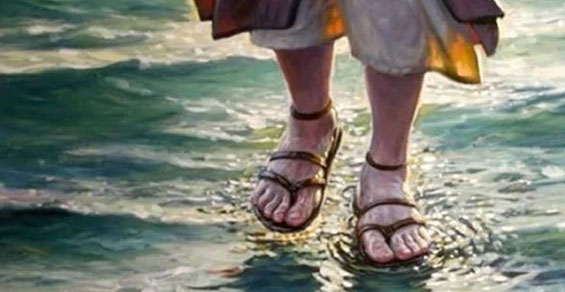
Jesus is full of surprises! You can never guess the things He will do next. He is Lord after all. To walk on water is totally impossible. But Jesus does it. He walks on it as if it were a concrete sidewalk. He totally scares His disciples sitting in the boat. When they see Him they freak out. They couldn’t believe their eyes.

Jesus wants to reveal to His disciples His true nature. They had just seen Him multiply fish and loaves, He fed five thousand plus just a few hours ago. Wasn’t that a miracle enough? It seems that Jesus doesn’t think so. We now see Him strolling on the water like it was solid ground.

For some inexplicable reason, Peter wants to insert himself into Jesus’ miracle. Oddly, he has decided he’ll join Jesus, and leave behind the security of the boat–for the insecurity of the impossible! He truly believes that Jesus can hold him up somehow. Perhaps this alone is the most amazing part of this passage. Can a man duplicate the walk of Jesus? Can we walk like Him?

Peter really wants to leave the security of the boat, for the insecurity of the impossible.

It seems to me that we’re constantly doing the “Peter thing.” It’s true our walk of faith really is intensely supernatural, and yet we somehow forget this. Face it, we will never generate the “fruits of the Holy Spirit” on our own. Our most sincere effort simply will never turn water into something solid. We will never walk the disciple’s path without a faith in the Master who calls us to come to Him.

I think Jesus wants us to join Him. Our faith in Him is the key. We believe that we can walk with Him, we believe we will see the impossible. Without question it’s Jesus’ power that holds us up. Our faith in Him is the ignition point in all of this. Our mustard seed faith, combined with Jesus’ power. becomes the true walk of the disciple.

We must bravely launch ourselves into the purposes of God. To merely sit in the boat is hardly faith. When Peter steps over the gunwales, he steps into the world of the amazing. The water holds him, and his trust in Jesus solidifies like the water he walks on. He is now doing the impossible. He is now becoming very much like Jesus.

Our walk seems terribly weak at times, we can easily list our sin and weaknesses, our spiritual ugliness. We’re not quite convinced that the blood of Jesus covers all our sin–and we can’t step out of the boat. I think it’s Peter’s faith in Jesus’ power that holds him up. When his faith falters, he does the “rock thing,” There is something about his circumstances–the wind, and the waves that begin to frighten him. (But I must believe Jesus was pleased.)

Just let him sink, and teach the 11 who sit in the boat about the perils of unbelief? Nope.

Fear trumps faith. Adversity always frightens. We sink when our flawed faith can no longer hold us up. The amazing thing though, Jesus doesn’t change His mind or heart, He is still in the business of doing miracles. He calls His disciples to believe in Him–to have faith in His power. To really understand, to step out in faith, and to see miracles happen.

“Christ will always accept the faith the puts its trust in Him.”

-Andrew Murray
   

Peter’s New Job, Entry #16

“And Jesus said to Simon,”

“Do not be afraid; from now on you will be catching men.”

 “And when they had brought their boats to land, they left everything and followed him.”

Luke 5:10-11, (context vv. 4-11)

They were business men, sort of. These fisherman scraped out a living catching fish at night (with lanterns of course) and selling their catch to the merchants of Galilee by day. They worked very hard, fishing and always it seems, having to mend their nets. Plenty of back-breaking work and not much sleep.

Simon Peter seems to be their “foreman.” They probably had a collection of 2-3 boats that worked together and they ‘pooled’ their efforts to work the Sea of Galilee and go where the fishing would be best. They wanted to make money. That was their motivation.

But along comes Jesus, and their lives are about to be dramatically “turned-upside-down.”

Much of this account of Jesus’ calling these fishermen to become His disciples mystifies me. (I really challenge you to read the full account in Luke 5, and make your own judgments. The account is pretty straight forward and yet their is plenty of room for interpretation.)

Simon Peter is about to be schooled in the very first lesson of discipleship, and he doesn’t yet realize it.

Jesus commands them to throw out their nets again. But it’s daytime, and you don’t catch fish then, and besides they’ve already had a long hard night. They have already worked very hard.

This ‘crazy’ rabbi insists they throw out their nets. If they obey Him in this, they’ll catch a catch. Peter is a bit hesitant. They had fished all night. Zero. Zilch. Somehow I think Jesus had designed it that way.

At Jesus’ word the net is thrown out. And they catch such a catch that they filled up two boats, up to the brim. So full as a matter of fact, that both boats were on the verge of sinking. Peter was astonished. They had never ever seen anything like it!

“But when Simon Peter saw it, he fell down at Jesus’ knees, saying, “Depart from me, for I am a sinful man, O Lord.” 

This is Peter’s first step. He saw it, he broke down, and he fell at his Lord’s feet. He was completely undone. Kneeling on the fish, he saw who he was, a sinner extraordinaire. Peter realized then that he was a man who didn’t deserve forgiveness. He wanted Jesus to leave him alone.

Perhaps this is the first lesson we must take to be His witness to a watching world. If we want to reach those who are terribly lost, we must ‘discover’ our own brokenness.

Peter would reflect on his own weaknesses and ‘pen’ a letter to the Church: “Humble yourselves, therefore, under the mighty hand of God so that at the proper time he may exalt you.”

1 Peter 5:6

“We had long known the Lord without realizing that meekness and lowliness of heart should be the distinguishing feature of the disciple.”

-Andrew Murray


The Doves in the Temple, Entry #11

“And he told those who sold the pigeons, 

“Take these things away; do not make my Father’s house a house of trade.” 

John 2:16, (context 13-17)

The temple was meant to be a place where people could seek and find God. It was meant to be a place of seeking, of sacrifice, and a place of worship. It had no other purpose other than linking man to God. It wasn’t architecture, it was ‘reconciliation.’ The temple was God’s plan of making a way for sinners to engage Him.

Along the line somehow it became corrupted. Unscrupulous man had a way figured to make money off of pilgrims. The temple required temple currency, hence the money-changers who made a tidy little profit. The birds, lambs and bulls were suddenly provided to the worshipers as a convenient way to ‘sacrifice.’ (That made it easier if you had the cash to spend.)

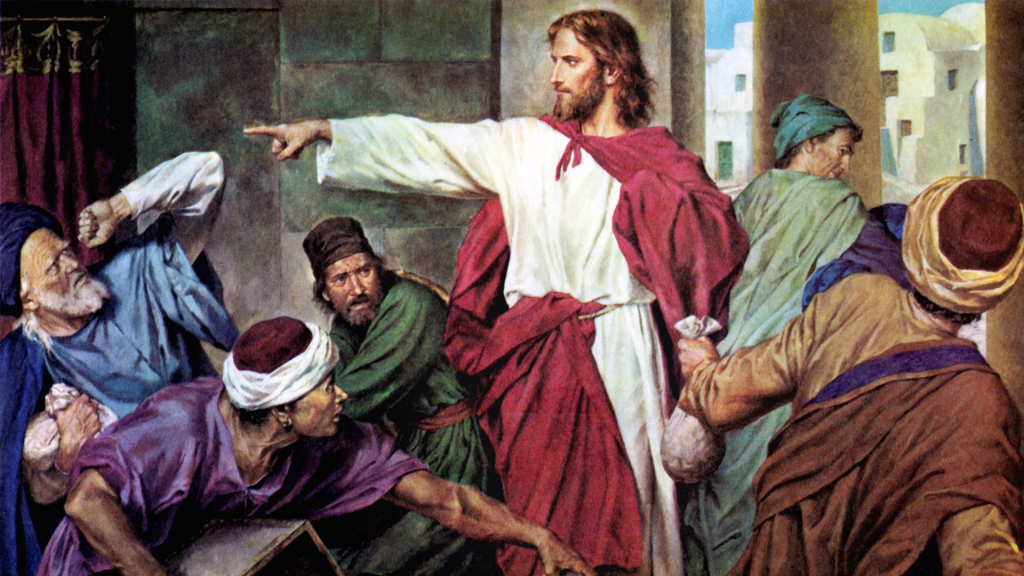
“So he took some rope and made a whip. Then he chased everyone out of the temple, together with their sheep and cattle. He turned over the tables of the moneychangers and scattered their coins.”

John 2:15

Was this wrong? Did Jesus really make a “whip?” Did He really flip over tables like some sort of ‘religious’ brawl from some old western movie? I have to believe He did do this. Chapter 2:17 explains things like this:

“The disciples then remembered that the Scriptures say, “My love for your house burns in me like a fire.”

Jesus loved God’s house, at least for what it was designed for at the beginning. (Some translations use the word, “zeal.”) God’s heart is for fellowship with man. He desperately wants to engage us, to bring us directly into the “holy place of the Holies.”

He wants us there for the companionship. He seeks “friends.”

The doves? Jesus never hurt them. His anger wasn’t directed at them, but rather at the humans who made the birds available to be sacrificed. The Lord didn’t focus His displeasure at those fine feathered ones in the cage, rather He commanded that they be removed from the temple. No whip was used here, only understanding of the need for a kinder approach. (They’re just little birds after all.)

He really wants to fellowship with you. He will do whatever it takes to remove things that should’ve never been there in the first place. He ‘discerns’ the issues, and is very gentle, not an ounce more than is necessary will be applied to your life. He is supremely wise and astonishingly kind.

“Nothing is so strong as gentleness, nothing so gentle as real strength.”

-Francis de Sales


Catching Men, Entry #9

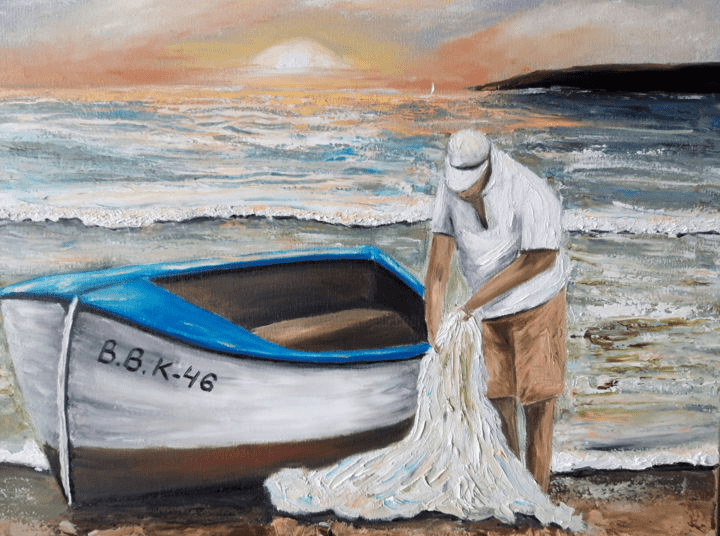
“The Morning of the Fisherman,” Valentina Kostadinva, oil

“And so also were James and John, sons of Zebedee, who were partners with Simon. And Jesus said to Simon,

“Do not be afraid; from now on you will be catching men.”

Luke 5:10

Fear is an ugly thing, it turns men into timid cowards who cannot really trust God. Simon Peter is promised courage. Throughout his life this will be a constant battle for him. It seems like Simon Peter will always struggle with what people will think about him. He is ‘crippled’ and he needs Jesus to intervene. And He does.

I remember Jody and I were sent out by a pastor to do “door-to-door” evangelism. I was terrified. We knocked on a door and then I sort of freaked out, I left her on the porch and hid behind a tree. Witnessing scared me. She shared Jesus while I ran away. How ‘Peter-like’ I am.

“Catching men” is a reference to Peter’s occupation as a fisherman. Jesus speaks so Peter will understand. He expresses evangelism in a way that describes the work of the Kingdom. Fishing describes the main task of the believer. All too often we’re ‘fixed’ on self-improvement, and our vision becomes blurred. Evangelism is to be our work.

“Evangelism is not a professional job for a few trained men, but is instead the unrelenting responsibility of every person who belongs to the company of Jesus.”

-Elton Trueblood