“Centurion” Faith, #25

Jesus said to him, “I come and heal him.”

Matthew 8:7 (context, vv. 5-13)

See the remarkable faith of a Roman centurion. Can we really fathom the deep depth of such belief? He comes to Jesus with a desire for the healing of a servant. He was doing something that a Gentile would never stoop to do. He sought the healing from a homeless itinerant teacher who happened to be a Jew.

This Roman soldier was an enemy. They occupied the land of Israel. If Jesus decided to withhold a healing (to make a point) this was the time! I’m guessing that His refusal would be a good lesson to the disciples, and the watching crowds.

Although the numbers under the command of the centurion varied, he commonly oversaw up to 6,000 men. In battle, they took position in the very front, they were expected to be the first over a wall or through a breach. The centurion was responsible for every aspect of his men. Every centurion of Rome was expected to display ultimate courage on the battlefield.

Typically it took 15-20 hard years to become a centurion. Service was very difficult, living conditions were rough at best. The centurion was not married, he had no family. To be a centurion’s servant you would be responsible for every aspect of his master’s needs. But most of all, the servants became the centurion’s only family. They stayed with him for the duration of his service.

I suppose this explains much. The servant was paralyzed. The text in Matthew says that he was suffering terribly. No doubt the centurion sought out doctors and treatments, but apparently this didn’t help. He was at wit’s end and really didn’t know what to do. I suppose being helpless will often turn people to Jesus.

Jesus seems to have developed a reputation. Those in need, the desperate, sought out His healing power. It seems like that He was now becoming famous for His ability to heal diseases. It’s interesting but scripture clearly shows that Jesus really didn’t want to be this famous. He repeatedly told people not to tell anyone about their healing.

We can see the centurion’s respect for rank and authority.

He explains his own authority over his own soldiers. When he commands he is obeyed without question. He recognizes command and leadership. This man fully understands, and he clearly acknowledges the ultimate authority of Jesus Christ.

When Jesus heard this, he was amazed and said to those following him,” 

“Truly I tell you, I have not found anyone in Israel with such great faith.”

Matthew 8:10

Emulating this man’s faith is the true task of every believer. We must continually put ourselves under the authority of Jesus. His lordship is to be supreme. His rule over us should never be questioned. He commands everything, and we must obey without any reservation. This new depth of faith must now become our true calling.

A couple of observations. 1) There exists a “quality” kind of faith in comparison to a weaker faith. There seems to be degrees of faith. 2) Quality faith recognizes the true authority and supreme lordship of Jesus. 3) Quality faith can be seen in very strange places. 4) This quality faith is meant to be sought and imitated. It is meant to be recognized by every disciple.

“Just as a servant knows that he must first obey his master in all things, so the surrender to an implicit and unquestionable obedience must become the essential characteristic of our lives.”

-Andrew Murray   

Show Me the Mercy, Entry #24

“I tell you, something greater than the temple is here. And if you had known what this means, 

‘I desire mercy, and not sacrifice,’

you would not have condemned the guiltless. For the Son of Man is lord of the Sabbath.”

Matthew 12:6-8 (context, vv. 1-8)

Do we honestly want to see mercy? To give it is much harder than making a sacrifice. Mercy often entails forgiving or helping someone, and that’s usually difficult. We do better by making a religious offering, than having to reach out in love and touch someone we really don’t like. To let someone “off-the-hook” grates us.

Mercy is commonly defined “as compassion or forgiveness shown toward someone whom it is within one’s power to punish or harm.”

Wow. Isn’t this hard sometimes? We really do excel when we try to “punish” those who hurt us, we are experts at this. We ‘automatically’ lash out at those who we feel defy or somehow cross us. I find that I can get quite defensive very fast. And usually that thing is very trivial.

Jesus said to him,

“I do not say to you seven times, but seventy times seven.”

(Matthew 18:22.)

On our own, it seems we just can’t be as compassionate or forgiving like Jesus. We vastly prefer religious duties over forgiveness. Jesus told Peter to forgive 70 x 7, whenever a ‘sinning’ brother asks for leniency, we have to give it. If we forgive, then we’ll be forgiven!

But if you do not forgive others their sins, your Father will not forgive your sins.

Matthew 6:15

He wants to see our mercy. That outweighs any spiritual sacrifice we might make. One of Jesus’ own beatitudes hits the nail on the head,

“Blessed are the merciful, for they shall receive mercy.

Matthew 5:7

We can’t evade this. We may try but He will keep bringing us back to it until we can pass this test, and even then we can anticipate “surprise” tests. That typically kicks us out of a false sense of maturity, and our ‘spiritual’ arrival.

We think we’ve got mercy down pat, and yet He wants to take it deeper still. Mercy for us will always be a spiritual action to a physical situation. And He brings these situations to us, to see what we do, and to reveal what is truly in our hearts at the time.

Sacrifice was a critical definition in the Pharisee’s dictionary, and Jesus more or less destroyed that entire religious concept. Sacrificing without real love, can never be part of a believer’s vocabulary. Jesus wants every disciple to show an outrageous mercy to everyone they meet.

The most miserable prison in the world is the prison we make for ourselves when we refuse to show mercy.

-Warren Wiersbe

Leaving the Mat Behind, Entry #23

“When Jesus saw him lying there and knew that he had already been there a long time, he said to him, 

“Do you want to be healed?”

John 5:6 (context, vv. 2-9)

He’d been sick for 38 very long years. On this day he was laying like usual in his spot by the pool of Bethesda. He doesn’t realize it, but he was about to encounter Jesus. His life, as he knows it, is about to be turned upside down.

The question Jesus asks is pointed, and it savagely confronts him–“Do you really want to be healed?” Sometimes the sick, the injured, the handicapped become so aware of their issues that they can’t see any life beyond them. Perhaps Jesus wanted to jolt this man with this very odd question; of course he wants to be healed– doesn’t he?

Jesus clearly knew what was happening.

The Lord knew that this man must make a decision, and healing would only come if he could leave his mat behind. Before we get too hard on him though, we should consider that 38 years is a long, long time to be sick. One thing he had learned over time was that having any kind of hope was a very dangerous thing. In these many years he had worn out lots of mats.

Apparently, an angel would come and stir the waters; the first one who somehow jumped in would be healed. Over time the pool became the gathering place where there laid “a multitude of invalids—blind, lame, and paralyzed” (v. 3.) Someone once said that ‘misery loves company.’ The odds for healing however, were definitely not in their favor.

I’m somewhat curious, not so much with the ‘angel/pool’ thing, but with the Lord passing by a crowd of sick people. Jesus didn’t stop and just wholesale heal them, but instead He makes a bee-line to where this man lay. Why did He do this? Perhaps an encounter with Jesus was far too radical for the crowds; perhaps they weren’t ready. IDK.

The question Jesus asks does seem strange– “Of course he wants to be healed.” And yet the Lord (and this man) had to know for sure. It really isn’t a question of Jesus’ healing power–it is however, an issue with one’s desire to be made whole, and then to leave his mat behind.

A disclaimer though.

People will often talk about having enough faith to be healed, and that’s well and good, but what about having faith to continue to be sick; day after endless day? Will we continue to believe in Him no matter what happens to us? I do wonder about this sometimes.

“How sweet the name of Jesus sounds, In a believer’s ear! It soothes his sorrows, heals his wounds, And drives away his fear.”

-John Newton


Waiting for Our Bridegroom, Entry #22

“The days will come when the bridegroom is taken away from them, and then they will fast.”

Matthew 9:15 (context vv. 14-17)

I detest fasting, I really do. I blame this spiritual deficiency on the fact I’m quite slender and tall and need all the calories I can get. I don’t think that this passes muster though. But I do it anyway. God forgives me but I suppose I’m missing out on something quite wonderful though. (I hope you’re different.)

Jesus makes an announcement. He intends to leave them behind. The disciples will ‘fast’ instead of partying. They will begin to do this with the understanding that He will return for them.

True fasting will clarify the spiritual.

We begin to understand things that we have missed up to now. When we discipline ourselves like this we begin to see and discern the real and the eternal. Fasting is much like a ‘telegraph line’ to a future glory. We are learning to communicate with the throne room and it teaches us to ‘listen.’

We are being prepared for something quite grand. If we start to see this particular discipline as a way of bringing us clarity, we’ll find it much easier and more rewarding. Fasting is hard for most of us, and maybe we need a refresher course. (Just writing about fasting is easier than doing it, trust me.)

When we start to fast we’ll begin to see reality. We can visualize the return of the true King, who is now setting up our future home. We’ll begin to walk, knowing beyond a shadow of a doubt, that the Bible world is the real world.

“And I saw the holy city, new Jerusalem, coming down out of heaven from God, prepared as a bride adorned for her husband.”

Revelation 21:2


Let’s Follow the Master, Entry # 21

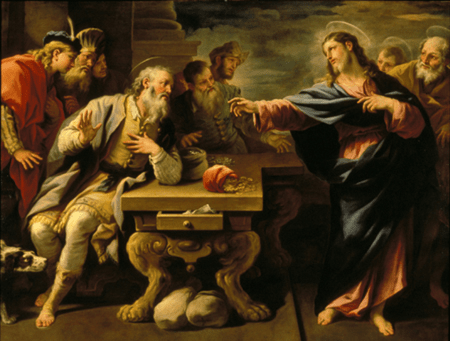
Luca Giordano
Naples; 1634-1705
The Calling of St. Matthew, c. 1685
oil on canvas; 78.5 x 100.5 inches

As Jesus passed on from there, he saw a man called Matthew sitting at the tax booth, and he said to him, 

“Follow me.” 

And he rose and followed him.”

Matthew 9:9

Another “tax collector.” (Why won’t Jesus ever learn?) It really does seem that He has a definite preference for the scum and the outcast. For some very odd reason that’s the sort of person He likes. But really, do we dare question His wisdom in this? Do we think we have a right to pass judgement on Jesus’ choices?

I have to think that Jesus is showing us His deep fondness for the ‘ungodly.’ Tax-collectors, egads!!!! I don’t really understand, until I consider my own ‘wretched’ life. Until Jesus comes to me, calling me, I will continue to set in my dreary booth, taking money from other dreary people.

So what does it really mean to really follow Jesus?

I think of Matthew, a wicked man who has no qualms about betraying his people for money. It’s always been odd to me, that Matthew’s name meant “pure.” (What were his parents thinking? Maybe they grasped his future destiny as an apostle? IDK.) But I am certain that Matthew’s call to follow meant he had to leave something ‘behind.’

We follow Jesus. We’ve accepted the call that we must turn away from our past life. We’ve left behind all the money and just walked away from our table. We understand that we can’t bring it along; we have renounced its claim on us.

Following Him means taking up our “cross,” and everything that it might entail. We really do need to leave it all behind. What a deal, huh?

“And calling the crowd to him with his disciples, he said to them, “If anyone would come after me, let him deny himself and take up his cross and follow me.”

Mark 8:34


Eating With Sinners, # 20

Courtesy of Holy Spirit Catholic Church

“And when the Pharisees saw this, they said to his disciples, “Why does your teacher eat with tax collectors and sinners?” 12 But when he heard it, he said, 

“Those who are well have no need of a physician, but those who are sick. 13 Go and learn what this means: ‘I desire mercy, and not sacrifice.’ For I came not to call the righteous, but sinners.”

Matthew 9:11-13 (context vv. 10-13)

God is not against us because of our sin. He is with us against our sin. We barely believe this. It doesn’t make any sense at all. It’s one of those pure and unadulterated grace ideas and somehow that just might confuse us. It’s counter-intuitive to everything we know; and it’s the tragic way of the religious world.

Jesus is now sitting and eating with sinners!

Can we even grasp how amazing this is? His guests at the table were the awful–the nasty dregs of a nice proper society. Tax collectors who had renounced Judaism for Rome. There were the sinners who were the unacceptable. (Even the whores and the drunks showed up!) Can’t He do any better than this?

It seems to me we’re living in this world ‘blind and dumb’ to what grace really is. Our legal analysis seems right on, but we have to admit we’ll sometimes operate under certain dictates of a ‘comfortable’ propriety instead. “What can we do to merit God’s love and become acceptable?” How can we truly fellowship with a God who is completely holy?

We see (or read) of the Lord who chooses to fellowship with the ungodly rather than the religious. That shakes us to the core, as it should. He loves associating with unacceptable people. That alone should floor us-and maybe scare us too.

The religious Pharisees found ‘grace’ to be unacceptable. They walked and breathed legalism. Keeping the Law was their way to be acceptable in God’s eyes. And they were now angry, or maybe somewhat mystified, by Jesus’ incredible desire to associate with evil people. But they’re misunderstanding the grace and mercy that resides in God’s heart.

Man is born broken. He lives by mending. The grace of God is glue.

–Anne Lamott

Do we seriously understand the kindness and grace of Jesus? Does it ‘saturate’ your mind and heart? Are you completely ‘marinated’ in God’s outrageous love for you, the ugly? Think about this; ‘Could it be that pharisees are still alive and well today?’

Eating with sinners. We read that the Pharisees objected. It strikes me that these guys were trying to attack Jesus by ‘splitting’ the disciples from Him. They wanted them to question His actions. This is Satan’s strategy.”Why does your teacher eat with tax collectors and sinners?” ‘Why’ seems to be the voice of the disbelieving and ‘ungraceful.’

Mercy is always better that any “sacrifice” we can make. Does this bother you? (It should.)

The ‘healthy’ don’t need any help. No doctor’s appointments are necessary. And yet Jesus chooses out the sinners” instead. You need to understand this, to be called like this is the ultimate gift. Grace for the ungraceful is unreal. It seems oddly unnatural. And yet the Father’s grace is now waiting for you. You must believe this.

What are you struggling with?

What ‘distracts you? What are you trying to do to be ‘righteous’ in God’s eyes? Do you really believe that He desperately wants to sit down and have a meal with you, just as you are?

“I do not understand the mystery of grace — only that it meets us where we are and does not leave us where it found us.

-Anne Lamott

Mercy for My Sin, Entry #19

“And behold, some people brought to him a paralytic, lying on a bed. And when Jesus saw their faith, he said to the paralytic,” 

“Take heart, my son; your sins are forgiven.”

Matthew 9:2 (context vv. 1-8)

This man needed a touch. But more importantly he had to know that he was forgiven. It seems to me that this was his real need. Forgiveness must come first and foremost. And Jesus’ spoke directly at him. Jesus completely released him. There were no preconditions. Only the faith of his friends (v. 2.) Interesting.

“Your sins are forgiven.”

The religious leaders are very disturbed. Their analysis of this man’s forgiveness was a frontal attack on Jesus’ right to acquit sin. They said nothing, and the miracle really wasn’t even acknowledged. These leaders were in sharp contrast to those who witnessed this first-hand.

The text says that “the crowds saw it, they were afraid, and they glorified God, who had given such authority to men” (v. 8.)

The religious leaders determined that only God Himself could forgive; to let someone ‘off-the-hook’ like this. They said nothing (perhaps they were feeling ‘out numbered? IDK.)

To forgive sins is God’s exclusive prerogative. No man can release another man from sin. It has the Lord’s exclusive territory. And yet Jesus did precisely that to the chagrin of the ‘legalism’ that was running rampant in the hearts of the religious leaders .

I’m of the opinion that we’re all suffering a certain paralysis of sorts. Each of us have issues that cripple us. We each are sick, and we desperately need Jesus’ touch. “None of us is righteous” (Romans 3:10.) Perhaps Matthew 5:3-4 explains our walk knowing that we all need to be touched.

It seems that we are all dead men walking, separated from God.

The healing of this man was astonishing in itself. To miraculously heal was certainly profound. It doesn’t happen everyday. And yet these scribes, who were thinking about what Jesus said, called it “blasphemy.” They could not see the miracle that freed this man’s great burden.

“The high heaven covereth as well tall mountains as small mole hills, and mercy can cover all. The more desperate thy disease, the greater is the glory of thy physician, who hath perfectly cured thee.”

-Abraham Wright


Be Clean, Entry #18

And Jesus stretched out his hand and touched him, saying, 

“I will; be clean.” 

And immediately his leprosy was cleansed.

Matthew 8:3 (context vv. 1-4)

He lives completely devastated. Leprosy was more than physical, it had spiritual consequences. He probably had been living as an outcast for many years. When he got anywhere close to the healthy they would shout out that he was “unclean.” They were afraid of him. He was the consummate ‘boogeyman.’

Lepers were excluded from any temple services. They could never ‘sacrifice.’ They wore their sin like a heavy coat, and they were destined to wear it for the rest of their sad lives. The Jews regarded them as cursed by God; never ever to be touched by anyone. They were the damned.

Can you even imagine the awful ugliness that life had given him?

To be clean was only a wonderful dream. It evaporated when he woke; it was never, ever realized. His disease ‘stuck’ to him permanently. (He must’ve realized that it was forever and ever.) He was cursed by God to live alone, and die damned.

It throughly amazes me that Jesus reached out and touched him. Most likely he hadn’t known any human contact for many years. I think the Lord knew and understood this man’s biggest need. To be touched was a bonanza, to be healed was ‘heaven.’

What sin has hypnotized you?

What ugliness degrades your spirit? Look to Him (and His mercy) and let Him touch you deep inside. The Law insists that contamination would spread to the person who touched the unclean, but Jesus being ‘clean’ passed on His wholeness.

That’s the kind of God I serve.

“Give up the struggle and the fight; relax in the omnipotence of the Lord Jesus; look up into His lovely face and as you behold Him, He will transform you into His likeness. You do the beholding–He does the transforming. There is no short-cut to holiness.”

–Alan Redpath


Preaching With a Purpose, Entry #17

“But he said to them, 

“I must preach the good news of the kingdom of God to the other towns as well; for I was sent for this purpose.”

Luke 4:43 (context, vv. 42-44)

God directed preaching extends the Kingdom of Heaven. Jesus understands this and embraces a calling from the Father to communicate God’s rule in the heart and souls of people. He publicly acknowledges that this was now His ministry and purpose. This was the reason He came for us. He was sent!

Jesus understands that when the Gospel is combined with the Father’s intentional purpose it develops into a true understanding of what He is looking for in our lives. Perhaps it’s the only thing that can. He obeys and the world is completely changed.

Anointed preaching accomplishes Kingdom purposes.

Understanding the Kingdom takes humility and repentance. The message of Jesus is not a ‘given,’ It requires a solid reaction that will take the listener deeper than he has ever gone before. The gospel message must be understood through a ‘broken’ life. It has zero impact when the heart is hard. We are teflon.

Preaching this “good news” is the only thing that can pierce the hard shell of the human heart. I believe that His purpose requires a commitment on the preacher as well as the listener. It demands obedience. It requires a repentant faith.

Jesus seems to agree.

“Go into all the world and preach the gospel, and if necessary, use words.”

― Francis of Assisi


Peter’s New Job, Entry #16

“And Jesus said to Simon,”

“Do not be afraid; from now on you will be catching men.”

 “And when they had brought their boats to land, they left everything and followed him.”

Luke 5:10-11, (context vv. 4-11)

They were business men, sort of. These fisherman scraped out a living catching fish at night (with lanterns of course) and selling their catch to the merchants of Galilee by day. They worked very hard, fishing and always it seems, having to mend their nets. Plenty of back-breaking work and not much sleep.

Simon Peter seems to be their “foreman.” They probably had a collection of 2-3 boats that worked together and they ‘pooled’ their efforts to work the Sea of Galilee and go where the fishing would be best. They wanted to make money. That was their motivation.

But along comes Jesus, and their lives are about to be dramatically “turned-upside-down.”

Much of this account of Jesus’ calling these fishermen to become His disciples mystifies me. (I really challenge you to read the full account in Luke 5, and make your own judgments. The account is pretty straight forward and yet their is plenty of room for interpretation.)

Simon Peter is about to be schooled in the very first lesson of discipleship, and he doesn’t yet realize it.

Jesus commands them to throw out their nets again. But it’s daytime, and you don’t catch fish then, and besides they’ve already had a long hard night. They have already worked very hard.

This ‘crazy’ rabbi insists they throw out their nets. If they obey Him in this, they’ll catch a catch. Peter is a bit hesitant. They had fished all night. Zero. Zilch. Somehow I think Jesus had designed it that way.

At Jesus’ word the net is thrown out. And they catch such a catch that they filled up two boats, up to the brim. So full as a matter of fact, that both boats were on the verge of sinking. Peter was astonished. They had never ever seen anything like it!

“But when Simon Peter saw it, he fell down at Jesus’ knees, saying, “Depart from me, for I am a sinful man, O Lord.” 

This is Peter’s first step. He saw it, he broke down, and he fell at his Lord’s feet. He was completely undone. Kneeling on the fish, he saw who he was, a sinner extraordinaire. Peter realized then that he was a man who didn’t deserve forgiveness. He wanted Jesus to leave him alone.

Perhaps this is the first lesson we must take to be His witness to a watching world. If we want to reach those who are terribly lost, we must ‘discover’ our own brokenness.

Peter would reflect on his own weaknesses and ‘pen’ a letter to the Church: “Humble yourselves, therefore, under the mighty hand of God so that at the proper time he may exalt you.”

1 Peter 5:6

“We had long known the Lord without realizing that meekness and lowliness of heart should be the distinguishing feature of the disciple.”

-Andrew Murray