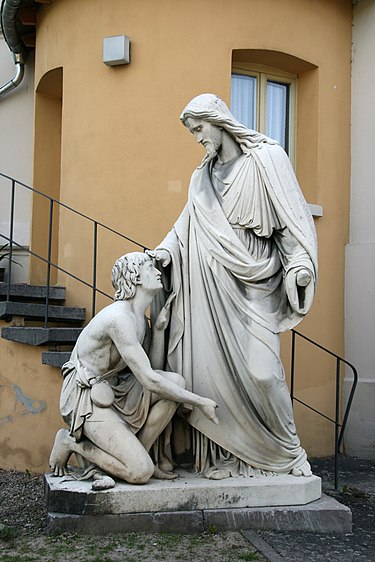
To Seek and to Save, #87

9 “And Jesus said to him, “Today salvation has come to this house, since he also is a son of Abraham. 10 For the Son of Man came to seek and to save the lost.””

Luke 19:9-10 (context, vv. 1-10)

The Jewish people regarded salvation simply as being a child of Abraham. Faith was not necessary, but being saved was simply genealogical. It was the exclusive privilege of every Jewish man and woman. It was the sole position of anyone who was descended from Abraham.

There were exceptions however. If an Israelite lived outside of the Law, they forfeited their salvation. If they cooperated with the Gentiles, or if they committed some heinous crime, they couldn’t be a true Israelite. You were saved, just because you had descended from Abraham.

Zacchaeus couldn’t be saved. He had essentially had renounced his salvation when he cooperated with the Romans as a tax-collector. He had made the choice of a living his life outside of what was acceptable to the religious norms. In short he chose to be damned. He had decided to walk the highway to hell, but that was his decision.

When Jesus called up the tree to Zacchaeus, and invited himself to dinner, Jesus was committing a forbidden act. You must understand that Zacchaeus was unclean, a sinner, and any contact with was regarded as a grossly evil action. In short, Jesus had allied himself with an unclean man. Thus Jesus must be unclean as well.

The “righteous” Jew would never ever have anything to do with Zacchaeus. That is why they had such an issue with Jesus’ decision to eat with him. And that’s why Zacchaeus was thrilled to have such an eminent teacher as his guest.

Jesus was seeking to save the lost.

Zacchaeus invited all of his “evil” friends to come and come to join in the feast. It’s funny, when it came to “evangelism,” he did all the work!

Zacchaeus would prove himself as a “child of Abraham” by his amazing repentance. The presence of Jesus in his home sparked life in his heart. Zachaeus’ repentance was remarkable and truly spontaneous. And probably more astonishing was Jesus declaring that Zacchaeus was now a true child of Abraham.

When we finally decide we can mingle with the lost, just like Jesus did, we can expect to see miraculous things. We won’t contaminate ourselves–it doesn’t work that way. When we reach out, we can count on the “Jesus” who now lives inside of us to touch the outcast. He wants to, and all he needs is for us to find the lost, and be with them.

I must implore you to “seek and save” those who are outside the norm. Ask Jesus to lead you to them–and quit worrying about what other Christians might say and think.

“The church is not a select circle of the immaculate, but a home where the outcast may come in. It is not a palace with gate attendants and challenging sentinels along the entrance-ways holding off at arm’s-length the stranger, but rather a hospital where the broken-hearted may be healed, and where all the weary and troubled may find rest and take counsel together.”

   James H. Aughey

Being Short of Stature, #86

“When Jesus reached the spot, he looked up and said to him, “Zacchaeus, come down immediately. I must stay at your house today.” So he came down at once and welcomed him gladly.”

Luke 19:5-6, (context, vv. 1-9)

I see no problem with assigning this story to a Sunday school lesson. It’s imaginative, witty and seriously funny. Kids enjoy the story, especially when the teacher decides to use flannelgraphs. If the teacher is any good at all it can verge on the hilarious. I must admit I enjoy it far more than Leviticus or Numbers.

Just moments before, Jesus–who was travelling the road from Jericho to Jerusalem, had just healed a blind man (Luke 18:35-43), who was wildly enthusiastic about receiving his sight–a crowd had stopped to watch and wonder. The road was a busy one to begin with, so the clog of people was definitely unusual.

Then there was Zacchaeus, “a head tax man and quite rich. He wanted desperately to see Jesus, but the crowd was in his way—he was a short man and couldn’t see over the crowd. So he ran on ahead and climbed up in a sycamore tree so he could see Jesus when he came by.” (Luke 19:2-4, Message).

There something funny here. First–he’s so short that he looks for a way to see Jesus. That tells me that he’s a true seeker, and he’s resourceful. Second–he climbs the tree in a robe, which is a bit challenging I suppose. It does seem he’s lacking in the dignity department. But he really doesn’t care what others think of him.

For years I’ve thought about this story. I’ve come to see some things that have blessed me, and I hope they will somehow help you to climb the tree of discipleship.

There are many branches on a sycamore tree, which made it easy to climb. I would suggest something to you. I’d like to think of these as the ways we see Jesus. The different disciplines are attached to a singular trunk, perhaps that’s obvious.

Perhaps that trunk is our prayer life. It seems that each of the list below will have that in common. In all of these branches that make-up our discipleship, prayer is truly our definite beginning point. Below are the branches we can climb out on, but remember, they’re all attached to prayer:

  • Meditation
  • Fasting
  • Fellowship
  • Chastity
  • Submission/Obedience
  • Evangelism
  • Solitude
  • Self-Examination
  • Silence

Let’s be very clear. Zacchaeus climbed the tree only to see Jesus. These disciplines are not the Christian’s life. Zacc. only climbed to see Jesus; he didn’t get attached, or find a comfortable spot up there. He didn’t build a tree fort. He only used the branches to see Jesus.

Fasting, or prayer or meditation are incredibly useful. But they’re only ways that we can see him. There comes a point where we come down to be with Jesus, and have a feast with our Lord. When he calls our name, it’s time to climb down. (Luke 19:5-6).

“I wish there were more of us who did not mind being laughed at if only what we did helped us to see Jesus.”

(Maclaren’s comments)

Blind and Desperate, #85

Jesus healing blind Bartimaeus, by Johann Heinrich Stöver, 1861

“Jesus stopped and ordered the man to be brought to him. When he came near, Jesus asked him, 41 “What do you want me to do for you?”

“Lord, I want to see,” he replied.”

42 “Jesus said to him, “Receive your sight; your faith has healed you.” 43 Immediately he received his sight and followed Jesus, praising God. When all the people saw it, they also praised God.”

Luke 18:40-43

Tradition tells us that his name is Bartimaeus. This man, led by others, plopped on a mat by a curb, that’s where he will hold out a basket to collect coins. Hopefully, he would do well, and if not–well there will always be tomorrow–another black and meaningless day. Is this is as good as it’ll ever get?

The crowd around him starts to get more and more excited, and this man, who is very much attuned to the noise of the things around him, tries to pick out conversations, he wants to understand. He keeps listening, and the voices get louder and louder, and he finally pieces together what’s happening.

He finally hears one of them shout out, “It’s the Messiah! It’s him–he has come!” At that moment he too stands up, and begins to shout himself. But his shouting gets louder, and it turns into screams. Within seconds he’s out-of-control, and wild and insane. He releases years of pent up anger and frustration.

The crowd, who was once preoccupied by Jesus’ interesting entourage, now tries hard to quiet this wild dervish down. But he quite mad by now, completely out-of-control. His deranged screams are those of man pushed totally beyond reason.

The original Greek text describes two different words in the New Testament.

The first word used by the crowd is used as a cry for assistance, and deliverance. It’s basically a “respectable” kind of a shout for help. Loud, but still within reason. Earsplitting maybe, but still aware of itself and yet somewhat respectable.

But the second kind of scream, isn’t the regular ‘run-of-the-mill’ kind, rather it’s the scream of someone extremely disturbed. It is wild, primal–something animalistic, shrieking, unearthly, something that’s very disturbing. It’s the cry when an animal goes berserk and in pain, chews off its leg that’s caught in a steel trap. It’s much more than loud, it’s a scream from someone that’s completely out of control.

Dear friend, this is not a human scream. He’s far, far past that point.

Jesus is completely in control. He’s not disturbed, shocked or offended–he’s not fazed by this awful darkness of this desperate man. He orders that he be brought to him. At that moment, all eyes are glued to Jesus and this blind man. I have to believe a hush fell over everyone, quiet enough for them to hear the conversation.

“What do you want me to do for you?”

Jesus asks that question, and it seems an unreal thing to ask. And yet Jesus speaks it into this man’s wild, raving, out-of-control pain. It was Jesus who calmed the turbulent seas; he is now reaching into this man’s incredible darkness. “What do you want?” It’s a question that must be asked.

“Lord, I want to see,” he replied.”

Jesus calmly announces to the man that his faith has saved him. At that instant Bartimaeus sees. That’s all that was needed.

I really need to ask you this–How far will you go, how loud will you get? How many people will you ignore to reach your Savior and your Healer? How insistent will you become? How outrageous will you get to see Jesus reach in and touch your need?

“Heartache forces us to embrace God out of desperate, urgent need. God is never closer than when your heart is aching.”

Joni Eareckson Tada

Impossibilities, #84

“Jesus looked at them and said, “With man this is impossible, but not with God; all things are possible with God.”

Mark 10:27 (context, vv. 23-31)

We’re pretty much like the twelve, sometimes it’s hard for us to connect the dots, and to see truth and love develop in our hearts. I suppose that this subject of possessions might be divisive–especially for Americans who live far above the world’s standard. I mean no harm, but maybe we can pray about this.

The issue in this passage is a disciple’s wealth. And if you really want to stir up a hornet’s nest, this is a terrific way to start (politics comes in a close second). The verse we’re looking at can be really confusing to us in different ways, and sometimes we’ll miss the point, and maybe at times we’ll even misapply this.

This passage is like the last one we looked at–they’re like puzzle pieces that fit with each other. I really must encourage you to look back at the last post, #83, to understand this one.

I must start out by saying I’m no expert in these matters.

But I’m really afraid for the church in the United States. My family and I worked for three years with several evangelical groups in Mexico–most of the time serving in the migrant camps. We learned Spanish, which was hard (especially for me). And when we crossed the border, we entered a world that was nothing like the life we had in the U.S,

It could get surreal at times.

We learned to live without electricity, or running water. Our water supply was a rusty 55 gallon drum, we had to boil the water to kill the mosquito larva. We fought with tarantulas, poisonous beetles, and an occasional rattlesnake. We managed for almost three years, and it was hard, but we learned an awful lot from other believers who had very little.

Some memories stick out.

Showing the Jesus film at night in the camps, with a white sheet for a screen and an old (and noisy) generator; Lynn and I packed in a little shack with 200 kids, fighting the heat and the flies, her beat-up guitar strumming out children’s songs. Converting our old van into an ambulance; fighting a fire that spread through a group of shacks; seeing my wife with her hands raw from the lye soap–scrubbing our clothes on a concrete washboard.

Perhaps I’m not the right person to write this post.

One of the things that absolutely stunned me though, was the heresy of the “Word of Faith” movement. I always thought it was confined to the U.S., but it’s not. It too spread like wildfire through the shacks of the poorest of the poor. In its extreme form it hurt many brothers and sisters.

There was this belief that having enough faith would set a person free from the grinding poverty. That somehow their positive confessions would somehow translate into material wealth. (It didn’t, and won’t–and I’m sorry). Sometimes people came to Christ to “escape” the destitution and the hopelessness, and I certainly don’t blame them. But it really did become a grief to me.

Some would come to Christ with the idea that he would meet all their material needs.

The 12 were astonished by Jesus’ declaration. (And they often were.) Jesus made it crystal clear that following him through the minefield of a believer’s wealth and service, was going to be really hard–actually he uses the word, “impossible.” But, if God got involved, it became possible.

Sometimes, something quite miraculous really did happen.

And quite often, it seemed like it was a miracle that ranked right up there with healing a leper, or raising the dead! Our Father met us time after time, and we really did know his hand of grace and kindness.

I’m very sorry if I offended anyone out there, that certainly wasn’t my intention.

“The words of Jesus amazed the disciples because they assumed that wealth was always a sign of God’s blessing and favor. They thought that the rich were especially saved.”

David Guzik

Disheartened, #83

“And Jesus, looking at him, loved him, and said to him, “You lack one thing: go, sell all that you have and give to the poor, and you will have treasure in heaven; and come, follow me.” 22 Disheartened by the saying, he went away sorrowful, for he had great possessions.”

Mark 10:21-22, ESV

Let’s be clear–Jesus really did love him, and that explains a whole lot. In verse 17, we see this man running to Jesus, and he kneels right in front of him. I suppose that this man desperately wanted the Lord’s full attention. He had to know–he must understand. He was a driven man with some very deep questions.

To be wealthy was the clear evidence that God really did love you. If you were rich, you must have God’s approval, and if you happened to be richer than rich–he must love you even more than that. That big bank account was the proof that you were set apart, and completely accepted by God. (Not a whole lot has changed, has it?)

All of this must be understood before we can go any further.

The rich young ruler was suddenly jolted by Jesus’ words–he simply had to give away all his money–and then, to start to follow him. I don’t think anyone had ever dared to confront him like this. Jesus spoke so clearly–and so concisely. The things that came out of Jesus’ mouth cut him like a knife, and then, smashed him like a hammer–they wallopped him hard, and quite honestly, nothing had ever hurt so much.

But dear one, remember this; Jesus always uses a rubber hammer.

The passage told us earlier that Jesus, “loved him” (10:21). Jesus lists five of the 10 commandments, but interestingly enough, the ones that Jesus spoke were the ones written on the second tablet–the ones that dealt with how we treat each other.

Did this man really keep them? Perhaps he may have–maybe yes, maybe no. But knowing human nature, and looking through the lens of God’s word, it was clearly impossible. He may have been seriously conscientious, and maybe he really tried his best to live righteously, but scripture is clear, “all have sinned, all have fallen short of the glory of God” (Romans 3:23).

The text tells us that when Jesus spoke to this man, he issued an invitation, but it also doubled as a command, “come, follow me.” I don’t think that following was as simple as it sounds–and it seems it was the one thing that the rich young ruler couldn’t, or wouldn’t do.

He’d certainly made a valiant effort to be holy, no one could dispute that. But he had to know he was really saved, and he was desperately afraid he wasn’t. This man had a questions that weighed him down–but he must know for sure–he was tied by a golden rope to a heavy treasure chest, and that was something he couldn’t leave behind.

“The fellow that has no money is poor. The fellow that has nothing but money is poorer still.”

Billy Sunday

This man seems to have been ruled by fear. And that is something wealth will do to people. The richest people seem to be the most afraid, and although I admit that seems strange, and perhaps even a bit judgmental, scripture tells us that having possessions often leads one into mortal danger–it’s just the cheese in the mousetrap, (Psalm 49:5).

He ended up “disheartened.” A simple definition of that word means “having lost determination or confidence; dispirited and afraid.” That pretty much describes this man’s state of mind. Jesus had issued a command, and the rich young ruler couldn’t, or wouldn’t, ever meet the terms of Christian discipleship.

Money can be a useful servant, but it’s really a terrible master. That false god–Mammon is an idol, and a deadly one. And that evil god intends to destroy you, if you can’t release your wealth to God. and to others.

“He also did not choose to love God more than his wealth, even though Jesus specifically promised him treasure in heaven. The man was more interested in the earthly treasure of men than in God’s heavenly treasures. This man was essentially an idolater. Wealth was his god instead of the true God of the Bible. He put money first.”

David Guzak

“Most people fail to realize that money is both a test and a trust from God.”

Rick Warren

What About the Children? #82

 “People were bringing infants to him so that he might touch them, but when the disciples saw it, they rebuked them. Jesus, however, invited them: 

“Let the little children come to me, and don’t stop them, because the kingdom of God belongs to such as these. 17 Truly I tell you, whoever does not receive the kingdom of God like a little child will never enter it.”

Luke 18:15-17

There is conflict here–and we can’t ignore it. The disciples seem to see themselves as the unofficial “protecters” of Jesus. I suppose that the sheer immensity of the crowds, and Jesus’ popularity, forced them to act as go-betweens. They believed that they needed to protect Jesus by only letting certain people, with certain needs, get close to him. I believe that their motives were good and proper.

Jesus’ disciples were getting headaches. His ministry was wildly successful by this time–wherever he went massive crowds followed, if not for the teaching and healings, but at least for the spectacle. In a dull and dreary life, the Lord Jesus was their entertainment (this was before MTV and video games).

Celebs often need protection. The president of the United States has the Secret Service–they surround him, and form a barrier. Perhaps this is what the 12 saw as their duty and calling. Only certain people, those who were properly vetted, could get close enough to really meet him.

The disciples had a plan–but it meant restricting access to him. They would set up their perimeter, and only let certain people access Jesus. In theory it was wisdom, but in practice it was really difficult. But disciples would find a way–and, of course, parents would find ways to get around them.

But I’m digressing here.

The real issue here is how we enter his kingdom. Jesus was crystal clear. Only “children” get in. The simple and the unsophisticated are the only ones who are given kingdom passports. They’re the ONLY ones who can enter in–that means the proud theologian, the all together socialite, and the mature elder will only get “citizenship” if they become children again.

“The gospel is so simple that small children can understand it, and it is so profound that studies by the wisest theologians will never exhaust its riches.”

Charles Hodge

But what does this really mean? It seems to me that it most definitely ties into Nicodemus’ late night talk with Jesus, John 3, and being “born again.” In chapter 3, Jesus sits down with a sophistically religious man, and rocks his sophisticated world–

“Truly I tell you, unless someone is born again, he cannot see the kingdom of God.”

John 3:3 (context, vv. 1-13)

We must stay simple, (K.I.S.S.) It’s the enemy who tries to pull us away from that, and into a knotty complexity, and a fairly elaborate theological correctness. But this dear reader, isn’t the way of Jesus, nor is it the way of true maturity. We can understand Nicodemus’ confusion all too well, when we try to enter God’s kingdom without the humbleness of a child.

“Not only did Jesus welcome these little human beings as members of the kingdom of God; He also extolled them as model citizens of the same, because of their capacity to trust and love.”

-Some unknown guy

I’m His Unworthy Servant, #81

Born to Serve Others

“So you also, when you have done everything you were told to do, should say, ‘We are unworthy servants; we have only done our duty.’”

Luke 17:10, (context, vv. 7-10)

After many years of ministry— this particular passage has become one of my favorites. The path I’ve walked has been challenging, and it seems to me that I haven’t done it very well at all. I’ve been a fool much of the time, and yet, if anything, God has held me firmly in place. I haven’t always been faithful:

“Through many dangers, toils and snares

I have already come

T’was Grace that brought me safe thus far

And Grace will lead me home.”

Amazing Grace, Third Stanza

There should be a humility in doing the work that we begin to learn, and I really hope I’m communicating that to you. I sometimes see it in myself, and more often see it in others. I used to kill rattlesnakes when I lived in Mexico. It demanded a certain cautiousness, and lesson #1 was this–you never, ever take your eyes off of the snake–no matter what. We must approach ourselves that carefully.

The Lord Jesus tells us one of those stories of his. This, IMHO, it’s one of his best. It makes a lot of sense, and it resonates within me. And I must watch myself, lest I forget the idea behind this passage.

We live in a society of equals–having a servant today is frowned upon. (I really could use 2 or 3 myself.) But in Jesus’ time, it was the norm–some people were regarded as property. It was more common than we think, as 30-40% of the general population were slaves. Early Christians condemned this, and regarded all men as equals, and as a result, many slaves became believers.

Jesus uses the concept very well. It seems that after a hard day’s work, a slave still needed to prepare his master’s dinner. No matter how much he toiled out in the fields, he had a duty to serve his master in this way; and it does seem unfair–we live in a land “where all men are created equal.”

But this is how the Kingdom works. Yes, it’s a foreign concept, and we can’t relate–we can only imagine it. Jesus uses it quite adroitly. The servant works for his master; completely, exclusively.

“Pray as though everything depended on God. Work as though everything depended on you.”

St. Augustine

Most of us work the “fields” pretty hard. We get dirty, we toil hard, and we sweat under the hot sun. We dream of a glass of cold lemonade (with ice), and a cool shower when we quit the fields. But that isn’t the way it works. Yes, Jesus gives his laborers rest–but the work continues.

Someone once said, “the work goes on, even when God buries his workers.” Hopefully, the next generation will continue my humble efforts, and his work in his fields will continue. But, in the meantime I must “watch” myself carefully, and do his will out in his fields.

“What have we done for him compared with what he has done for us? Our service put beside Christ’s is like one single grain of dust put in comparison with the mighty orb of the sun.”

C.H. Spurgeon

The Other Nine, #80

Jesus asked, “Were not all ten cleansed? Where are the other nine? 18 Has no one returned to give praise to God except this foreigner?” 19 Then he said to him, “Rise and go; your faith has made you well.”

Luke 17:17-19, (context, vv. 11-19)

He was the unlikely one. Samaritans were at the bottom of the spiritual “food chain.” He was only included in the group because he also was a leper–a person’s religion meant nothing. He was a leper first and foremost, and after all, they do say that “misery loves company.”

The group of ten stood far away, so they had to yell. They “called out in a loud voice, “Jesus, Master, have pity on us!” (verse 13).

The text implies that Jesus never touched them, which is somewhat unusual because Jesus usually did. Their healing was a bit odd as well, as they were healed as they traveled to see the priest. That was one of the many duties the priest had to do, Leviticus 14:2-32.

So it seems that this particular healing wasn’t exactly instantaneous, but something gradual. But still, it required faith, but I have to believe that these guys may have expected something a little more. (But having faith sometimes, isn’t what we expect.)

The ex-leper, a.k.a. the Samaritan, returns and comes back to the One who healed him. The previous verses tell us that he fell at Jesus’ feet. Now tell me–was he “disobeying” the Lord’s command to go to the priest? I’m not so sure. When we consider that he was a Samaritan, and not really part of the Jewish religion or rites, it might make some sense.

He’s not rebuked by Jesus. Instead Jesus turns and in a way, lavishes praise on him. Maybe there is an application here to those we consider to be “outside” of our faith. Sometimes rules get broken by those who we consider on the margins–they seem to be external to our religious sensibilities.

“Your faith has made you well,” is Jesus’ evaluation; he recognizes the essentials that are necessary. Jesus understands the reality of this man’s faith in him–and it’s that faith which has becomes the conduit for his healing.

“Christ will always accept the faith the puts its trust in Him.”

    Andrew Murray

Plain Talk, #79

14 “So then he told them plainly, “Lazarus is dead, 15 and for your sake I am glad I was not there, so that you may believe. But let us go to him.”

John 11:14-15, (context, vv. 1-44)

It’s not easy to speak concisely. Our world is filled with overly careful verbiage, and confusing talk. Often we will complicate things to make them palatable, and comfortable for others. As a ‘writer-wannabe’, I’m aware of bringing confusion when I complicate words, sentences and paragraphs.

Not that being careful and diplomatic is wrong. The book of Proverbs, over and over, makes it clear that our words are powerful things, and they must be carefully watched. What we say, to be astringently honest, communicates what is hidden in our hearts.

Jesus is God’s megaphone in a world that has grown deaf.

The real thing is not what we say, but what we do. Jesus intends to do the impossible. He is going to raise the dead, which has never, ever been done. Jesus intends to simply speak out, simply, and life will come to Lazarus again.

Just as he spoke plainly here to his disciples–he will speak simple words to Lazarus as well. Jesus’ words–very plain and quite simple–will bring life to a body that has laid on a stone slab for four days. The decomposition was already quite advanced. His body, “stinketh.” (John 11:39, KJV).

“When he had said this, Jesus called in a loud voice, “Lazarus, come out!” 44 The dead man came out, his hands and feet wrapped with strips of linen, and a cloth around his face.”

John 11:43-44

Jesus is the Word made flesh. Jesus created the world by words–it is said that he holds the world together by his words. And when he speaks, (or commands), definite things are going to happen.

He’s God’s megaphone in a world that has grown deaf. All that he says is spiritually amplified over the mumbling’s of a confusing darkness. When he stands and speaks to Lazarus, life returns. Jesus is clearly heard in the deep corridors of death, and what he speaks is going to happen.

“And because of his words many more became believers.”

John 4:41, NIV

Behold, the Hen of God, #78

havenlight.com

“So many times I have longed to gather a wayward people, as a hen gathers her chicks under her wings—but you were too stubborn to let me.”

Matthew 23:37, TPT

Scripture tells us that Jesus only wept twice. The first at the tomb of Lazarus, when he cried over the evil and destructive power of death. The second is here–the night before he was crucified, where he stood on the Mount of Olives–and wept over the city of Jerusalem. The disciples saw (and noted) that his tears rolled down his face.

Mother hens do not provide milk for their chicks, they simply aren’t equipped for that. Instead they teach them by example–and occasionally hold food in their beaks until the little ones get the idea that they can scratch on their own. The yolk sack from their eggs they are hatched from will provide food for the first 72 hours–after that, they’re on their own.

Chicks will always return to their mother. She provides them with heat and shelter. You’ll see then snuggling up to mom, especially when the weather gets cold, wet–or for protection. The little chicks instinctively know that she has all that they need. They’ll always stay close to her.

There is no “magic force field” for the believer. We’ll face all the things that the unbeliever does–but he does cover, and lavishly provides the grace and peace that we need. Life can be brutal and nasty, there is no question about that.

“O God, have pity, for I am trusting you! I will hide beneath the shadow of your wings until this storm is past.”

Psalm 57:1

The Lord will always protect his people. He’s intensely aware of us–he shields and provides everything we need. He covers us, keeps us and protects us. We truly belong to him.

Do we really understand this? Do we really grasp the profound implications of his promises?

I have many questions (of course.) Why do we do the things our Father hates? Do we bring him tears by the way we behave? Will we come to him at the first sign of “danger?” The city of Jerusalem was stubborn, and unreceptive–can I also resist him?

“But let all who take refuge in You rejoice; let them shout for joy forever. May You shelter them, and may those who love Your name boast about You.”

Psalm 5:11