Five K Plus, Entry #42

 But Jesus said, 

“They need not go away; you give them something to eat.” 

17 They said to him, “We have only five loaves here and two fish.” 

Matthew 14:16-17, (context, vv. 14-21)

The people are hungry. The disciples are worried. A very large number had come to listen to Jesus speak/heal. Earlier that day (in verse 14,) He responds and heals all that were sick, ministering to everyone out of deep, deep compassion (also found in verse 14.)

The crowds wanted to see some healings, (which was pretty much their ‘entertainment,’ breaking up a fairly dull existence,) And perhaps some of them scoured the streets to find the really hard cases–just to see if Jesus could pull it off. (“Let’s get ‘Joshua,’ he’s blind, and crippled and a leper besides–he’ll be a real challenge!”)

The dusty day was done (v.15.) The surroundings were “desolate,” and the crowds were getting antsy. But the merchants were happy, they’d sellout and make a bundle! And the disciples–well they were concerned about the crowd dispersing. They hoped that Jesus would dismiss everyone before it got too dark. (Apparently, not only did they forget to bring food, but they left their flashlights at home.)

It’s interesting to note that Jesus seems to look for new ways to teach His disciples. (They need to learn the Kingdom.) Jesus wants them to become involved in this particular miracle. They would distribute the food, and perhaps mingle a bit. (No sidelining for you, Thaddeus.)

And could it be this is how He operates with all of His disciples? Could it be our response all these crazy-life thingees we have to deal with are revealing to us–and to everyone–how deep, and wide, and far our discipleship really does go?

Jesus throws out a challenge, but in order to make this happen, the disciples had to shake down a kid, and take away the lunch mom had packed. All this for two fish, and five loaves of bread. Apparently no one else thought to bring bring any food. Perhaps no one expected it to be a long day, and packing a dinner basket around was a hassle. Who knows?

Five loaves, two fishes.

The official count was 5000, plus the women and children. I imagine that the disciples were a little confused. Maybe intimidated too. Perhaps there was an effort among them to discourage Jesus from keeping the crowd hanging around? “Surely Jesus wasn’t serious, He just needed to understand these things.”

The disciples think taking away the boy’s dinner was completely idiotic in the light of the situation. Then maybe Jesus would then understand all this silliness, and make an announcement that the day was done. The crowd was milling around, perhaps ‘catching up’ with friends and distant relatives–the kids were playing tag nicely for a change. And maybe they stuck around to see if Jesus would heal (or teach) again. They certainly didn’t want to miss the show.

The disciples had already seen a ton of miracles. They had heard tremendous teachings. (Those parables were mystifying though.) But everything about Jesus as the real Messiah seemed to click (at times.) And I do think they understood–at least to a degree. And yet Jesus is stretching His disciples even further into this whole idea of discipleship.

I think Jesus wanted them to learn about the two tools they should use:

  • One–for each one to understand God’s amazing love for people.
  • Two–for them to grasp God’s almighty power in every situation they will face..

The disciples must learn to use these. In order to pull off this idea of making disciples throughout the big blue earth–they’ll definitely need lots and lots of compassion, and a really strong confidence in God’s power. After all they merely had to break through every bit of darkness they came across; and carry in the light. Just like Jesus! Easy, right? (“Holy Spirit, we need all the strength you can spare.”)

The twelve really have to become aware, and snatch up these two–they’re not trivial. They seem to be the very steady heartbeat of discipleship. Understanding these two principles causes the deep nature of the Kingdom to enter these hard human hearts. (Some of us need a ‘transplant.’) We have to apply His compassion again, like a bandage on the wounds. We need to wield His power once more, cutting away the lies.

Both dear one–are really, really needed right now.

“God’s work done in God’s way will never lack God’s supplies.”

-Hudson Taylor, Missionary to China for 51 years

Serpents and Doves, Entry #29

“Behold, I am sending you out as sheep in the midst of wolves, so be wise as serpents and innocent as doves. Beware of men, for they will deliver you over to courts and flog you in their synagogues. 

Matthew 10:16-17 (context, vv. 16-24)

We are being sent into a dangerous place. There will be those who hate us, they take us and lead us into courts and they will bring out a whip. The world is not a kind place for believers in Jesus. He warns the disciples of a definite persecution that they face as His disciples. This deep darkness has teeth.

The servant of Jesus will never be “above His master.” Since they called Jesus, “Beelzebul,” they’ll certainly “malign those of His household” (Matthew 10:24-25). We must accept this. At best they will criticize, and at worst they will kill us. We are facing a hostile world who hates our faith.

If a Christian is not having tribulation in the world, there’s something wrong!

And yet Jesus still sends us. We dare not step away from this viciousness. It’s part of the package He gives. We should expect to be treated this way. Jesus warns us honestly of the terrible things we can expect, He does not sugarcoat things. The Lord is well-acquainted with what the world is capable of.

When sheep and wolves meet each other it becomes a slaughter house. And yet there is another side to all of this. We are called to think like a serpent, to have a definite wisdom of all that must be faced, and what we must do to faithfully survive this persecution.

It troubles me somewhat that believers are called to be snakes. Somehow, that doesn’t seem to equate to an innocent faith in Jesus. (Snakes are bad, at least in my thinking). And yet Jesus clearly welds this holy innocence with a wisdom that is very much aware. I suppose that there is a thoughtful balance here, we must find it, and then live it out.

He calls us to vulnerability, most certainly, but mixed into this we need a grasp of being aware; a holy shrewdness (but never a naïvety) that knows how to face the darkness without becoming apostate. We need to use our brains, but be led by our hearts. We are His witnesses, but we must never become His victims.

“It has become a settled principle that nothing which is good and true can be destroyed by persecution, but that the effect ultimately is to establish more firmly, and to spread more widely, that which it was designed to overthrow. It has long since passed into a proverb that “the blood of the martyrs is the seed of the church.”

-Albert Barnes


Doing Jesus’ Work, #28

“And proclaim as you go, saying, ‘The kingdom of heaven is at hand.’ Heal the sick, raise the dead, cleanse lepers, cast out demons.”

Matthew 10:7-8, (context vv. 5-15)

Heal. Raise. Cleanse. Cast out. What a job description for Jesus’ disciples! He truly believes that those who follow Him are ready, and it’s time for them to go to work. I suppose they could keep sitting at Jesus’ feet, just soaking up His teaching, and watching Him do His miracles. But this isn’t what they’re called to do. They’ve sat long enough.

Don’t get me wrong. It’s vital that we absorb His words to us. It’s absolutely critical that we hear His voice and really do find our rest in Him. We must intimately listen to Jesus and be filled with His Spirit. Yet it strikes me that far too many disciples think their life is an inward one; a concentration on personal growth and one’s own spiritual attainment. But I don’t think this is the case.

The disciples must go to work.

Jesus ‘commissions’ them to go out and proclaim the ‘Kingdom come.’ The labors of Jesus must be done by these inadequate (and sinful) men. Heal. Raise. Cleanse. Cast out. It’s time for them to go out and meet the desperate needs of the world. But stepping out can be a scary thing.

The works that these disciples are to do are truly marvelous. They now have an ability and an anointing to do remarkable things. Jesus is comfortable that His disciples are ready, and yet knows that when they return they will have much to learn from Him. It seems however, that we are waiting for a certain amount of “perfection” before we step out.

Most of us, I suppose, are ‘hamstrung’ by our own sin. We see know our inadequacies and deep weaknesses. Most of the time we feel completely unworthy. Seldom do we think we’re ready to spread the Kingdom news to a needy world. Our own sin, we believe, disqualifies us from ministry to others. It seems Satan is very quick to neutralize us, and to annul the “work” of the Father. He accuses us, and we listen.

We’re overwhelmed by what we see within us, and as a result we seldom see the needs around us.

It seems we shelf His work and replace our faith into some sort of personal rehabilitation program. “When we are finally holy enough, we will hit the streets.” Until then, we will try to get enough personal purity to work His miracles. Commendable I suppose, but I don’t think this is what Jesus intends. I’m convinced the work itself is a vital part of our sanctification.

“Have thy tools ready. God will find thee work.”

-Charles Kingsley

Let’s Follow the Master, Entry # 21

Luca Giordano
Naples; 1634-1705
The Calling of St. Matthew, c. 1685
oil on canvas; 78.5 x 100.5 inches

As Jesus passed on from there, he saw a man called Matthew sitting at the tax booth, and he said to him, 

“Follow me.” 

And he rose and followed him.”

Matthew 9:9

Another “tax collector.” (Why won’t Jesus ever learn?) It really does seem that He has a definite preference for the scum and the outcast. For some very odd reason that’s the sort of person He likes. But really, do we dare question His wisdom in this? Do we think we have a right to pass judgement on Jesus’ choices?

I have to think that Jesus is showing us His deep fondness for the ‘ungodly.’ Tax-collectors, egads!!!! I don’t really understand, until I consider my own ‘wretched’ life. Until Jesus comes to me, calling me, I will continue to set in my dreary booth, taking money from other dreary people.

So what does it really mean to really follow Jesus?

I think of Matthew, a wicked man who has no qualms about betraying his people for money. It’s always been odd to me, that Matthew’s name meant “pure.” (What were his parents thinking? Maybe they grasped his future destiny as an apostle? IDK.) But I am certain that Matthew’s call to follow meant he had to leave something ‘behind.’

We follow Jesus. We’ve accepted the call that we must turn away from our past life. We’ve left behind all the money and just walked away from our table. We understand that we can’t bring it along; we have renounced its claim on us.

Following Him means taking up our “cross,” and everything that it might entail. We really do need to leave it all behind. What a deal, huh?

“And calling the crowd to him with his disciples, he said to them, “If anyone would come after me, let him deny himself and take up his cross and follow me.”

Mark 8:34


Eating With Sinners, # 20

Courtesy of Holy Spirit Catholic Church

“And when the Pharisees saw this, they said to his disciples, “Why does your teacher eat with tax collectors and sinners?” 12 But when he heard it, he said, 

“Those who are well have no need of a physician, but those who are sick. 13 Go and learn what this means: ‘I desire mercy, and not sacrifice.’ For I came not to call the righteous, but sinners.”

Matthew 9:11-13 (context vv. 10-13)

God is not against us because of our sin. He is with us against our sin. We barely believe this. It doesn’t make any sense at all. It’s one of those pure and unadulterated grace ideas and somehow that just might confuse us. It’s counter-intuitive to everything we know; and it’s the tragic way of the religious world.

Jesus is now sitting and eating with sinners!

Can we even grasp how amazing this is? His guests at the table were the awful–the nasty dregs of a nice proper society. Tax collectors who had renounced Judaism for Rome. There were the sinners who were the unacceptable. (Even the whores and the drunks showed up!) Can’t He do any better than this?

It seems to me we’re living in this world ‘blind and dumb’ to what grace really is. Our legal analysis seems right on, but we have to admit we’ll sometimes operate under certain dictates of a ‘comfortable’ propriety instead. “What can we do to merit God’s love and become acceptable?” How can we truly fellowship with a God who is completely holy?

We see (or read) of the Lord who chooses to fellowship with the ungodly rather than the religious. That shakes us to the core, as it should. He loves associating with unacceptable people. That alone should floor us-and maybe scare us too.

The religious Pharisees found ‘grace’ to be unacceptable. They walked and breathed legalism. Keeping the Law was their way to be acceptable in God’s eyes. And they were now angry, or maybe somewhat mystified, by Jesus’ incredible desire to associate with evil people. But they’re misunderstanding the grace and mercy that resides in God’s heart.

Man is born broken. He lives by mending. The grace of God is glue.

–Anne Lamott

Do we seriously understand the kindness and grace of Jesus? Does it ‘saturate’ your mind and heart? Are you completely ‘marinated’ in God’s outrageous love for you, the ugly? Think about this; ‘Could it be that pharisees are still alive and well today?’

Eating with sinners. We read that the Pharisees objected. It strikes me that these guys were trying to attack Jesus by ‘splitting’ the disciples from Him. They wanted them to question His actions. This is Satan’s strategy.”Why does your teacher eat with tax collectors and sinners?” ‘Why’ seems to be the voice of the disbelieving and ‘ungraceful.’

Mercy is always better that any “sacrifice” we can make. Does this bother you? (It should.)

The ‘healthy’ don’t need any help. No doctor’s appointments are necessary. And yet Jesus chooses out the sinners” instead. You need to understand this, to be called like this is the ultimate gift. Grace for the ungraceful is unreal. It seems oddly unnatural. And yet the Father’s grace is now waiting for you. You must believe this.

What are you struggling with?

What ‘distracts you? What are you trying to do to be ‘righteous’ in God’s eyes? Do you really believe that He desperately wants to sit down and have a meal with you, just as you are?

“I do not understand the mystery of grace — only that it meets us where we are and does not leave us where it found us.

-Anne Lamott

Peter’s New Job, Entry #16

“And Jesus said to Simon,”

“Do not be afraid; from now on you will be catching men.”

 “And when they had brought their boats to land, they left everything and followed him.”

Luke 5:10-11, (context vv. 4-11)

They were business men, sort of. These fisherman scraped out a living catching fish at night (with lanterns of course) and selling their catch to the merchants of Galilee by day. They worked very hard, fishing and always it seems, having to mend their nets. Plenty of back-breaking work and not much sleep.

Simon Peter seems to be their “foreman.” They probably had a collection of 2-3 boats that worked together and they ‘pooled’ their efforts to work the Sea of Galilee and go where the fishing would be best. They wanted to make money. That was their motivation.

But along comes Jesus, and their lives are about to be dramatically “turned-upside-down.”

Much of this account of Jesus’ calling these fishermen to become His disciples mystifies me. (I really challenge you to read the full account in Luke 5, and make your own judgments. The account is pretty straight forward and yet their is plenty of room for interpretation.)

Simon Peter is about to be schooled in the very first lesson of discipleship, and he doesn’t yet realize it.

Jesus commands them to throw out their nets again. But it’s daytime, and you don’t catch fish then, and besides they’ve already had a long hard night. They have already worked very hard.

This ‘crazy’ rabbi insists they throw out their nets. If they obey Him in this, they’ll catch a catch. Peter is a bit hesitant. They had fished all night. Zero. Zilch. Somehow I think Jesus had designed it that way.

At Jesus’ word the net is thrown out. And they catch such a catch that they filled up two boats, up to the brim. So full as a matter of fact, that both boats were on the verge of sinking. Peter was astonished. They had never ever seen anything like it!

“But when Simon Peter saw it, he fell down at Jesus’ knees, saying, “Depart from me, for I am a sinful man, O Lord.” 

This is Peter’s first step. He saw it, he broke down, and he fell at his Lord’s feet. He was completely undone. Kneeling on the fish, he saw who he was, a sinner extraordinaire. Peter realized then that he was a man who didn’t deserve forgiveness. He wanted Jesus to leave him alone.

Perhaps this is the first lesson we must take to be His witness to a watching world. If we want to reach those who are terribly lost, we must ‘discover’ our own brokenness.

Peter would reflect on his own weaknesses and ‘pen’ a letter to the Church: “Humble yourselves, therefore, under the mighty hand of God so that at the proper time he may exalt you.”

1 Peter 5:6

“We had long known the Lord without realizing that meekness and lowliness of heart should be the distinguishing feature of the disciple.”

-Andrew Murray


The Doves in the Temple, Entry #11

“And he told those who sold the pigeons, 

“Take these things away; do not make my Father’s house a house of trade.” 

John 2:16, (context 13-17)

The temple was meant to be a place where people could seek and find God. It was meant to be a place of seeking, of sacrifice, and a place of worship. It had no other purpose other than linking man to God. It wasn’t architecture, it was ‘reconciliation.’ The temple was God’s plan of making a way for sinners to engage Him.

Along the line somehow it became corrupted. Unscrupulous man had a way figured to make money off of pilgrims. The temple required temple currency, hence the money-changers who made a tidy little profit. The birds, lambs and bulls were suddenly provided to the worshipers as a convenient way to ‘sacrifice.’ (That made it easier if you had the cash to spend.)

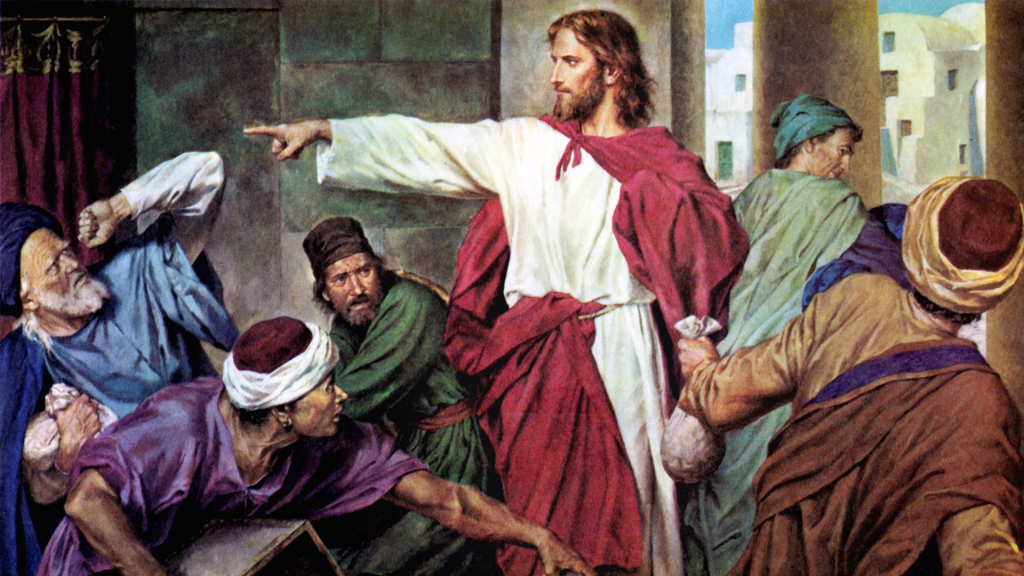
“So he took some rope and made a whip. Then he chased everyone out of the temple, together with their sheep and cattle. He turned over the tables of the moneychangers and scattered their coins.”

John 2:15

Was this wrong? Did Jesus really make a “whip?” Did He really flip over tables like some sort of ‘religious’ brawl from some old western movie? I have to believe He did do this. Chapter 2:17 explains things like this:

“The disciples then remembered that the Scriptures say, “My love for your house burns in me like a fire.”

Jesus loved God’s house, at least for what it was designed for at the beginning. (Some translations use the word, “zeal.”) God’s heart is for fellowship with man. He desperately wants to engage us, to bring us directly into the “holy place of the Holies.”

He wants us there for the companionship. He seeks “friends.”

The doves? Jesus never hurt them. His anger wasn’t directed at them, but rather at the humans who made the birds available to be sacrificed. The Lord didn’t focus His displeasure at those fine feathered ones in the cage, rather He commanded that they be removed from the temple. No whip was used here, only understanding of the need for a kinder approach. (They’re just little birds after all.)

He really wants to fellowship with you. He will do whatever it takes to remove things that should’ve never been there in the first place. He ‘discerns’ the issues, and is very gentle, not an ounce more than is necessary will be applied to your life. He is supremely wise and astonishingly kind.

“Nothing is so strong as gentleness, nothing so gentle as real strength.”

-Francis de Sales


Catching Men, Entry #9

“The Morning of the Fisherman,” Valentina Kostadinva, oil

“And so also were James and John, sons of Zebedee, who were partners with Simon. And Jesus said to Simon,

“Do not be afraid; from now on you will be catching men.”

Luke 5:10

Fear is an ugly thing, it turns men into timid cowards who cannot really trust God. Simon Peter is promised courage. Throughout his life this will be a constant battle for him. It seems like Simon Peter will always struggle with what people will think about him. He is ‘crippled’ and he needs Jesus to intervene. And He does.

I remember Jody and I were sent out by a pastor to do “door-to-door” evangelism. I was terrified. We knocked on a door and then I sort of freaked out, I left her on the porch and hid behind a tree. Witnessing scared me. She shared Jesus while I ran away. How ‘Peter-like’ I am.

“Catching men” is a reference to Peter’s occupation as a fisherman. Jesus speaks so Peter will understand. He expresses evangelism in a way that describes the work of the Kingdom. Fishing describes the main task of the believer. All too often we’re ‘fixed’ on self-improvement, and our vision becomes blurred. Evangelism is to be our work.

“Evangelism is not a professional job for a few trained men, but is instead the unrelenting responsibility of every person who belongs to the company of Jesus.”

-Elton Trueblood