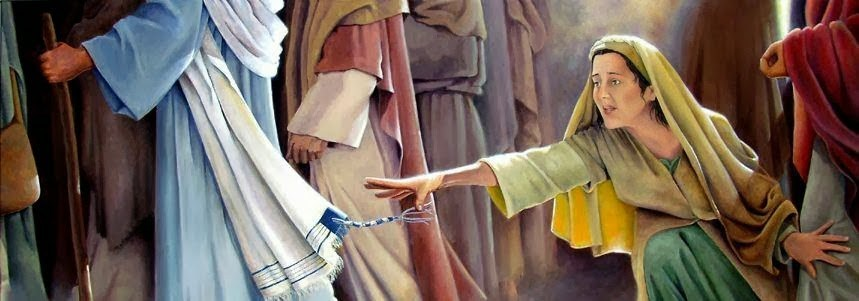
Simply the Hem, Entry #39

“Just then a woman who had been subject to bleeding for twelve years came up behind him and touched the edge of his cloak. 21 She said to herself, “If I only touch his cloak, I will be healed.”

22 “Jesus turned and saw her. 

“Take heart, daughter,” he said, “your faith has healed you.” And the woman was healed at that moment.”

Matthew 9:20-22

I really don’t have a faint idea of her sickness. But I think to bleed constantly must’ve been tiring. Physically, and emotionally–exhausting. She had to ‘plan’ her days carefully to accommodate all of this. Things were never easy for this woman. It truly crippled her life; it would’ve consumed her.

This Jewish woman was suffering with an issue of blood for 12 long years. She had sought help from one physician after another, and spent all her money paying doctor’s bills. But she had not been helped. In fact, her problem got worse. And we need to remember, that she’d be completely ostracized socially–a total write-off, a reject.

Leviticus 15 explains this:

Anything she lies on during her period will be unclean, and anything she sits on will be unclean. 21 Anyone who touches her bed will be unclean; they must wash their clothes and bathe with water, and they will be unclean till evening. 22 Anyone who touches anything she sits on will be unclean; they must wash their clothes and bathe with water, and they will be unclean till evening. 23 Whether it is the bed or anything she was sitting on, when anyone touches it, they will be unclean till evening.

(vv. 19-23)

Fourteen years of being unclean; it seems like a half of a lifetime. She was cut off from any solace of the Temple–that would’ve denied her a sacrifice for her sin. Not only was 14 years a long time, her physical disease had powerful implications spiritually as well. She would have carried around her sin like a heavy coat. She would never know the peace that infuses grace.

Her only hope was Jesus, plain and simple. His reputation as a healer and a teacher had spread like crazy through the country (even King Herod followed His ministry!)

She had one overriding desire. Nothing but a healing would be acceptable.

Perhaps Jesus had already passed by her? After all, He was on His way to a simple resurrection! But in her thinking, she could still touch Him, perhaps she just stretch out and grab the tassel of His robe. And guess what; she was healed, completely. A lightening strike!

We don’t bleed, but we sin all the time.

All of us are like this woman. We don’t bleed, but we sin all the time. Romans states, “we all have sinned, we all have fallen short of the glory of God.” Isaiah graphically describes all of us “to be like and unclean thing.” The Hebrew word for those two words is “menstrual cloth.” All the good we do amounts to something less than zero.

Each of us have definitely sinned. We’re very much ‘defiled’ even at our very best. Sin has completely ruined us. We are foul.

We must reach out, and keep reaching out, grabbing a hold of Jesus. We must seize Him, even if it’s a tiny tassel of His robe. We must snatch it and never let go; until He heals us and restores our lives. We know He can.

“Christ is the Good Physician. There is no disease He cannot heal; no sin He cannot remove; no trouble He cannot help. He is the Balm of Gilead, the Great Physician who has never yet failed to heal all the spiritual maladies of every soul that has come unto Him in faith and prayer.”

-James H. Aughley

Gonzo Faith, Entry #38

He said to them, “Why are you so afraid? Have you still no faith?” 

Mark 4:40 (context vv. 35-41)

Often fear rules the human heart. Quite suddenly the waves seem too high, and the wind starts to really howl. We look at our circumstances and we freak out by what we see. Things look grim, and often we imagine the worse is going to happen. Fear has its sharp hooks in us; and everything is starting to get really crazy.

Jesus often zaps us at times like this. When our boat is pitching violently in open seas, we’ve lost our anchor and the sails are useless, it’s then we start looking around to find where we put our life-jackets. We choose this approach rather than calling out to Him.

It seems that becomes our last option–to beg Him to come and save us. (We can get so stiff-necked sometimes. I think it really is a pride/humility issue.)

Faith is probably the most significant part of this verse. It’s faith in Him that screams out of our storm. When faith shows up, fear leaves. We get one or another. I suppose it’s always going to come to this–will it be fear or faith? We must grasp this lesson, hopefully sooner rather than later. The storm is how the Kingdom of God gets worked into the human heart.

“Faith expects from God what is beyond all expectation.”

-Andrew Murray

“Have you no faith?” That’s Jesus’ interesting question to His believers who are about die. Crazy! But know this, these tempests will never be random or capricious. His love has absolute control over each of them. All He wants is that His disciples will see a truly powerful love, that really does save.

Calling on Him must become our first reaction, and not the fifteenth.

We’ll learn to do this first eventually, even if it means repeating the lesson over and over and over, until faith becomes our first response. Jesus often uses a bad storm to put the Kingdom even deeper inside of people. “Have you no faith” isn’t so much as an indictment of you, as it’s a deep and concerned observation. And only the storm can reveal your faith.

The Easy Yoke, Entry #35

“Come to me, all who labor and are heavy laden, and I will give you rest. Take my yoke upon you, and learn from me, for I am gentle and lowly in heart, and you will find rest for your souls. For my yoke is easy, and my burden is light.”

Matthew 11:28-30, (context, vv. 25-30)

I have thought some on these two verses; I’ve come to the conclusion that it really must be understood as a holy ‘invite.’ A gracious bidding to come to Him, to find much needed rest, and discover meaningful work. This is a gentle summons to blend both rest and work and then live it out in our lives.

Jesus is aware of my weak and faltering steps. I stumble a lot, I weave and trip often. Yet He never criticizes me, He finds no fault, but matches His steps to mine. On His own, Jesus could do the work much faster. But He insists we stay yoked, connected with each other. This amazes me.

The moment we do this we’ll understand that the combination of these two will always balance and correct us. It will pour out of us love, grace and gentleness. The fruits of the Spirit can be seen, and we become salt of the earth.

He invites us to come and be yoked, and to enter into true rest, and true work.

“Thou hast created us for Thyself, and our heart is not quiet until it rests in Thee.”

-St. Augustine

Cold Water, Entry #32

“And whoever gives one of these little ones even a cup of cold water because he is a disciple, truly, I say to you, he will by no means lose his reward.”

Matthew 10:42, (context vv. 40-42)

People are empty, desperate and spiritually dead. I once served Jesus as a “street preacher” in the inner-city of San Francisco. Over and over, I saw the heavy darkness of the city. I was the ‘point-man’ who led a team of believers who were training to do church on the street. Once a dedicated pastor-friend told me he believed that a cult a day was born there. What pain that must bring to God!

People have a tremendous need. They’re waiting, and they are desperately thirsty, and I witnessed it first hand. I saw every weird aberration of truth that floated through the hearts of lost people. At times I began to understand the broken heart of God, and it hurt me inside. I never asked for it. But sometimes He gives it to those who are trying to follow Him.

So, we hand out cold water. We give it to His followers without considering if they’re worthy of it. We freely serve it to Jesus’ “littlest” disciples. Stature in our eyes means zero to God, and yet it somehow means everything to us. Often His grace comes through the small hands of another child of God. That’s the way it’s suppose to work anyway.

“Give, and it will be given to you. Good measure, pressed down, shaken together, running over, will be put into your lap. For with the measure you use it will be measured back to you.”

Luke 6:38, ESV

Rewards will be given. They come to anyone who dares to reach into the life of another. The giver will always be seen by our Lord– everything we do, or don’t do, is lovingly observed by Him. This simple cup of water now has eternal consequences. We can hardly believe it, but it’s true.

“There are many of us that are willing to do great things for the Lord, but few of us are willing to do little things.”

-D.L. Moody


Being Worthy of Jesus, Entry #31

“Whoever loves father or mother more than me is not worthy of me, and whoever loves son or daughter more than me is not worthy of me. 38 And whoever does not take his cross and follow me is not worthy of me.”

Matthew 10:37-38 (context, vv. 34-38)

It’s funny, but we never realize that the challenges of following Jesus are never more than the cost of not following Him. The cross leads to death, most certainly. But let’s never forget that there is a resurrection that does happen after that death. We’ll never live unless we die first.

The problem is that we don’t want to die!

We cling to our lives with the intensity of a drowning man clinging to a ‘life ring.’ We dare not let go. We dare not simply give up and really call out to Jesus. We hang on to the old life, and as a result, will never, ever experience the new. We believe that we will really drown. We are afraid.

Jesus is demanding from us a preeminent love for Him. A love that ‘nullifies’ anything earthly; a love that surpasses anything “good and proper.” He wants it all! There will be no competition, no contesting our love for Him. Jesus is either all, or He will be nothing.

Yes, there is a “cross.”

There will be a awful terrible death to everything we think brings us life. The “disciples” understood crucifixion. A Roman general once did it to the members of a Jewish rebellion. He lined the highways with 2000 crosses, to declare the iron-clad sovereignty of Rome.

Yes, the disciples knew. They remembered the horrifying deaths of so many. They undoubtedly passed by these insurrectionists who hung on these crosses and died. They vividly understood that a cross wasn’t a piece of jewelry, but it meant an awful bloody death of a human being. They knew. The cross was gruesome.

Following Jesus means this kind of death.

It ends everything dear to us. It irrevocably ends life as we know it. Life now consists of having a first love, a renouncing everything else that we hold dear. The relationships we thought were good, are now stumbling blocks to the path to our cross.

Yes, there is always a resurrection. Life will be given back to us. But death comes first, and it is incredibly painful. Sometimes we preach and teach, we embrace a “resurrection” life that excludes a cross. We jump right into a Christianity that has circumvented a terrible death. We are now officially, “cross-less Christians.”

“Unless he obeys, a man cannot believe.”

-Dietrich Bonhoeffer


Serpents and Doves, Entry #29

“Behold, I am sending you out as sheep in the midst of wolves, so be wise as serpents and innocent as doves. Beware of men, for they will deliver you over to courts and flog you in their synagogues. 

Matthew 10:16-17 (context, vv. 16-24)

We are being sent into a dangerous place. There will be those who hate us, they take us and lead us into courts and they will bring out a whip. The world is not a kind place for believers in Jesus. He warns the disciples of a definite persecution that they face as His disciples. This deep darkness has teeth.

The servant of Jesus will never be “above His master.” Since they called Jesus, “Beelzebul,” they’ll certainly “malign those of His household” (Matthew 10:24-25). We must accept this. At best they will criticize, and at worst they will kill us. We are facing a hostile world who hates our faith.

If a Christian is not having tribulation in the world, there’s something wrong!

And yet Jesus still sends us. We dare not step away from this viciousness. It’s part of the package He gives. We should expect to be treated this way. Jesus warns us honestly of the terrible things we can expect, He does not sugarcoat things. The Lord is well-acquainted with what the world is capable of.

When sheep and wolves meet each other it becomes a slaughter house. And yet there is another side to all of this. We are called to think like a serpent, to have a definite wisdom of all that must be faced, and what we must do to faithfully survive this persecution.

It troubles me somewhat that believers are called to be snakes. Somehow, that doesn’t seem to equate to an innocent faith in Jesus. (Snakes are bad, at least in my thinking). And yet Jesus clearly welds this holy innocence with a wisdom that is very much aware. I suppose that there is a thoughtful balance here, we must find it, and then live it out.

He calls us to vulnerability, most certainly, but mixed into this we need a grasp of being aware; a holy shrewdness (but never a naïvety) that knows how to face the darkness without becoming apostate. We need to use our brains, but be led by our hearts. We are His witnesses, but we must never become His victims.

“It has become a settled principle that nothing which is good and true can be destroyed by persecution, but that the effect ultimately is to establish more firmly, and to spread more widely, that which it was designed to overthrow. It has long since passed into a proverb that “the blood of the martyrs is the seed of the church.”

-Albert Barnes


Laborers Wanted, # 27

Then he said to his disciples, 

“The harvest is plentiful, but the laborers are few; therefore pray earnestly to the Lord of the harvest to send out laborers into his harvest.”

Matthew 9:37-38, (context, vv. 35-38)

The issue here is laborers–this is our work, plain and simple. The fact is that there isn’t enough workers. It’s funny, it seems God is constrained by our prayers–earnest prayers for a harvest to be brought into the barns. But there aren’t enough hands. The harvest will be ruined if help doesn’t come soon.

God must have our help if it’s going to get done.

The harvest seems contingent on our prayer life. We decide what is going to happen. Prayer is the work of the authentic believer and our hearts must be for the fields. We are the people who work, who sweat, and get tired. That is our call. That is the true work of discipleship.

Mother Teresa once commented that what we see in front of us is our “Calcutta.” We have got to open our eyes and look, we must see the incredible needs of desperate people that surround us. We must have eternal eyes–God’s eyes. We do our work on behalf of others. I really do believe that it will be ‘sweaty’ prayers that will move the hand of God.

I think ‘prayer’ is the real work in evangelism.

Prayer is our effort that gets combined with the Holy Spirit’s great passion of lost souls. Our “earnest” prayer for the harvest will call workers to the fields. Every generation is responsible for their own part of the field.

For some reason God has chosen to limit Himself by our decision to pray. He patiently waits for us to intercede. Everything seems contingent on us, we can point no finger at God, or accuse Him of ignoring the work that must be done. We must make the decision. Evangelism, and missions, is God’s intense passion. He now shares with us this responsibility.

All of Heaven is standing on its tiptoes, waiting to hear our pleas for the lost.

“Pray as though everything depended on God. Work as though everything depended on you.”

-St. Augustine


He Touched the Coffin, #26

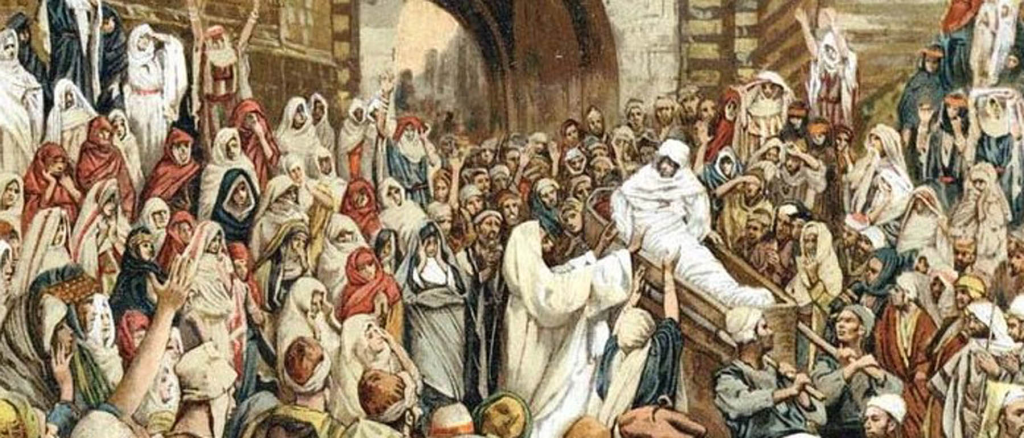
And when the Lord saw her, he had compassion on her and said to her, 

“Do not weep.” 

Then he came up and touched the coffin, and the bearers stood still. And he said, 

“Young man, I say to you, arise.”

Luke 7:13-14 (context, vv. 11-17)

Widows who had no family to support them had it rough. This woman’s husband had died and now her only son was gone. A widow was forced to rely on relatives to meet their needs, but now she had no one. She was all alone and faced a very difficult life. She was vulnerable. And now she saw her only son being carried out of the city to be buried.

The two groups came together. Jesus and His group of disciples were going into Nain and met the funeral procession coming out. Jesus came to the woman as she led the crowd. She was weeping as she walked. I have to believe that His heart met hers.

Jesus response to her was mercy and compassion.

I really think His heart was broken for her. He immediately stopped the funeral march and went straight to her to comfort and console. Apparently no one else took up this. Yet Jesus went to her. That really encourages me.

The body had been washed and rubbed with aromatic spices. His hair had been combed and his fingernails had been clipped. He had been carefully wrapped in linen according to Jewish custom. He had been placed in an open funeral bier, to be carried to the grave site.

Nain was an interesting place. Just a few miles away the prophet Elisha had raised the dead by laying on the corpse repeatedly, 2 Kings 4:32-35. Jesus however, raises the dead with a simple sentence. I think that is interesting. It shows that the power of God that resides in the person of Jesus.

God cares for people.

Obviously Jesus is a full and complete member of the Trinity. He possesses all power and strength. He is the Word and the Creator of everything in the universe. And yet we see that this all powerful one is full of mercy and compassion. He loves widows and orphans. He loves people, and understands their needs. He rolls up His sleeves and enters into their pain and misery.

I suppose the compassion that Jesus has is the most intriguing part of Matthew 7. God loves people intensely. He intervenes in their lives. He meets needs that no one else can understand. He possesses all power and has an infinite amount of love. He can be trusted to meet every need. After all, He can raise the dead with a few simple words.

“His is a loving, tender hand, full of sympathy and compassion.”

-D.L. Moody

“Centurion” Faith, #25

Jesus said to him, “I come and heal him.”

Matthew 8:7 (context, vv. 5-13)

See the remarkable faith of a Roman centurion. Can we really fathom the deep depth of such belief? He comes to Jesus with a desire for the healing of a servant. He was doing something that a Gentile would never stoop to do. He sought the healing from a homeless itinerant teacher who happened to be a Jew.

This Roman soldier was an enemy. They occupied the land of Israel. If Jesus decided to withhold a healing (to make a point) this was the time! I’m guessing that His refusal would be a good lesson to the disciples, and the watching crowds.

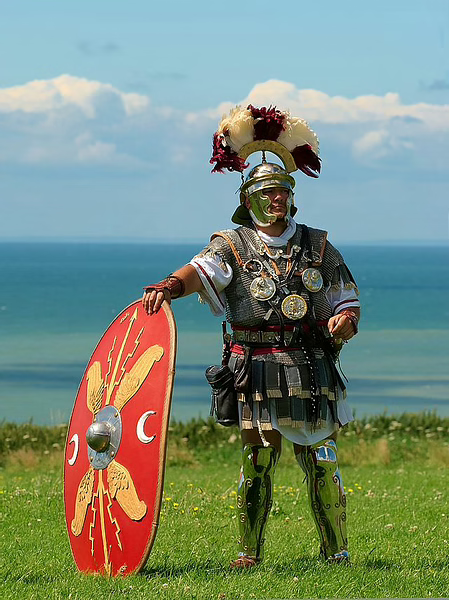
Although the numbers under the command of the centurion varied, he commonly oversaw up to 6,000 men. In battle, they took position in the very front, they were expected to be the first over a wall or through a breach. The centurion was responsible for every aspect of his men. Every centurion of Rome was expected to display ultimate courage on the battlefield.

Typically it took 15-20 hard years to become a centurion. Service was very difficult, living conditions were rough at best. The centurion was not married, he had no family. To be a centurion’s servant you would be responsible for every aspect of his master’s needs. But most of all, the servants became the centurion’s only family. They stayed with him for the duration of his service.

I suppose this explains much. The servant was paralyzed. The text in Matthew says that he was suffering terribly. No doubt the centurion sought out doctors and treatments, but apparently this didn’t help. He was at wit’s end and really didn’t know what to do. I suppose being helpless will often turn people to Jesus.

Jesus seems to have developed a reputation. Those in need, the desperate, sought out His healing power. It seems like that He was now becoming famous for His ability to heal diseases. It’s interesting but scripture clearly shows that Jesus really didn’t want to be this famous. He repeatedly told people not to tell anyone about their healing.

We can see the centurion’s respect for rank and authority.

He explains his own authority over his own soldiers. When he commands he is obeyed without question. He recognizes command and leadership. This man fully understands, and he clearly acknowledges the ultimate authority of Jesus Christ.

When Jesus heard this, he was amazed and said to those following him,” 

“Truly I tell you, I have not found anyone in Israel with such great faith.”

Matthew 8:10

Emulating this man’s faith is the true task of every believer. We must continually put ourselves under the authority of Jesus. His lordship is to be supreme. His rule over us should never be questioned. He commands everything, and we must obey without any reservation. This new depth of faith must now become our true calling.

A couple of observations. 1) There exists a “quality” kind of faith in comparison to a weaker faith. There seems to be degrees of faith. 2) Quality faith recognizes the true authority and supreme lordship of Jesus. 3) Quality faith can be seen in very strange places. 4) This quality faith is meant to be sought and imitated. It is meant to be recognized by every disciple.

“Just as a servant knows that he must first obey his master in all things, so the surrender to an implicit and unquestionable obedience must become the essential characteristic of our lives.”

-Andrew Murray   

Show Me the Mercy, Entry #24

“I tell you, something greater than the temple is here. And if you had known what this means, 

‘I desire mercy, and not sacrifice,’

you would not have condemned the guiltless. For the Son of Man is lord of the Sabbath.”

Matthew 12:6-8 (context, vv. 1-8)

Do we honestly want to see mercy? To give it is much harder than making a sacrifice. Mercy often entails forgiving or helping someone, and that’s usually difficult. We do better by making a religious offering, than having to reach out in love and touch someone we really don’t like. To let someone “off-the-hook” grates us.

Mercy is commonly defined “as compassion or forgiveness shown toward someone whom it is within one’s power to punish or harm.”

Wow. Isn’t this hard sometimes? We really do excel when we try to “punish” those who hurt us, we are experts at this. We ‘automatically’ lash out at those who we feel defy or somehow cross us. I find that I can get quite defensive very fast. And usually that thing is very trivial.

Jesus said to him,

“I do not say to you seven times, but seventy times seven.”

(Matthew 18:22.)

On our own, it seems we just can’t be as compassionate or forgiving like Jesus. We vastly prefer religious duties over forgiveness. Jesus told Peter to forgive 70 x 7, whenever a ‘sinning’ brother asks for leniency, we have to give it. If we forgive, then we’ll be forgiven!

But if you do not forgive others their sins, your Father will not forgive your sins.

Matthew 6:15

He wants to see our mercy. That outweighs any spiritual sacrifice we might make. One of Jesus’ own beatitudes hits the nail on the head,

“Blessed are the merciful, for they shall receive mercy.

Matthew 5:7

We can’t evade this. We may try but He will keep bringing us back to it until we can pass this test, and even then we can anticipate “surprise” tests. That typically kicks us out of a false sense of maturity, and our ‘spiritual’ arrival.

We think we’ve got mercy down pat, and yet He wants to take it deeper still. Mercy for us will always be a spiritual action to a physical situation. And He brings these situations to us, to see what we do, and to reveal what is truly in our hearts at the time.

Sacrifice was a critical definition in the Pharisee’s dictionary, and Jesus more or less destroyed that entire religious concept. Sacrificing without real love, can never be part of a believer’s vocabulary. Jesus wants every disciple to show an outrageous mercy to everyone they meet.

The most miserable prison in the world is the prison we make for ourselves when we refuse to show mercy.

-Warren Wiersbe