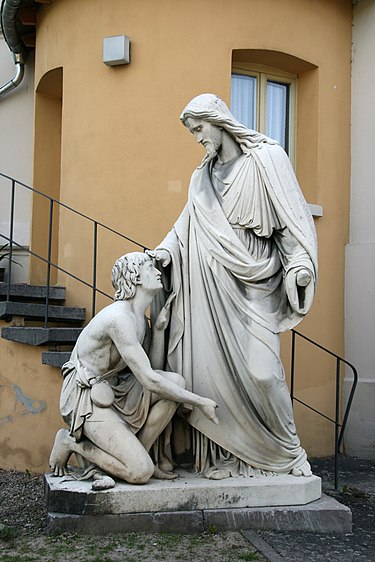
Blind and Desperate, #85

Jesus healing blind Bartimaeus, by Johann Heinrich Stöver, 1861

“Jesus stopped and ordered the man to be brought to him. When he came near, Jesus asked him, 41 “What do you want me to do for you?”

“Lord, I want to see,” he replied.”

42 “Jesus said to him, “Receive your sight; your faith has healed you.” 43 Immediately he received his sight and followed Jesus, praising God. When all the people saw it, they also praised God.”

Luke 18:40-43

Tradition tells us that his name is Bartimaeus. This man, led by others, plopped on a mat by a curb, that’s where he will hold out a basket to collect coins. Hopefully, he would do well, and if not–well there will always be tomorrow–another black and meaningless day. Is this is as good as it’ll ever get?

The crowd around him starts to get more and more excited, and this man, who is very much attuned to the noise of the things around him, tries to pick out conversations, he wants to understand. He keeps listening, and the voices get louder and louder, and he finally pieces together what’s happening.

He finally hears one of them shout out, “It’s the Messiah! It’s him–he has come!” At that moment he too stands up, and begins to shout himself. But his shouting gets louder, and it turns into screams. Within seconds he’s out-of-control, and wild and insane. He releases years of pent up anger and frustration.

The crowd, who was once preoccupied by Jesus’ interesting entourage, now tries hard to quiet this wild dervish down. But he quite mad by now, completely out-of-control. His deranged screams are those of man pushed totally beyond reason.

The original Greek text describes two different words in the New Testament.

The first word used by the crowd is used as a cry for assistance, and deliverance. It’s basically a “respectable” kind of a shout for help. Loud, but still within reason. Earsplitting maybe, but still aware of itself and yet somewhat respectable.

But the second kind of scream, isn’t the regular ‘run-of-the-mill’ kind, rather it’s the scream of someone extremely disturbed. It is wild, primal–something animalistic, shrieking, unearthly, something that’s very disturbing. It’s the cry when an animal goes berserk and in pain, chews off its leg that’s caught in a steel trap. It’s much more than loud, it’s a scream from someone that’s completely out of control.

Dear friend, this is not a human scream. He’s far, far past that point.

Jesus is completely in control. He’s not disturbed, shocked or offended–he’s not fazed by this awful darkness of this desperate man. He orders that he be brought to him. At that moment, all eyes are glued to Jesus and this blind man. I have to believe a hush fell over everyone, quiet enough for them to hear the conversation.

“What do you want me to do for you?”

Jesus asks that question, and it seems an unreal thing to ask. And yet Jesus speaks it into this man’s wild, raving, out-of-control pain. It was Jesus who calmed the turbulent seas; he is now reaching into this man’s incredible darkness. “What do you want?” It’s a question that must be asked.

“Lord, I want to see,” he replied.”

Jesus calmly announces to the man that his faith has saved him. At that instant Bartimaeus sees. That’s all that was needed.

I really need to ask you this–How far will you go, how loud will you get? How many people will you ignore to reach your Savior and your Healer? How insistent will you become? How outrageous will you get to see Jesus reach in and touch your need?

“Heartache forces us to embrace God out of desperate, urgent need. God is never closer than when your heart is aching.”

Joni Eareckson Tada

The Other Nine, #80

Jesus asked, “Were not all ten cleansed? Where are the other nine? 18 Has no one returned to give praise to God except this foreigner?” 19 Then he said to him, “Rise and go; your faith has made you well.”

Luke 17:17-19, (context, vv. 11-19)

He was the unlikely one. Samaritans were at the bottom of the spiritual “food chain.” He was only included in the group because he also was a leper–a person’s religion meant nothing. He was a leper first and foremost, and after all, they do say that “misery loves company.”

The group of ten stood far away, so they had to yell. They “called out in a loud voice, “Jesus, Master, have pity on us!” (verse 13).

The text implies that Jesus never touched them, which is somewhat unusual because Jesus usually did. Their healing was a bit odd as well, as they were healed as they traveled to see the priest. That was one of the many duties the priest had to do, Leviticus 14:2-32.

So it seems that this particular healing wasn’t exactly instantaneous, but something gradual. But still, it required faith, but I have to believe that these guys may have expected something a little more. (But having faith sometimes, isn’t what we expect.)

The ex-leper, a.k.a. the Samaritan, returns and comes back to the One who healed him. The previous verses tell us that he fell at Jesus’ feet. Now tell me–was he “disobeying” the Lord’s command to go to the priest? I’m not so sure. When we consider that he was a Samaritan, and not really part of the Jewish religion or rites, it might make some sense.

He’s not rebuked by Jesus. Instead Jesus turns and in a way, lavishes praise on him. Maybe there is an application here to those we consider to be “outside” of our faith. Sometimes rules get broken by those who we consider on the margins–they seem to be external to our religious sensibilities.

“Your faith has made you well,” is Jesus’ evaluation; he recognizes the essentials that are necessary. Jesus understands the reality of this man’s faith in him–and it’s that faith which has becomes the conduit for his healing.

“Christ will always accept the faith the puts its trust in Him.”

    Andrew Murray

Plain Talk, #79

14 “So then he told them plainly, “Lazarus is dead, 15 and for your sake I am glad I was not there, so that you may believe. But let us go to him.”

John 11:14-15, (context, vv. 1-44)

It’s not easy to speak concisely. Our world is filled with overly careful verbiage, and confusing talk. Often we will complicate things to make them palatable, and comfortable for others. As a ‘writer-wannabe’, I’m aware of bringing confusion when I complicate words, sentences and paragraphs.

Not that being careful and diplomatic is wrong. The book of Proverbs, over and over, makes it clear that our words are powerful things, and they must be carefully watched. What we say, to be astringently honest, communicates what is hidden in our hearts.

Jesus is God’s megaphone in a world that has grown deaf.

The real thing is not what we say, but what we do. Jesus intends to do the impossible. He is going to raise the dead, which has never, ever been done. Jesus intends to simply speak out, simply, and life will come to Lazarus again.

Just as he spoke plainly here to his disciples–he will speak simple words to Lazarus as well. Jesus’ words–very plain and quite simple–will bring life to a body that has laid on a stone slab for four days. The decomposition was already quite advanced. His body, “stinketh.” (John 11:39, KJV).

“When he had said this, Jesus called in a loud voice, “Lazarus, come out!” 44 The dead man came out, his hands and feet wrapped with strips of linen, and a cloth around his face.”

John 11:43-44

Jesus is the Word made flesh. Jesus created the world by words–it is said that he holds the world together by his words. And when he speaks, (or commands), definite things are going to happen.

He’s God’s megaphone in a world that has grown deaf. All that he says is spiritually amplified over the mumbling’s of a confusing darkness. When he stands and speaks to Lazarus, life returns. Jesus is clearly heard in the deep corridors of death, and what he speaks is going to happen.

“And because of his words many more became believers.”

John 4:41, NIV

That Fox, #77

 “Go and tell that fox, ‘Behold, I cast out demons and perform cures today and tomorrow, and the third day I finish my course. “

Luke 13:32, (context, vv. 31-35)

Herod’s “accomplishments” were hardly the stuff of a righteous king. He flagrantly committed several very public sins. He wasn’t a good king, as he flouted his authority over the Jewish people. He was regarded as cunning, but weak. Some of his evil things he did is listed below:

  • Signed a decree to murder all the children under two year old and under.
  • Ruled as a “puppet” leader and was given his authority by the emperor Augustus and the Roman government.
  • He permitted Salome to dance before an audience, which was forbidden by the Jewish Law.
  • Ordered the murder of John the Baptist after John confronted him about his evil relationship with Herodias.
  • Turned Jesus over to Pontius Pilate for judgement and execution.

Needless to say King Herod Antipas didn’t have a good track record, he was regarded as a wicked man, and an evil king. He actively opposed any threats to his rule. It’s interesting that he resisted both John, and later Jesus. He was a definite threat to the kingdom of God.

Typically the Pharisees’ and the Herodians’ were on opposite poles, especially when it came to religious and legal matters. It’s quite interesting that they united to oppose Jesus and his ministry. Herod was very superstitious and paranoid–for instance, he believed that Jesus was actually John the Baptist risen from the dead to continue his ministry.

Jesus called him a fox, which certainly wasn’t an endearing description, and described the rule of Antipas as an evil ruler. Usually kings choose a “lion” as their emblem–it represented strength and authority, Jesus refused to recognize Herod in this way. Herod was an evil man, and ruled like a fox.

“To the Jew the fox was a symbol of three things. First it was regarded as the slyest of animals. Second, it was regarded as the most destructive of animals. Third, it was the symbol of a worthless and insignificant man.”

Barclay’s Commentary on the Bible

Jesus is direct and blunt. He knew the character of Herod’s reign, and didn’t mince words when he referred to him. Jesus recognized the evil and “labeled” it. At the same time he seemed to acknowledge the authority of Herod’s reign.

Jesus was well aware of the “timetable” he had. He understood that he had plenty of work to do, and the time that he had to do it. Jesus was definitely aware of Herod’s resistance to his ministry, but wasn’t the least bit intimidated or cowed into silence or fear.

It’s interesting to note that Jesus understood that his death was imminent.

The ministry of Satan often can be seen in the influence of fallen man–it seems the more authority one has over others, the more the enemy can work. Perhaps that’s the awareness that Jesus has. Rather than altering his ministry, Jesus has confidence that he is on God’s timetable. He refuses to be afraid of this wicked king.

“The fear of man lays a snare, but whoever trusts in the Lord is safe.”

Proverbs 29:25, ESV

The Father, #76

“If I am not doing the works of my Father, then do not believe me; 38 but if I do them, even though you do not believe me, believe the works, that you may know and understand that the Father is in me and I am in the Father.”

John 10:37-38

The Father is in me.” This is one of the clearest passages Jesus uses to explain his ministry. His listeners are doubters. They have decided that he must be executed for blasphemy. In verse 31 we read of their deep, deep anger–“The Jews picked up stones again to stone him.”

It’s crazy how “bad religion” affects people. The Pharisees thought for certain that they were defending God’s honor. They really believed that they were doing exactly what they needed to do. Their religion demanded it.

“I and the Father are one” (v. 30), really disturbed them. Leviticus 24:16 delineated their duty. They must defend God from blasphemers, it was their duty as religious leaders. And Jesus was one of the most egregious offenders that they had ever seen.

This confrontation between them and Jesus was quite intense, and yet Jesus, (instead of backing off) presses the issue. The Father has sent him–Jesus must speak the truth, and there is absolutely no sugarcoating his message. He very clearly states what is real. It has to be believed.

“Believe” is mentioned three times. “Know and understand” are thrown out there for good measure. All explain the necessary components that must be present in a saving faith. And yet, all it did was make them angrier.

I believe that Jesus speaks softly, and with wisdom and compassion–but what is real and true, must be spoken. I really don’t think he “returned” their anger. That would’ve been wrong. And John doesn’t mention it.

“A hot-tempered person stirs up conflict, but one slow to anger calms strife.”

(Prov. 15:8)

“The Father is in me and I am in the Father” explains his ministry, and Jesus can’t, or won’t, compromise his message, or the truth. It is a fact. It’s something you can hang your hat on.

“He is not ‘making himself God’; he is not ‘making himself’ anything, but in word and work he is showing himself to be what he truly is – the Son sent by the Father to bring life and light to mankind.”

Bruce’s Commentary

When they looked at Jesus–they saw the face of God. The Father was living in him–and he resided in the Father. This is the truth, and it blew out their religious circuits. It was something they simply couldn’t accept.

A Crooked Back, #74

Jesus and the Bent Over Woman

“When Jesus saw her, he called her over and said to her, “Woman, you are freed from your disability.” And he laid his hands on her, and immediately she was made straight, and she glorified God.”

Luke 13:12-13, (context, vv. 10-17)

Doctors call it spondylitis ankylopoetica, which produces the fusion of the spinal bones. Sometimes physical issues have spiritual reasons, and many times crippling diseases leave their marks on our hearts. They damage us inside.

Eighteen years is an awful long time.

The response to this astounding miracle was less then ideal. Quite often “religion” responds out of foolishness, and anger at what God wants to do:

“But the ruler of the synagogue, indignant because Jesus had healed on the Sabbath, said to the people, “There are six days in which work ought to be done. Come on those days and be healed, and not on the Sabbath day.” 

(verse 14)

Jesus is angry. He rebukes the hypocrisy of the synagogues leaders. Their livestock get better treatment.

“Of all bad men religious bad men are the worst.”

    C.S. Lewis

“As he said these things, all his adversaries were put to shame, and all the people rejoiced at all the glorious things that were done by him.”

(verse 17)

“Christ is the Good Physician. There is no disease He cannot heal; no sin He cannot remove; no trouble He cannot help. He is the Balm of Gilead, the Great Physician who has never yet failed to heal all the spiritual maladies of every soul that has come unto Him in faith and prayer.”

    James H. Aughey

The Parable of the Good Mormon, #72

“”But a Samaritan, as he journeyed, came to where he was, and when he saw him, he had compassion. He went to him and bound up his wounds, pouring on oil and wine. Then he set him on his own animal and brought him to an inn and took care of him.”

Luke 10:33-34

As I write this, I’m waiting for my plane in Salt Lake City, Utah. I just passed by the Mormon Temple, and that’s always disturbing to me. I guess as a teacher to the body of Christ, to see this much deception concentrated in a place like this is evil. The LDS church has a staggering 16.5 million scattered worldwide. And it’s growing fast.

Back in 1982, two Mormon security guards ushered me off of the temple grounds. But as I was escorted off their temple mount, Christian believers outside the gate gave me tracts to read, and they were praying that I would find the Lord Jesus. Their ministry is hard, but effective,

It’s strange how things work out sometimes.

The road from Jerusalem to Jericho was treacherous, well-known by the people as a haven for robbers and muggers. Think the south-side of Chicago; it was dangerous, and typically when you did have to make the trip, you traveled in a group for safety.

Samaritans were the unholy and the godless. Jews never dreamed of fellowshipping with them–both regarded each other with contempt and scorn. To the Jew, the Samaritan was apostate, and there was a deep distaste for them. And the worse part of it all, they believed that God agreed.

They did respect each others turf though, at least, to a limited degree. At best, they simply didn’t acknowledge the others existence–at worst, they did the jihad thing, and went to outright war with each other. It’s all very complicated. It almost always is.

We must modernize this parable in order to really understand its implications. Let’s make sure we understand a few things though:

  • The Jews and the Samaritan detested each other. Each declared that they were the true nation of Israel.
  • The priest and the Levite both had religious reasons for avoiding situations like this. They quite easily justified themselves, as their interpretation of the Law forbid them from touching a corpse.
  • The Samaritan was doing the will of God, the religious leaders were not. Plain and simple. Jesus’ parable has ruined our conceptions forever of a religion that costs us nothing, and somehow gives us everything.
  • Jesus schools the Jewish leaders with the responsibility of loving each other–no matter what the other person believes is true.

This is a present day parable. It’s lost none of its zing-and we can’t rationalize away any of its authority. It speaks to us today, as powerfully as when Jesus first spoke it. This particular passage has never lost its punch, and we dare not minimize the message. If we do, typically, it’s for carnal reasons, and we do so, it’s at extreme peril to our very souls.

Who is your neighbor? We needn’t look far for understanding–each parable that Jesus spoke was simple, and it could be understood by a child–and yet it carried the full authority, and weight of heaven. If we minimize it, we risk our discipleship. We’ll suddenly cease to be real and authentic.

Is this a Sunday school flannelgraph, or is it a real truth for real believers?

I easily could go on, and on, ad nauseam–pummeling you with insignificant details, but I won’t. The critical message is one of an active, aggressive love for each one who is made in God’s image–for the Catholic and the Mormon, the black and the white, gay and straight, republican or democrat, the homeless and the mansion-dweller–everyone who the Lord God has created. Everyone. (Even illegal aliens–egads. Not them!)

No exceptions can be made. When we serve others–sacrificially, if we have to–we’re really serving the Lord Jesus. And if a Mormon happens along, and if they do what the Samaritan did, they’re doing the will of God. And that disturbs us, and it should.

Then Jesus said to him, “Go and do likewise.”

To Fall, Like Lightning, #71

“The seventy-two returned with joy, saying, “Lord, even the demons are subject to us in your name!” 18 And he said to them, “I saw Satan fall like lightning from heaven. 19 Behold, I have given you authority to tread on serpents and scorpions, and over all the power of the enemy, and nothing shall hurt you.”

Luke 10:17-19, (context vv. 17-20)

All seventy-two returned, not one had been eaten by the wolves. It was a good day, and the disciples are filled with joy. They came back to Jesus with stories to tell him, and with each other. I’ve no doubt that they were truly excited, astonished at what had happened.

The Bible mentions Satan falling four times, and each time it’s a dramatic plunge from a high place. There’s no question in my mind that the disciples, obedient to Jesus, brought to a end Satan’s claim on this planet. The Church had arrived, and the world was now at last a very different place.

The success of the disciples was the downfall of Satan.

Like the cavalry that finally arrives at the last possible moment, these followers of Jesus enter the scene, and the balance of power shifts. Their work has irrevocably disturbed the forces of darkness, and Satan has fallen. Nothing will ever be the same again.

Who can really fathom what really happened at this particular moment? There must’ve been something significant that shook heaven when the disciples obeyed Jesus. Satan was no longer in a position of authority–something was permanently altered in the universe when his Church became faithful.

Jesus transmits his authority to his own, he never will leave them defenseless. Serpents and scorpions, figuratively speaking, are not eradicated. They’re still very much alive and well, but they can no longer harm the believer–they’re rendered harmless and impotent. They can never hurt us again.

“There is no neutral ground in the universe; every square inch, every split second, is claimed by God and counter-claimed by Satan.”

 C.S. Lewis

The King’s Work, #70

 Go your way; behold, I am sending you out as lambs in the midst of wolves. 

Luke 10:3, (context, vv. 1-12)

What happens when lambs are attacked by wolves? My simple guess is that they tear them up. Jesus doesn’t paint a rosy picture of ministry. He’s very clear what the seventy can expect. There shouldn’t be any illusions about the work, it’s not entirely easy, or pleasant. There maybe casualties.

This passage is crucial, not only for Jesus’ disciples, but for the harvest. Seventy-two are selected; they’re given clear instructions on the work ahead–what they must know, and how they need to act. The kingdom of God must be announced, that’s imperative. His rule extends over all, and that dear one, is markedly good news.

They’re given them supreme authority over demons–that’s going to be a necessity for doing his work. There’s an awful lot of darkness out there, and they will engage it head-on. Satan rules temporarily, but God triumphs forever. The disciple’s ministry is to step into this, and extend the kingdom of God. This is now your work.

Doing this means they have to follow his detailed instructions. The disciples are going to move into both the physical and spiritual, and the wolves are coming– the seventy-two have been warned. The world will hate, but the believers still have to preach.

It’s not just a message to preach. There’s more.

Words are not going to be enough. They’re also to have a ministry of physical healing. They’re to touch the sick, and God will heal. But please, don’t misconstrue the work, bloodshed is a real possibility. The wolves are coming in packs.

Jesus is not only training, but he’s extending the Father’s rule by sending them out. He is duplicating himself, and the seventy-two are clearly extensions of him, they’re to be his witnesses, doing his work. Essentially that’s what true ministry is, doing what he would do if he were in your shoes.

The kingdom comes–“thy kingdom come, thy will be done” is the believer’s prayer. We’re committed to this, and we follow our king’s example. The world will be ruled by him, and we have the incredible privilege of being his witnesses–we are his healers, and proclaimers of his gospel.

“The only significance of life consists in helping to establish the kingdom of God.”

Leo Tolstoy

Night is Coming, #69

“We must work the works of him who sent me while it is day; night is coming, when no one can work. As long as I am in the world, I am the light of the world.”

John 9:4-5, (context, vv. 1-12)

Jesus now understands that his earthly ministry is ending. He’s been working a long, hard day, and night is quickly coming. He has been doing what the Father has asked him to do on planet earth–but the work has its limits. The most challenging act of obedience will soon be upon him. Can he endure the shame? Will he really go to the cross–for us?

When he really resides within us, he will glow like a light-stick does in the dark.

It’s starting to get dark, the night is creeping in, and it’s getting to the point where one can’t see to do his work. It seems there are certain limits, one does what he can, as long as he can. Jesus understands this–but there are certain restrictions that must be considered. He will only do what the Father has laid out for him. Nothing more, and nothing less.

Jesus says he is “the light of the world, and I believe him. Oh yes, the darkness is still there–sin, selfishness and pride continue their ugly work. But there’s someone who illuminates everyone around him. When he’s present, he glows like one of those light-sticks.

Peter and two others once saw Jesus catch on fire up on the mountain top, and that’s what his whole ministry was like. When he arrives we can really see–and when he has worked out his earthly ministry, he has done his job.

The most astonishing thing is that he has made believers light, a city on a hill which can’t be hidden, (Matthew 5:14). He does it, not us–never us. It seems that the closer we get to him, the more we’ll shine. And Jesus shows us how to do ministry, in its truest sense.

“If I don’t do the things my Father does, well and good; don’t believe me. But if I am doing them, put aside for a moment what you hear me say about myself and just take the evidence of the actions that are right before your eyes.”

John 10:37, the Message