The Easy Yoke, Entry #35

“Come to me, all who labor and are heavy laden, and I will give you rest. Take my yoke upon you, and learn from me, for I am gentle and lowly in heart, and you will find rest for your souls. For my yoke is easy, and my burden is light.”

Matthew 11:28-30, (context, vv. 25-30)

I have thought some on these two verses; I’ve come to the conclusion that it really must be understood as a holy ‘invite.’ A gracious bidding to come to Him, to find much needed rest, and discover meaningful work. This is a gentle summons to blend both rest and work and then live it out in our lives.

Jesus is aware of my weak and faltering steps. I stumble a lot, I weave and trip often. Yet He never criticizes me, He finds no fault, but matches His steps to mine. On His own, Jesus could do the work much faster. But He insists we stay yoked, connected with each other. This amazes me.

The moment we do this we’ll understand that the combination of these two will always balance and correct us. It will pour out of us love, grace and gentleness. The fruits of the Spirit can be seen, and we become salt of the earth.

He invites us to come and be yoked, and to enter into true rest, and true work.

“Thou hast created us for Thyself, and our heart is not quiet until it rests in Thee.”

-St. Augustine

Mercy for My Sin, Entry #19

“And behold, some people brought to him a paralytic, lying on a bed. And when Jesus saw their faith, he said to the paralytic,” 

“Take heart, my son; your sins are forgiven.”

Matthew 9:2 (context vv. 1-8)

This man needed a touch. But more importantly he had to know that he was forgiven. It seems to me that this was his real need. Forgiveness must come first and foremost. And Jesus’ spoke directly at him. Jesus completely released him. There were no preconditions. Only the faith of his friends (v. 2.) Interesting.

“Your sins are forgiven.”

The religious leaders are very disturbed. Their analysis of this man’s forgiveness was a frontal attack on Jesus’ right to acquit sin. They said nothing, and the miracle really wasn’t even acknowledged. These leaders were in sharp contrast to those who witnessed this first-hand.

The text says that “the crowds saw it, they were afraid, and they glorified God, who had given such authority to men” (v. 8.)

The religious leaders determined that only God Himself could forgive; to let someone ‘off-the-hook’ like this. They said nothing (perhaps they were feeling ‘out numbered? IDK.)

To forgive sins is God’s exclusive prerogative. No man can release another man from sin. It has the Lord’s exclusive territory. And yet Jesus did precisely that to the chagrin of the ‘legalism’ that was running rampant in the hearts of the religious leaders .

I’m of the opinion that we’re all suffering a certain paralysis of sorts. Each of us have issues that cripple us. We each are sick, and we desperately need Jesus’ touch. “None of us is righteous” (Romans 3:10.) Perhaps Matthew 5:3-4 explains our walk knowing that we all need to be touched.

It seems that we are all dead men walking, separated from God.

The healing of this man was astonishing in itself. To miraculously heal was certainly profound. It doesn’t happen everyday. And yet these scribes, who were thinking about what Jesus said, called it “blasphemy.” They could not see the miracle that freed this man’s great burden.

“The high heaven covereth as well tall mountains as small mole hills, and mercy can cover all. The more desperate thy disease, the greater is the glory of thy physician, who hath perfectly cured thee.”

-Abraham Wright


A Father’s Love, Entry #15

“Jesus said to him, 

“Go; your son will live.” 

The man believed the word that Jesus spoke to him and went on his way.”

John 4:50, (context vv. 46-54).

How do you quantify the love a father has for his son? This nobleman had absolutely nowhere to go, his son was going to die and he could do nothing to stop it. He was half out of his mind with grief and desperation. There wasn’t a thing he could do to save his son. He was going to watch his boy die; and he was powerless to do anything to prevent it.

He finds Jesus and begs for a miracle. He isn’t proud or arrogant, all of that was set aside a long time ago. He’s no longer the king’s official, he is now a very earnest father who is begging for Jesus’ touch on his very sick son. It’s funny how that happens, God uses everything to break through our defenses and touch our lives.

The incredible love this man has drives him to Jesus. He cries desperately out to the Lord and we see him shamelessly begging for his son’s life. He remains insistent even after Jesus seems to turn him down. He continues to hang on to a very feeble hope that Jesus will relent. The nobleman has no other options–Jesus is his last chance.

Jesus chooses to reach out and heal the boy, even at a distance.

“God so loved the world that he gave His one and only son…” (John 3:16). How do we fathom this kind of love? Can we even imagine trading your son’s life for a bunch of proud rebels who detest you? We so easily we forget the incredible pain and loss involved in this act of redemption. Our Father decided His Son must die for you and I. We are criminals, and yet He loves us enough to sacrifice Himself to ‘heal’ us.

“What marvelous love the Father has extended to us! Just look at it—we’re called children of God! That’s who we really are.”

1 John 3:1, MSG 

Quenching Our Thirst, Entry #13

“Jesus answered her, 

“If you knew the gift of God, and who it is that is saying to you, ‘Give me a drink,’ you would have asked him, and he would have given you living water.”

John 4:10, (context 4:7-42)

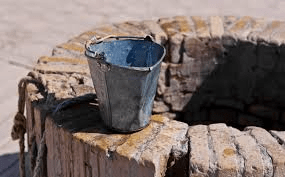
A rusty pail and a very old well. A woman comes to draw out some water from a well dug by Jacob, a patriarch from the pages of Genesis. I believe she was a ‘scarred’ person, she had been married to five men, and she really hadn’t decided to marry #6.

Noon wasn’t the norm, it seems she purposefully waited until the coast was clear. She avoided any contact with others. She would go in the heat of the day. But really deep down, she was ashamed of herself, and grieved over how she had destroyed her life.

She didn’t count on meeting someone at the well, much less a Jewish man who was tired and weary and waiting for a cool drink. She was even more surprised when Jesus spoke to her, that wasn’t proper. A Samaritan woman with a checkered past conversing with a holy Jewish teacher. On heard of.

Jesus waited for her to come, she has an appointment to keep with the second person of the Trinity who was waiting by this well.

“Living water,” how quickly we zoom through this phrase. We seldom stop to consider that what Jesus was offering her was ‘alive.’ It was water infused with life itself. It was water with eternal vitality over sickness, sin or death. When He talks about “living water,” Jesus is referring to Himself.

This particular incident with the woman at the well became the entry point for the ‘good news’ to come to the entire village. Living water would quench the thirst of this backwater Samaritan town.

“People pay attention when they see that God actually changes persons and sets them free. When a new Christian stands up and tells how God has revolutionized his or her life, no one dozes off. When someone is healed or released from a life-controlling bondage, everyone takes notice.”

-Jim Cymbala


Nicodemus Finally Understands, Entry #12

Truly, truly, I say to you, unless one is born again he cannot see the kingdom of God.”

John 3:3 (context vv. 3-15).

He came at night. The questions are burning inside deep inside him and he desperately wants to understand. Nicodemus is a “ruler of the Jews,” (V. 1) and yet it’s not enough. He is unsure and must speak to Jesus, alone and I suppose, “off the record.” Yet he is the rare someone who feels ‘compelled’ to seek God, and will look just about anywhere for an answer.

Nicodemus is a pharisee, “a pure one,” and a teacher of the Jewish people, and yet he is bereft of real answers. He is looking for the missing piece, or maybe something much more then that, but he has to know that it is real and true. There are too many fakes out there after all. He has to know, so he goes to Jesus. Nicodemus needs to understand.

A little baby in a crib, brought to life by a mother’s painful love. It is to this kind of birth that our Lord points to as the very beginning of spiritual life. The real answer to Nicodemus’ questions do not involve ‘rehabilitation’ but rather transformation. Eternal life will not come by personal effort or by ‘working’ for it.

It’ll take nothing less than a new birth to change a person.

Yet somehow Nicodemus is confused by this. He’s trying very hard to “connect the dots” but his mind can’t comprehend the truths Jesus is saying. (A new birth? You’ve got to be kidding.) But Jesus isn’t joking and He isn’t purposefully making it hard for Nicodemus.

New births aren’t possible unless God intervenes. Being freshly birthed is a far cry from being rehabilitated. One is definitely God’s gift of salvation, and the other comes by human sweat and effort. We must understand that we can do nothing that will make us acceptable to God, we can only accept the new birth that He offers us.

It comes not through our effort, but by a repentant faith. We must become spiritually resurrected by believing in His Word, and allowing the Holy Spirit to give us real life. We start completely over it seems, radically receiving a spiritual life. Righteousness doesn’t come through sweaty, ‘grit your teeth’ determination, but by faith alone.

“If anyone belongs to Christ, there is a new creation. The old things have gone; everything is made new!”

2 Corinthians 5:17