Water, Like Concrete, #43

27 “But immediately Jesus spoke to them, saying, 

“Take heart; it is I. Do not be afraid.”

28 And Peter answered him, “Lord, if it is you, command me to come to you on the water.” 29 He said, “Come.” So Peter got out of the boat and walked on the water and came to Jesus.”

Matthew 14:27-29, (context, vv. 22-33) 

Jesus is full of surprises! You can never guess the things He will do next. He is Lord after all. To walk on water is totally impossible. But Jesus does it. He walks on it as if it were a concrete sidewalk. He totally scares His disciples sitting in the boat. When they see Him they freak out. They couldn’t believe their eyes.

Jesus wants to reveal to His disciples His true nature. They had just seen Him multiply fish and loaves, He fed five thousand plus just a few hours ago. Wasn’t that a miracle enough? It seems that Jesus doesn’t think so. We now see Him strolling on the water like it was solid ground.

For some inexplicable reason, Peter wants to insert himself into Jesus’ miracle. Oddly, he has decided he’ll join Jesus, and leave behind the security of the boat–for the insecurity of the impossible! He truly believes that Jesus can hold him up somehow. Perhaps this alone is the most amazing part of this passage. Can a man duplicate the walk of Jesus? Can we walk like Him?

Peter really wants to leave the security of the boat, for the insecurity of the impossible.

It seems to me that we’re constantly doing the “Peter thing.” It’s true our walk of faith really is intensely supernatural, and yet we somehow forget this. Face it, we will never generate the “fruits of the Holy Spirit” on our own. Our most sincere effort simply will never turn water into something solid. We will never walk the disciple’s path without a faith in the Master who calls us to come to Him.

I think Jesus wants us to join Him. Our faith in Him is the key. We believe that we can walk with Him, we believe we will see the impossible. Without question it’s Jesus’ power that holds us up. Our faith in Him is the ignition point in all of this. Our mustard seed faith, combined with Jesus’ power. becomes the true walk of the disciple.

We must bravely launch ourselves into the purposes of God. To merely sit in the boat is hardly faith. When Peter steps over the gunwales, he steps into the world of the amazing. The water holds him, and his trust in Jesus solidifies like the water he walks on. He is now doing the impossible. He is now becoming very much like Jesus.

Our walk seems terribly weak at times, we can easily list our sin and weaknesses, our spiritual ugliness. We’re not quite convinced that the blood of Jesus covers all our sin–and we can’t step out of the boat. I think it’s Peter’s faith in Jesus’ power that holds him up. When his faith falters, he does the “rock thing,” There is something about his circumstances–the wind, and the waves that begin to frighten him. (But I must believe Jesus was pleased.)

Just let him sink, and teach the 11 who sit in the boat about the perils of unbelief? Nope.

Fear trumps faith. Adversity always frightens. We sink when our flawed faith can no longer hold us up. The amazing thing though, Jesus doesn’t change His mind or heart, He is still in the business of doing miracles. He calls His disciples to believe in Him–to have faith in His power. To really understand, to step out in faith, and to see miracles happen.

“Christ will always accept the faith the puts its trust in Him.”

-Andrew Murray


Five K Plus, Entry #42

 But Jesus said, 

“They need not go away; you give them something to eat.” 

17 They said to him, “We have only five loaves here and two fish.” 

Matthew 14:16-17, (context, vv. 14-21)

The people are hungry. The disciples are worried. A very large number had come to listen to Jesus speak/heal. Earlier that day (in verse 14,) He responds and heals all that were sick, ministering to everyone out of deep, deep compassion (also found in verse 14.)

The crowds wanted to see some healings, (which was pretty much their ‘entertainment,’ breaking up a fairly dull existence,) And perhaps some of them scoured the streets to find the really hard cases–just to see if Jesus could pull it off. (“Let’s get ‘Joshua,’ he’s blind, and crippled and a leper besides–he’ll be a real challenge!”)

The dusty day was done (v.15.) The surroundings were “desolate,” and the crowds were getting antsy. But the merchants were happy, they’d sellout and make a bundle! And the disciples–well they were concerned about the crowd dispersing. They hoped that Jesus would dismiss everyone before it got too dark. (Apparently, not only did they forget to bring food, but they left their flashlights at home.)

It’s interesting to note that Jesus seems to look for new ways to teach His disciples. (They need to learn the Kingdom.) Jesus wants them to become involved in this particular miracle. They would distribute the food, and perhaps mingle a bit. (No sidelining for you, Thaddeus.)

And could it be this is how He operates with all of His disciples? Could it be our response all these crazy-life thingees we have to deal with are revealing to us–and to everyone–how deep, and wide, and far our discipleship really does go?

Jesus throws out a challenge, but in order to make this happen, the disciples had to shake down a kid, and take away the lunch mom had packed. All this for two fish, and five loaves of bread. Apparently no one else thought to bring bring any food. Perhaps no one expected it to be a long day, and packing a dinner basket around was a hassle. Who knows?

Five loaves, two fishes.

The official count was 5000, plus the women and children. I imagine that the disciples were a little confused. Maybe intimidated too. Perhaps there was an effort among them to discourage Jesus from keeping the crowd hanging around? “Surely Jesus wasn’t serious, He just needed to understand these things.”

The disciples think taking away the boy’s dinner was completely idiotic in the light of the situation. Then maybe Jesus would then understand all this silliness, and make an announcement that the day was done. The crowd was milling around, perhaps ‘catching up’ with friends and distant relatives–the kids were playing tag nicely for a change. And maybe they stuck around to see if Jesus would heal (or teach) again. They certainly didn’t want to miss the show.

The disciples had already seen a ton of miracles. They had heard tremendous teachings. (Those parables were mystifying though.) But everything about Jesus as the real Messiah seemed to click (at times.) And I do think they understood–at least to a degree. And yet Jesus is stretching His disciples even further into this whole idea of discipleship.

I think Jesus wanted them to learn about the two tools they should use:

  • One–for each one to understand God’s amazing love for people.
  • Two–for them to grasp God’s almighty power in every situation they will face..

The disciples must learn to use these. In order to pull off this idea of making disciples throughout the big blue earth–they’ll definitely need lots and lots of compassion, and a really strong confidence in God’s power. After all they merely had to break through every bit of darkness they came across; and carry in the light. Just like Jesus! Easy, right? (“Holy Spirit, we need all the strength you can spare.”)

The twelve really have to become aware, and snatch up these two–they’re not trivial. They seem to be the very steady heartbeat of discipleship. Understanding these two principles causes the deep nature of the Kingdom to enter these hard human hearts. (Some of us need a ‘transplant.’) We have to apply His compassion again, like a bandage on the wounds. We need to wield His power once more, cutting away the lies.

Both dear one–are really, really needed right now.

“God’s work done in God’s way will never lack God’s supplies.”

-Hudson Taylor, Missionary to China for 51 years

He Touched the Coffin, #26

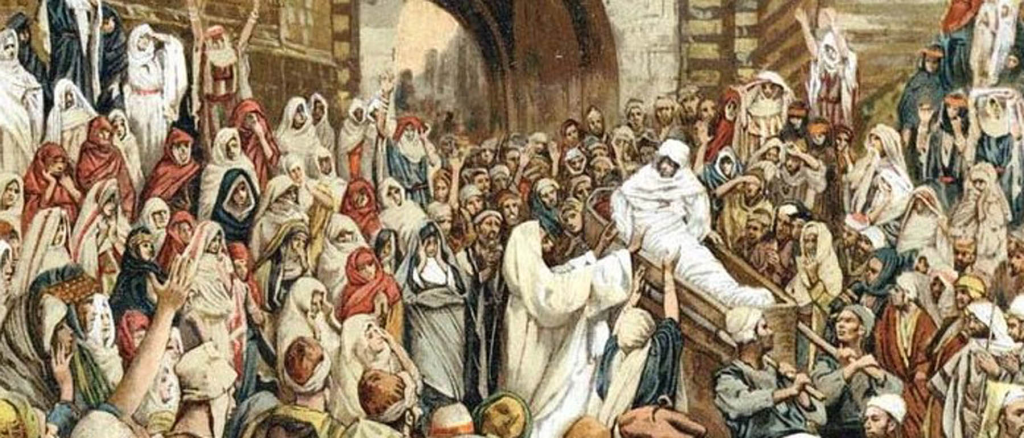
And when the Lord saw her, he had compassion on her and said to her, 

“Do not weep.” 

Then he came up and touched the coffin, and the bearers stood still. And he said, 

“Young man, I say to you, arise.”

Luke 7:13-14 (context, vv. 11-17)

Widows who had no family to support them had it rough. This woman’s husband had died and now her only son was gone. A widow was forced to rely on relatives to meet their needs, but now she had no one. She was all alone and faced a very difficult life. She was vulnerable. And now she saw her only son being carried out of the city to be buried.

The two groups came together. Jesus and His group of disciples were going into Nain and met the funeral procession coming out. Jesus came to the woman as she led the crowd. She was weeping as she walked. I have to believe that His heart met hers.

Jesus response to her was mercy and compassion.

I really think His heart was broken for her. He immediately stopped the funeral march and went straight to her to comfort and console. Apparently no one else took up this. Yet Jesus went to her. That really encourages me.

The body had been washed and rubbed with aromatic spices. His hair had been combed and his fingernails had been clipped. He had been carefully wrapped in linen according to Jewish custom. He had been placed in an open funeral bier, to be carried to the grave site.

Nain was an interesting place. Just a few miles away the prophet Elisha had raised the dead by laying on the corpse repeatedly, 2 Kings 4:32-35. Jesus however, raises the dead with a simple sentence. I think that is interesting. It shows that the power of God that resides in the person of Jesus.

God cares for people.

Obviously Jesus is a full and complete member of the Trinity. He possesses all power and strength. He is the Word and the Creator of everything in the universe. And yet we see that this all powerful one is full of mercy and compassion. He loves widows and orphans. He loves people, and understands their needs. He rolls up His sleeves and enters into their pain and misery.

I suppose the compassion that Jesus has is the most intriguing part of Matthew 7. God loves people intensely. He intervenes in their lives. He meets needs that no one else can understand. He possesses all power and has an infinite amount of love. He can be trusted to meet every need. After all, He can raise the dead with a few simple words.

“His is a loving, tender hand, full of sympathy and compassion.”

-D.L. Moody

Leaving the Mat Behind, Entry #23

“When Jesus saw him lying there and knew that he had already been there a long time, he said to him, 

“Do you want to be healed?”

John 5:6 (context, vv. 2-9)

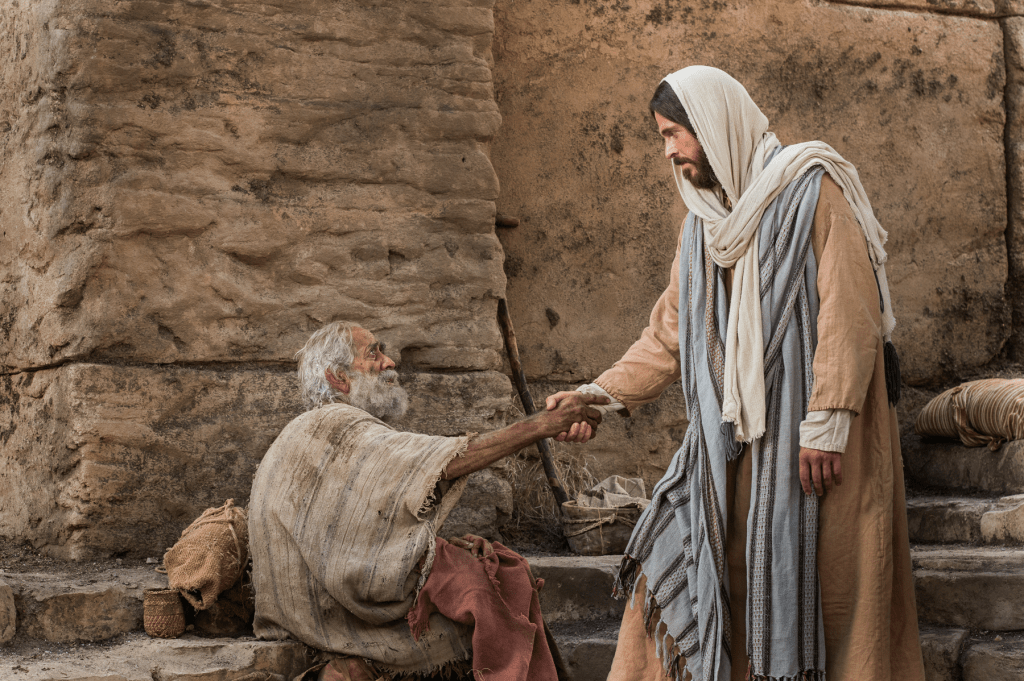
He’d been sick for 38 very long years. On this day he was laying like usual in his spot by the pool of Bethesda. He doesn’t realize it, but he was about to encounter Jesus. His life, as he knows it, is about to be turned upside down.

The question Jesus asks is pointed, and it savagely confronts him–“Do you really want to be healed?” Sometimes the sick, the injured, the handicapped become so aware of their issues that they can’t see any life beyond them. Perhaps Jesus wanted to jolt this man with this very odd question; of course he wants to be healed– doesn’t he?

Jesus clearly knew what was happening.

The Lord knew that this man must make a decision, and healing would only come if he could leave his mat behind. Before we get too hard on him though, we should consider that 38 years is a long, long time to be sick. One thing he had learned over time was that having any kind of hope was a very dangerous thing. In these many years he had worn out lots of mats.

Apparently, an angel would come and stir the waters; the first one who somehow jumped in would be healed. Over time the pool became the gathering place where there laid “a multitude of invalids—blind, lame, and paralyzed” (v. 3.) Someone once said that ‘misery loves company.’ The odds for healing however, were definitely not in their favor.

I’m somewhat curious, not so much with the ‘angel/pool’ thing, but with the Lord passing by a crowd of sick people. Jesus didn’t stop and just wholesale heal them, but instead He makes a bee-line to where this man lay. Why did He do this? Perhaps an encounter with Jesus was far too radical for the crowds; perhaps they weren’t ready. IDK.

The question Jesus asks does seem strange– “Of course he wants to be healed.” And yet the Lord (and this man) had to know for sure. It really isn’t a question of Jesus’ healing power–it is however, an issue with one’s desire to be made whole, and then to leave his mat behind.

A disclaimer though.

People will often talk about having enough faith to be healed, and that’s well and good, but what about having faith to continue to be sick; day after endless day? Will we continue to believe in Him no matter what happens to us? I do wonder about this sometimes.

“How sweet the name of Jesus sounds, In a believer’s ear! It soothes his sorrows, heals his wounds, And drives away his fear.”

-John Newton


Mercy for My Sin, Entry #19

“And behold, some people brought to him a paralytic, lying on a bed. And when Jesus saw their faith, he said to the paralytic,” 

“Take heart, my son; your sins are forgiven.”

Matthew 9:2 (context vv. 1-8)

This man needed a touch. But more importantly he had to know that he was forgiven. It seems to me that this was his real need. Forgiveness must come first and foremost. And Jesus’ spoke directly at him. Jesus completely released him. There were no preconditions. Only the faith of his friends (v. 2.) Interesting.

“Your sins are forgiven.”

The religious leaders are very disturbed. Their analysis of this man’s forgiveness was a frontal attack on Jesus’ right to acquit sin. They said nothing, and the miracle really wasn’t even acknowledged. These leaders were in sharp contrast to those who witnessed this first-hand.

The text says that “the crowds saw it, they were afraid, and they glorified God, who had given such authority to men” (v. 8.)

The religious leaders determined that only God Himself could forgive; to let someone ‘off-the-hook’ like this. They said nothing (perhaps they were feeling ‘out numbered? IDK.)

To forgive sins is God’s exclusive prerogative. No man can release another man from sin. It has the Lord’s exclusive territory. And yet Jesus did precisely that to the chagrin of the ‘legalism’ that was running rampant in the hearts of the religious leaders .

I’m of the opinion that we’re all suffering a certain paralysis of sorts. Each of us have issues that cripple us. We each are sick, and we desperately need Jesus’ touch. “None of us is righteous” (Romans 3:10.) Perhaps Matthew 5:3-4 explains our walk knowing that we all need to be touched.

It seems that we are all dead men walking, separated from God.

The healing of this man was astonishing in itself. To miraculously heal was certainly profound. It doesn’t happen everyday. And yet these scribes, who were thinking about what Jesus said, called it “blasphemy.” They could not see the miracle that freed this man’s great burden.

“The high heaven covereth as well tall mountains as small mole hills, and mercy can cover all. The more desperate thy disease, the greater is the glory of thy physician, who hath perfectly cured thee.”

-Abraham Wright


A Father’s Love, Entry #15

“Jesus said to him, 

“Go; your son will live.” 

The man believed the word that Jesus spoke to him and went on his way.”

John 4:50, (context vv. 46-54).

How do you quantify the love a father has for his son? This nobleman had absolutely nowhere to go, his son was going to die and he could do nothing to stop it. He was half out of his mind with grief and desperation. There wasn’t a thing he could do to save his son. He was going to watch his boy die; and he was powerless to do anything to prevent it.

He finds Jesus and begs for a miracle. He isn’t proud or arrogant, all of that was set aside a long time ago. He’s no longer the king’s official, he is now a very earnest father who is begging for Jesus’ touch on his very sick son. It’s funny how that happens, God uses everything to break through our defenses and touch our lives.

The incredible love this man has drives him to Jesus. He cries desperately out to the Lord and we see him shamelessly begging for his son’s life. He remains insistent even after Jesus seems to turn him down. He continues to hang on to a very feeble hope that Jesus will relent. The nobleman has no other options–Jesus is his last chance.

Jesus chooses to reach out and heal the boy, even at a distance.

“God so loved the world that he gave His one and only son…” (John 3:16). How do we fathom this kind of love? Can we even imagine trading your son’s life for a bunch of proud rebels who detest you? We so easily we forget the incredible pain and loss involved in this act of redemption. Our Father decided His Son must die for you and I. We are criminals, and yet He loves us enough to sacrifice Himself to ‘heal’ us.

“What marvelous love the Father has extended to us! Just look at it—we’re called children of God! That’s who we really are.”

1 John 3:1, MSG 

Simple Jars of Wine, Entry #10

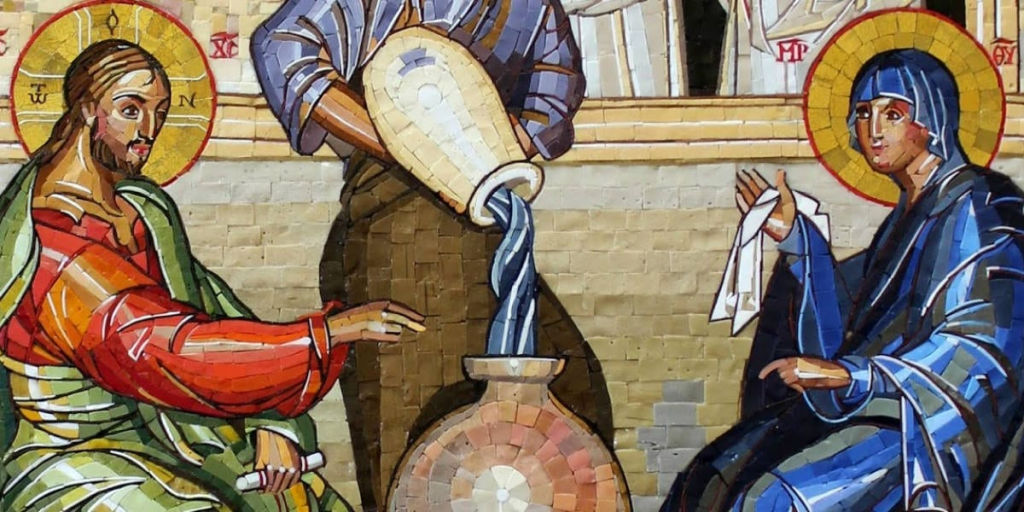
Jesus said to the servants,

“Fill the jars with water.” 

And they filled them up to the brim.”

John 2:7, (context, John 2:1-11) 

Turning water into wine? Easy, right? But let’s think for a moment. Molecules have to be drastically moved and profoundly altered, changed completely. They are totally transformed into something they were not. Chemistry says “impossible,” Jesus says “watch Me!”

We are the jars, clay and water. We stand in the hallway, and wait to be filled. But when Jesus comes to our lives, we are transformed. Our watery life becomes full of precious wine. It is our own personal miracle, we are totally transmuted, radically changed.

We are no longer water, but we have become wine. And not just any old wine, but the very best (v. 10). But why does Jesus do this? He is love, this is how He has chosen to operate.

It’s His primary motive (John 3:16,) “God so loved the world…”

But secondly, it is all for His “glory.” He declares His magnificence in us, puny little “clay” pots.

We sit in the hallway, just waiting for His touch. We bring nothing and become ‘everything.’ We are mere water only, until He speaks. Nothing, but now everything. And not just second-rate–but the very best.


“Do not conform to the pattern of this world, but be transformed by the renewing of your mind.”

Romans 12:2