It’s the Lord, #108

“Just as day was breaking, Jesus stood on the shore; yet the disciples did not know that it was Jesus. Jesus said to them, “Children, do you have any fish?” They answered him, “No.” He said to them, “Cast the net on the right side of the boat, and you will find some.” 

“So they cast it, and now they were not able to haul it in, because of the quantity of fish. That disciple whom Jesus loved therefore said to Peter, “It is the Lord!” 

John 21:4-7 (context, vv. 3-8)

Perhaps this is the way Jesus comes to us. Every time he comes to the 12, it’s unexpectedly. Three times he visits them, and he never comes with a rebuke, or a harsh word of correction. In my mind at least, I certainly wouldn’t have let them off-the-hook that easy. I would’ve pounced on them.

They’re out fishing, following Peter’s decision. Peter again is blowing it. And Jesus, rather than a word of correction, shouts to them that they need to cast their net to the other side of their boat. He tells them, if they do that, they’ll catch more than they can handle.

This has come before, when they were first called to follow. It’s appropriate that what happened at the beginning, has now occurred at the end. Later, when they counted fish, they had a 153. And the nets, had not been torn.

John is the first to recognize Jesus, but Peter will be the first to the shore.

Peter instantly knows that this man is Jesus. He strips down to his underwear and jumps in. He must be with Jesus, the others are pulling in the net, and the boat is moving too slow. (Maybe Peter thought he would walk on water a second time?)

“When they got out on land, they saw a charcoal fire in place, with fish laid out on it, and bread. 10 Jesus said to them, “Bring some of the fish that you have just caught.”

John 21:9-10

The passage points out that they worked till morning, and they probably were hungry. The Lord is aware, and he’s built a campfire for them. It’ll be fried fish and bread for breakfast.

There’s a sensitivity here, and a proactive kind of love that is really concerned about others. He’s aware of what others might need, and he finds a way to serve them. That’s precisely the way love works. (1 Cor. 13.)

“Do nothing from selfish ambition or conceit, but in humility count others more significant than yourselves. Let each of you look not only to his own interests, but also to the interests of others.”

Philippians 2:3-4

The resurrected Jesus is still the humble servant. The disciples could’ve fallen on their faces, and that would’ve been entirely appropriate. This after all, is the risen Savior of the world. Perhaps Jesus is more approachable than we think? Perhaps?

 “They ate the bread and fish that morning, I doubt not, in silent self- humiliation. Peter looked with tears in his eyes at that fire of coals, remembering how he stood and warmed himself when he denied his Master. Thomas stood there, wondering that he should have dared to ask such proofs of a fact most clear. All of them felt that they could shrink into nothing in his divine presence, since they had behaved so ill.”

C.H. Spurgeon

Oh, how he loves you.

He is Solid, #106

38 “Why are you troubled?” he asked them. “And why do doubts arise in your hearts? 39 Look at my hands and my feet, that it is I myself! Touch me and see, because a ghost does not have flesh and bones as you can see I have.” 40 Having said this, he showed them his hands and feet. 41 But while they still were amazed and in disbelief because of their joy, he asked them, “Do you have anything here to eat?”

Luke 24:38-41, CSB, (context vv. 36-43)

He isn’t a ghost, a hallucination or some sort of fabrication of hopeful desires. He’s real! As real as you or I–solid, flesh and blood, and real bones. That may seem like a small thing, but it reveals to the disciples (and us) so much. When his resurrection happened, it didn’t alter him, or change his physical attributes. The disciples were floored when the solid Jesus showed up to be with them.

It was a late Sunday evening.

The doors were shut tight, and the eleven were hiding out there–scared and wallowing in doubt. That’s a lousy mixture. Jesus doesn’t knock on the door, he just pops right in their gathering. That must of been a bit of a shake-up in itself. I know I would of freaked. (And I would’ve taken a serious look at that door.)

At the core, they couldn’t believe that he was real. Maybe a ghost, or his spirit or something else? I’m fairly certain that even if this “man” was really Jesus, it would, maybe be something mystical or ethereal. He wouldn’t be flesh anyway. That was a real stretch for them–and me too.

If it was really true, it meant that physical things are really spiritual.

What I mean by that earth was now combined with heaven. Jesus, the King of the known universe–the One who sits on the throne–is solidly human. Concrete and quite tangible. He’s not a vague kind of spirit, but he’s just like like us. Finally, something physical!

Let’s not get confused about this; I think it’s a critical point. Eternity will not be a vague and misty reality–nebulous and celestial. It’s now quite relatable. When Jesus walks with you on the golden paths of his heaven, you’ll not be walking with a ghost. He’ll be as you and I are right now. He’ll be real. You’ll be real.

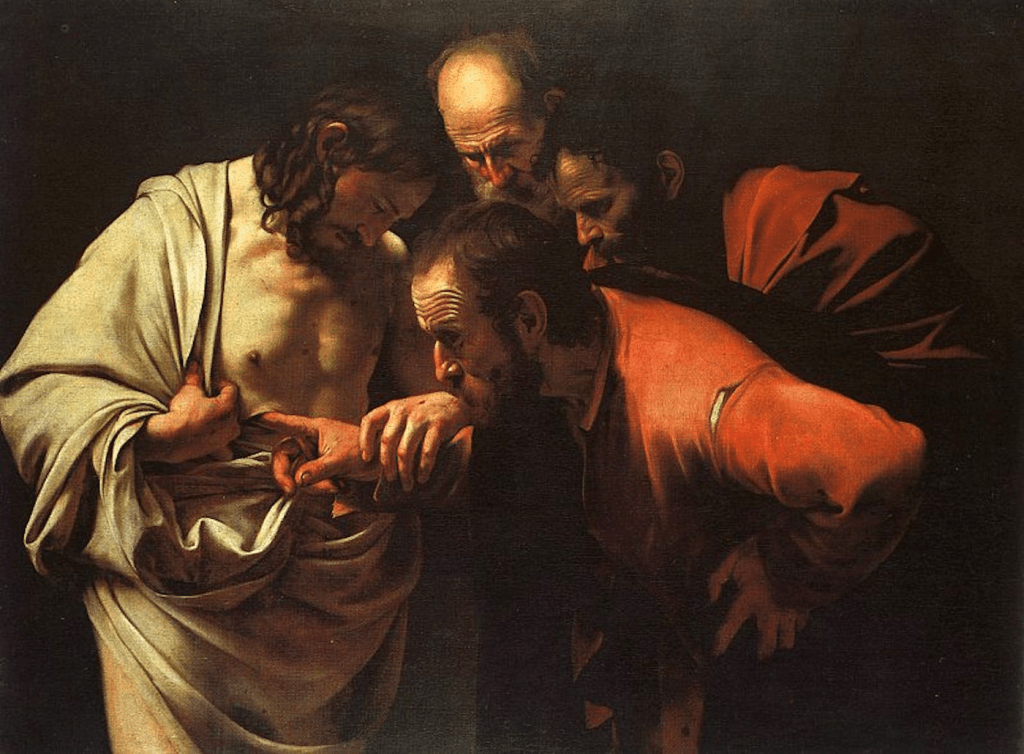
You’ll be able to touch him. And if you really want to you can stick your finger into his wounds (verse 40.) I love what this solid Jesus told Thomas in John 20:27:

“Then he said to Thomas, “Put your finger here and look at my hands. Reach out your hand and put it into my side. Don’t be faithless, but believe.

This should shatter any misconceptions you might have. Thomas had real doubts, and instead of getting rebuked, Jesus invites Thomas to discover the reality of himself. This is really quite profound when you think of it. I’m so glad that this happened, I needed to hear it for myself.

I maybe a very silly preacher and writer, but that’s the way I see it.

A light shining in this heart of darkness
A new beginning and a miracle
Day by day the integration
Of the concrete and the spiritual

Bob Bennett, “Heart of the Matter

A Member of Faithful Bloggers

Go to My Brothers, #105

“Don’t cling to me,” Jesus told her, “since I have not yet ascended to the Father. But go to my brothers and tell them that I am ascending to my Father and your Father, to my God and your God.”

“Mary Magdalene went and announced to the disciples, “I have seen the Lord!”

John 20:17-18, (context, vv. 11-18)

Some believe that somehow this ties into the holiness of Jesus and his need to ascend with God. This thought is that somehow Mary would defile him. I don’t believe this for a second. A much better idea is that Mary was so excited to see Jesus alive that she grabbed a hold of him and simply wouldn’t let go.

The risen Jesus was not a ghost, or a spirit.

He was solid, just like you and me. And he wasn’t Mary’s hallucination, delusion or some sort of wish-fulfillment. It was him–it’s Jesus. Yes, he was buried, everyone knew that. But now he was actually standing before her–very much alive.

“Go to my brothers” is quite profound when you think about it. There’s no superiority or condescending attitude to speak of. Rather he’s relating to his cowering and foolish followers who are hiding out as his brothers. They maybe in hiding, but he’s telling them that they needn’t be afraid.

“My Father and your Father, to my God and your God,” is wonderfully aware.

It’s funny, but this is the first time that he refers to them as his brothers, and the resurrection from the dead has changed everything. It’s interesting, but a brother relationship is even closer than a friend relationship. The disciple are now relating to Jesus in a new capacity. They’re now brothers–family.

Mary has been “commissioned” by Jesus.

She is now the first one to carry the Good News that the Lord has risen from the dead. The Jews didn’t recognize the testimony of a woman in their courts, but Jesus chose her. She’s been given the responsibility to carry the news to his followers. This is no small thing.

We see Mary announcing this to the disciples. The word “announcing” means she simply declared to them what she had just experienced. Perhaps that’s the essence of witnessing to others–we simply communicate what Jesus has done for us. Our testimony is a very powerful thing, (Rev. 12:11).

“Christ the Lord is risen today, Sons of men and angels say. Raise your joys and triumphs high; Sing, ye heavens, and earth reply.”

    Charles Wesley

We belong to Faithful Bloggers

His Last Breath, #103


“Then Jesus shouted, “Father, I commit my spirit to you,” and with those words he died.”

Luke 23:46, LB

The cross had done its vicious work–it brutalized Jesus, and we see him broken and nailed to it. So much is happening, it’s quite hard to assimilate it all. It’s difficult to focus on just one thing. Several events seem to be happening all at once.

  1. An eclipse of the sun, darkness at 3 pm. It lasted three hours.
  2. An earthquake that shook the entire scene, it was strong enough to split rocks.
  3. The veil in the temple that separated the holy from the holiest, torn from top to bottom.
  4. Resurrections, with dead people wandering through the streets of Jerusalem, preaching.
  5. The mocking thief, and the salvation of the one who believed in Jesus.
  6. A centurion, most likely overseeing the soldiers, declaring that Jesus was “the son of God.”
  7. The women disciples who had followed Jesus, standing and witnessing all of this some distance away. Eleven of the twelve “disciples” were absent.
  8. John given the charge to watch over Jesus’ mother.

Each are significant in their own right.

These are all noteworthy, and this post could take up one of them and go in any direction. Besides these eight main observations, there many other details that could be mentioned. Needless to say, the crucifixion of Jesus profoundly effects every person who has ever lived.

They say the last words of a dying man are significant, and many books have been written about what people have said at the moment of death. We expect to hear some final wisdom (and often we’re disappointed.) We now hear the last words of Jesus, and they’re packed with meaning.

“Father, into your hands I commit my spirit!”  This is the last thing Jesus spoke. We know that he had been separated from the Father because of our sin. Yet now we hear the faith of one who could hold on to his spirit while he died.

He had been beaten to an inch of his life.

He has been mocked and spit upon and made to wear a crown made of thorns. He stumbled through the streets of Jerusalem, carrying his cross–down what we now call the Via Dolorosa (lit. “the way of suffering.”)

“When he was insulted, he did not insult in return; when he suffered, he did not threaten but entrusted himself to the one who judges justly.”

1 Peter 2:23

We see his faith in the Father’s mercy. At the very last moment he lays his spirit into the hands of God. We must remember, he is not the victim of a terrible tragedy, but he’s the second person of the Trinity, who has decided he must die, so we wouldn’t have to. He carried away the sin that wasn’t his, yours, and mine.

Jesus “put” his spirit into God’s hands. He believed that the Father would take it up, and hold it for him. As a man who was seconds away from dying, he trusts the Lord absolutely. There’s no fear, and there’s no doubt. In spite of everything, he places his soul into the One who promises to save him.

Never doubt that the crucifixion was brutal.

His suffering was intense, and it was very real. He did what he did to free us from our sin. Jesus transformed his death on the place of the skull to the place where sinners find salvation that’s eternal. As we consider this, let’s not forget–it’s our sin that put him there.

“Before we can begin to see the cross as something done for us, we have to see it as something done by us.”

 John Stott

The breath that caused Adam to live (Genesis 2:7,) is now exhaled into the lives of anyone who believes.

The Skull, #102

“Two criminals were also led out with him for execution, and when they came to the place called The Skull, they crucified him with the criminals, one on either side of him.

“But Jesus himself was saying, “Father, forgive them; they do not know what they are doing.” Then they shared out his clothes by casting lots.”

Luke 23:32-34, Phillips

This is easily the darkest and evil point in human history. The Son of God, (the second person of the Trinity) allows himself to be crucified. Do we have the slightest idea what that means? Is this really something we can grasp?

The word “Calvary” means “place of the Skull.”

When criminals were put to death that’s where it took place. Since Romans liked to execute people, I imagine it was semi-permanent, with vertical poles set in place. The “skull” was visible to all, situated on a main highway. The men who were lifted up would’ve been able to see Jerusalem’s walls, and perhaps even the Temple.

Jonathan Edwards comments about putting people to death like this:

“Although the Romans did not invent crucifixion, they perfected it as a form of torture and capital punishment that was designed to produce a slow death with maximum pain and suffering.”

“Maximum pain and suffering.” Doesn’t that bring it into perspective?

Jesus spends his last few hours praying for his enemies. While he was suffering and dying, the soldiers were rolling dice for his robe. But as he was hanging, the nails holding him in place–he was praying. The pain must’ve been beyond belief. (It’s worth noting that we get our English word “excruciating” from the Latin word meaning “from the cross.”)

Jesus took my sin–he took yours too. He absorbed every ounce. And yet taking on all that, he was still innocent. He did not sin, but he carried every single drop of it. Why would he do this?

At that precise moment, the Father turned his back on him.

With all of that sin (my sin, and yours) God turned away, (Isaiah 53:10). He was now totally alone, and the wrath of God was poured out on him. Jesus, at that moment, was in our place–he substituted himself for us. He died, so we might go free, (2 Corinthians 8:9).

What more can I say? The darkest moment for him became the brightest one for us. He hung there, completely horrified–he was now all alone. God left him at that moment.

I now must live differently.

Once I really truly understood this, everything changed. God is now my friend, I’m at peace with him. When Jesus died on “the place of the skull” he substituted his life for mine. He died, and now I live. It was the greatest exchange in all of history, (1 John 4:9-10).

I now choose to turn away from those things that Jesus Christ went to the cross for.

The Interrogation, #100

friarmusings.com

“If You are the Christ, tell us.” But He said to them, “If I tell you, you will not believe; 68 and if I ask a question, you will not answer. 69 But from now on the Son of Man will be seated at the right hand of the power of God.” 70 And they all said, “So You are the Son of God?” And He said to them, “You say correctly that I am.” 71 And then they said, “What further need do we have of testimony? For we have heard it ourselves from His own mouth!”

Luke 22:67-71, NASB

The Sanhedrin thought they had him. Jesus mounts no defense in this particular trial. He is serene, quiet and very much in control. The interrogators tried 5-6 different questions, each purposefully designed to reveal Jesus’ guilt. We should remember, he was regarded as guilty until proven innocent.

This was regarded as a capital crime–a death penalty could be given. But the Law declares that a trial could only be held in the daylight. It was to be public, open to all Jewish men. And in cases like Jesus’, the evidence was to be offered on one day, and a verdict the following. It couldn’t be a “rush” to judgement.

They got there licks in even before the official arraignment before the high priest. Jesus is blindfolded, mocked and beaten, even before the trial began (Luke 22:63-65). All of this took place as soon as he was brought in from the Garden, even before he was charged with a crime!

The deck was definitely stacked against him. The blindfold seems to be a test of sorts, it was believed that the real Messiah would have the supernatural ability to discern his attackers, even while blindfolded. That explains much if it’s true. The spitting was pretty evil though (Mark 14:65).

In this passage Jesus carefully turns the tables on his interrogators. His reply is perfect–they are forced to examine their own hearts. When you put the Son of God on trial, you can expect to see things like this.

“Jesus warned them that though they sat in judgment of Him now, He would one day sit in judgment of them – and with a far more binding judgment.”

David Guzik’s Biblical Commentary

Jesus reply of “I am” carries significant meaning, and we see the impact it has on his captors. In verse 71, they now have the answer they’re looking for, and we sense that they’ve got the evidence in that response. It’s the breakthrough they’ve been waiting for.

The patience and endurance of Jesus amazes me.

He stands alone in the middle of accusations and after being mocked and beaten. In the Garden he states that at his word he can have “twelve legions of angels” ready to protect him (Matthew 26:53). This is profound–I consider not only his restraint, but also his steadfastness, his ability to press on no matter what.

He doesn’t crack or break under the pressure. He goes the distance. He patiently endures it all, and he did this for you and me. Now dear ones, that’s a very good thing.

“For consider him who endured such hostility from sinners against himself, so that you won’t grow weary and give up.”

Hebrews 12:3

Speaking His Language, #99

Peter Warms Himself

“The girl asked Peter, “Aren’t you one of Jesus’ disciples?”

“No,” he said, “I am not!”

“The police and the household servants were standing around a fire they had made, for it was cold. And Peter stood there with them, warming himself.”

John 18:17-18, Living Bible

The Galileans had a distinct accent. Just as we easily identify someone from Boston just by the tone and cadence of their speech, Peter had that distinct drawl that told everyone that he came from that same province as Jesus. It was something he couldn’t hide.

Peter was a very different man in his three years of being with Jesus. And you might say that had transformed him–you might even say that he was now a marked man, the enemy was now quite aware of him. He was no longer a captain of a small fishing boat looking for a catch. He was now the leader of Jesus’ disciples.

The entire text (18:15-18) reveals a confrontation that Peter had with a servant girl, and we hear him making a bold-faced lie. At this very moment Peter was fulfilling the “promise” that Jesus had predicted (Matthew 26:31-32).

What was going through Peter’s head at that moment? She was a simple servant girl, perhaps one who ministered at the gate of the high priest’s home. It’s interesting that she is the first one to question Peter’s duplicity. Most likely she was just doing her job, watching and listening. She was probably quite alert.

It’s easy to point our finger at Peter. He was a coward, and when he was put on the spot he bailed. People hate cowards–we extol those who take a definite stand against evil. But he was frightened, scared of being connected with Jesus–the man on trial. There was much at stake here.

We also speak with an accent. I know it might be a stretch–but being with Jesus has fundamentally changed us. Our lives now have a specific dialect that others hear, we’re not the same people that we once were.

We open our mouths and others hear the Kingdom of God.

Sometimes I try to pretend that I haven’t been with Jesus, and I’m very ashamed of that. Like Peter, I stand with the others and choose to warm myself by their fire, and I try very hard to make myself inconspicuous. But all I have to do is open my mouth, and I betray who I really am.

It’s really funny, but even servant girls know that I belong to him.

“To stand before the Holy One of eternity is to change.”

Richard Foster

My Kingdom, #98

 “Jesus answered, “My kingdom is not of this world. If my kingdom were of this world, my servants would have been fighting, that I might not be delivered over to the Jews. But my kingdom is not from the world.”

John 18:36

Jesus perfectly understood his kingdom. Three times in this one verse, Jesus uses the statement, “My kingdom.” Three times. Perhaps there is something here we should look at closer? Maybe?

First, Jesus tells Pilate that, yes, he was a king. Second, that this kingdom was not a political rival kingdom. Its boundaries were not physical ones–they’re spiritual, and Pilate and the emperor were not in the equation. King Jesus’ kingdom was not “of this world,” which also by the way, is repeated three times in this single verse.

These 40 words declare to Pilate that he shouldn’t be worried.

Those who look to King Jesus have renounced the tenets of this world’s ideas–force, pride, public image and power. The kingdom of God comes to us in the Red Letters of Jesus–the Beatitudes and the parables.

“Romans thought they knew about kingdoms and their might; that armies, navies, swords, and battles measured the strength of kingdoms. What Jesus knew was that His kingdom – though not of this world – was mightier than Rome and would continue to expand and influence when Rome passed away.”

David Guzik

Brokenness, humility, love, servanthood and sacrifice are the ways his kingdom comes to people. The world’s methods of doing things–even religious and “moral” approaches, are never the way things work under his authority. At times even, they may seem very noble and right; but that isn’t the way Jesus’ rule truly comes.

Interesting. I believe the church, especially here in the West, understands Jesus as a Savior, but not as the King. The idea of a king and lord aren’t automatics for us. We have senators and constitutions, media outlets and freedom of speech–but that somehow never prepares us for the rule of a true sovereign.

Jesus is calling us to live out his rule in our lives, and to embrace him as King. He’s much more than our Savior, and we must understand that. If we want to really grow in him, we must understand his lordship.

The lordship of Jesus is not simply a hope of Christians that someday might be realized; it is a truth that has already taken place.

R.C. Sproul

The Gospel According to Judas Iscariot, #97

Matthew 27:3-10

My name is Judas Iscariot, and I betrayed my Lord. It really had nothing to do with avarice or greed. The money was fine, don’t get me wrong, but that isn’t why I turned him in to the authorities. I simply did what they couldn’t. I wanted to force Jesus’ hand, so he had to drive the Romans out of our country. I was mistaken, I see that now.

Jesus loved each of us, including me. But I didn’t see it at the time.

When he knelt to wash my feet, I was deeply disturbed. When he stripped down to his underwear, I admit I had some serious doubts. Behaving like a common slave wasn’t really in my thinking. It would take extra work to shape him, and to deaden such strange behavior. But it would be worth it in the end, if only Jesus would cooperate.

In my mind I knew that Jesus only needed the right moment to become the next ruler of Israel. That was his destiny, and I was going to help him bring it to pass. I knew that God had called me–this was my purpose. I would be the kingmaker, and Jesus would certainly reward me.

Some have said that Satan was inside me.

But I hardly noticed. Instead, I was filled with excitement. Finally, the other disciples would come to my side, and together we could make it happen. Enough kneeling, no more groveling–we were going to rule Israel and end the wicked Roman occupation. I truly believed this. He was our Messiah, our deliverer.

The tricky part was to convince Jesus, to manipulate him if necessary, to take control.

He had to see the opportunity that was waiting for him. He was already immensely popular among the people. We could quite easily turn all of this enthusiasm into a full-blown insurrection. But we obviously needed him to lead us, and I could help him find his way. I knew we could do it. This was God’s will for me.

My plan was simple–after I met with the Pharisees, I’d lead them to the garden where Jesus was staying. They insisted on an armed escort, just in case there was trouble among the disciples. I suppose that was prudent, my part in all of this was simply to give Jesus a kiss on the cheek, to signify that he was the one to the soldiers.

I assumed he would resist and fight. I was very wrong.

Nothing went as planned. Jesus didn’t take charge, and he certainly didn’t overthrow the government. As a matter of fact, you could say that the opposite happened; he was silent and refused to answer most of their questions. I did hear him say, “My kingdom is not of this world.” I should have listened.

I realized way too late, that I shed innocent blood. I went back to the priests who hired me, and I insisted they take back the silver. They refused. I threw the bag at their feet and left the temple. Ugly thoughts now filled my mind, and I knew without a doubt that I was completely lost.

Please excuse me, but I have a date with a rope.

_____________________

This is a chapter from a book I considered writing a long time ago, “They Saw Jesus.” This was to be chapter 27. (I doubt it will ever happen though. Oh well.)

The Passover Code, #95

“And He took bread, gave thanks and broke it, and gave it to them, saying, “This is My body which is given for you; do this in remembrance of Me.””

Likewise He also took the cup after supper, saying, “This cup is the new covenant in My blood, which is shed for you.”

Luke 22:19-29

In 1838, the telegraph was invented by Samuel Morse. For the first time messages could be relayed from one place to another quickly and accurately. You didn’t need carrier pigeons, flags or a fast horse anymore, but electric impulses could be sent by trained operators over wires dedicated for that purpose. In its day, it was revolutionary; state-of-the-art stuff.

Jesus encodes spiritual lessons to his followers, and although the analogy isn’t perfect, he communicates what’s spiritual to the physical. He uses images–bread and wine, to explain salvation in ways that would’ve meant something to those who followed.

The lessons come from the feast of the Passover, Exodus 12 and Leviticus 23. Jesus reinterpreted them in Himself, and the focus was no longer on the suffering of Israel in Egypt, but on the ‘sin-bearing’ suffering of Jesus on their behalf. He was the “Lamb of God, who takes away the sin of the world! (John 1:29.)

The code is now fulfilled by Jesus.

The elements are tweaked (a great ‘theological” term, btw) and they mesh together quite well between the O.T. and the N.T. This meal was clearly communicated to Jesus’ followers–they knew exactly what he was saying–there would’ve been no ambiguity or confusion.

Jesus shares his imminent crucifixion, in common code–the bread and wine of the supper, to describe what was coming. From that point on, they would never forget that bread was now his “body,” and the wine had now become his “blood,” both broken, and shed respectively.

He explained that he was becoming their sacrifice–what he was going to do in a short span of a few hours was going to open up eternal life. Since then, a lot of theology has been discussed–transubstantiation, consubstantiation, or a memorial. You can toss in the idea of eucharistic prayer too. Books and books of each have been written. My library is loaded with them.

There seem to be merits for each concept, and I know that my own viewpoint won’t satisfy anyone at all. I’m sorry. But the critical issue for me is that the deed has been done. The code has been given, and eternal life has been given to us.

 “What is certain is that Jesus bids us commemorate, not his birth, nor his life, nor his miracles, but his death.”

D.A. Carson