“And I tell you, you are Peter, and on this rock I will build my church, and the gates of hell shall not prevail against it.”
Matthew 16:18, (context, vv. 13-20)
Peter was only stating what was now quite obvious– “You are the Christ, the Son of the living God.” I can only imagine that when Jesus heard him say this, the switch got flipped, and the lights of the universe turned on–all of a sudden it was all ‘angels-on -tiptoe,’ and all that convoluted theology made perfect sense.
The tumblers in the lock fall into place at last. Jesus is the key. He always has been.
The origination came from God (v. 17.) Peter knew it was the truth. He believed it and spoke it. But God made it.
Jesus is in the building business. He intends to construct a building that will handle all of the attacks of the enemy. In spite of what you heard, the Kingdom of God is advancing–Satan’s best last hope is his gates, and even that can never manage muster.
“And this is the victory that has defeated the world: our faith.”
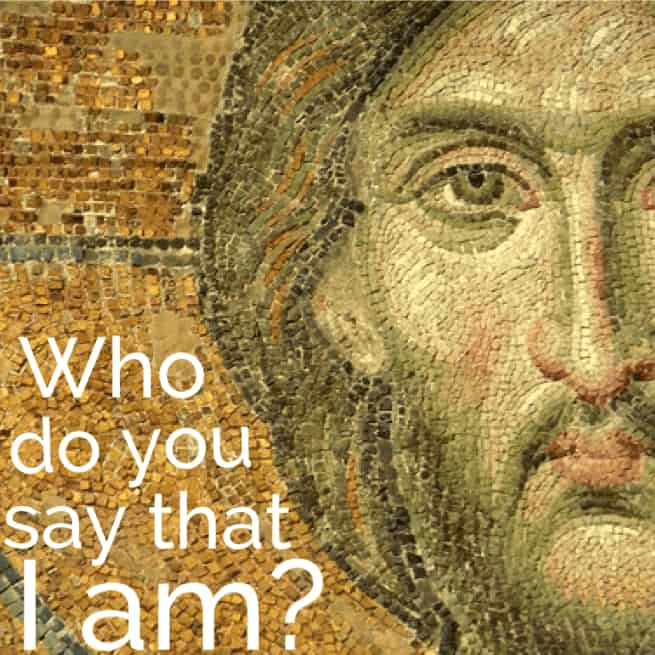
The question is significant; and it’s never been fully answered. Perhaps each of us must be asked this exact same thing. And perhaps it’s the crucial question that every human being who has ever drawn breath must ask themselves. Who is Jesus? Who is He really?
The crowds had witnessed Jesus feed them with a little boy’s lunch. They saw miracles and heard teaching, and yet maybe they were a bit confused. They could only put Jesus in the context of what they knew was “allowable” by the Pharisees. He definitely was some kind of prophet. Jesus was being evaluated by a very curious crowd.
Jesus isn’t distressed by this, He’s not full of self-doubt or second thoughts. He’s not looking around for our support–or accolades, palms or laurels. He knows exactly who He is. He is the only Son of God, the second person of the Trinity. He is fully and completely God; and He is now wearing a robe and walking around in sandals.
There exists a “crowd faith,” something more or less aware that God cares, and miracles do happen in this life. This is all well and good. But it seems there is a “personal faith,” which Peter now announces out loud. “You’re the Messiah, come from God.”
What Peter declares in front of everyone changes everything.
We must always draw our own conclusions, of course. We must look at Him, and decide for ourselves what He claims to be. There is no question it’s scary, and it’s hard. But you, and you alone, must decide. Crowd faith is almost always good, I suppose; but Peter’s bold declaration is what He really is waiting for. Are you convinced yet?
“You know how to interpret the appearance of the sky, but you cannot interpret the signs of the times.”
Matthew 16:3, (context, vv. 1-12)
This disturbing union of Pharisee and Sadducee was telling–they were polar opposites. One group was ultra-conservative, and the other flaming liberal, the yin and the yang. They detested each other. To somehow unite these hated enemies must have taken someone with some flair!
Leadership could no longer discern between what was right and what was wrong. These men had gravitated into high office for selfish reasons. They were hypocrites; they loved the praise of men immensely, and would never dream of giving up the power and prestige.
Hypocrisy becomes my way of ensuring that I can retain all that honor. When our positions of oversight, direction and wisdom are taken over by confused leaders who haven’t the slightest idea of what God is speaking we are in critical danger. We need those who can interpret these things to us without caving into either the fear or praise of men.
The Jews of Jesus’ day had a saying that if all the hypocrites in the world were divided into ten parts, Jerusalem would contain nine of the ten parts. Jesus wasn’t the first one who saw the religious lies of His day. It was more or less understood by everyone.
Jesus the Messiah had truly come. He preached, taught and healed. He revealed Himself over and over to the Jewish people. He explained the Kingdom of God. The Jewish “leaders,” didn’t recognize Him, they refused to see. They were the hypocrites who gravitated to ministry for the prestige that was given; never for the responsibility of the office.
Truth is as critical to a church as love is.
We are to be known by our love, but we’re also to be understood as being people of truth. We must understand the difference between black and white. We need leadership who will look at these sticky issues and explain it to us. We need them to decipher the moment.
I don’t know what the future holds for the Church. Whatever it is, I’m sure it will be an adventure. Let’s keep listening to Jesus, reading the Word, and hearing each other. Let’s avoid hypocrisy as if it were the smallpox. Let’s pray for leadership that understands the moment, and that knows the dark evil of the praise of men.
“For not only does sound reason direct us to refuse the guidance of those who do or teach anything wrong, but it is by all means vital for the lover of truth, regardless of the threat of death, to choose to do and say what is right even before saving his own life.”
“Then Jesus answered her, “O woman, great is your faith! Be it done for you as you desire.”
And her daughter was healed instantly.”
Matthew 15:28, (context, vv. 21-28)
Negotiating with God is not for the timid. It takes spiritual guts, and very few do it right. This chapter begins with a strong teaching on Jewish tradition and moral purity. The scribes and the Pharisee’s have cornered the market on social and religious correctness, and they have a solid grip on the Jewish faith. You must do what they say.
Suddenly there’s a noisy commotion, up jumps a Gentile woman who is terribly loud and terribly desperate, she’s caught somewhere between rudeness and hysteria. She has a disturbing need for her daughter to be released from a demon’s control–there’s a satanic oppression that wants to destroy her. Only Jesus can stop it.
The Judaism of Jesus’ day was not doing its job. Israel was meant to be a “light to the Gentiles,” and a source of healing and truth to the nations of the earth. Clearly it had become confused–its traditions and ceremonies that had nothing to do with the salvation of the world.
Perhaps the failure of the Jewish people to reach the world parallels the failure of the Church to carry out Jesus’ Great Commission? Religion has always stood in the way of God’s heart and His plan to bring salvation to everyone. I think this is the main reason Jesus hated it so.
This woman has a need that only Jesus could meet. She embarrasses herself insisting that Jesus take action. She seems almost rude to the point of being obnoxious. She is repeatedly told to be quiet, that her daughter’s deliverance was not in the plan of God. But that’s an answer she will not accept.
How honest are my conversations with God? Do I say what I really think? Do I intercede for others?
This is one of more unsettling verses in the New Testament–at least for me anyway. Everyone in this passage seems somewhat rude, even a bit boorish to me–even Jesus seems off, which really does unsettle me. There’s a stilted awkwardness in this passage that makes me want to apologize about Jesus’ attitude to all my unbelieving friends. I just don’t get all the national, racial, and social issues that are involved here.
An addendum though: Not every scripture is ever grasped once, and for all time understood. I’ve learned there are verses that reveal their layers years later. Onion-like. I think that this is probably true–for me anyway. The same verse will speak to me over and over again.
“A prophet has little honor in his hometown, among his relatives, on the streets he played in as a child.”
Jesus wasn’t able to do much of anything there—he laid hands on a few sick people and healed them, that’s all.”
Mark 6:4, the Message
“For some reason, they hate me.” There’s a real pain that we give each other, especially when it’s on the level of friends and our close family. It seems those relationships are vulnerable, and have the most exposure. When somebody close to us has an issue with us, that pain is deep and lasting. Others well, not so much.
Those closest to us have seen our issues. They’ve seen us at our best, and definitely at our worst. Other relationships are briefer, and they see us, and only subjectively. The salacious details never come out into the open, and we certainly won’t reveal them.
Jesus, the sinless one, faces the same problem in His hometown, the village of Nazareth where He was raised. He has already worked incredible miracles, things that absolutely stagger the imagination. He has raised the dead, healed lepers and cured the paralyzed. He has walked in the light of God unlike anyone who preceded him.
And His teaching? Oh my, no one was ever listen to such marvelous words that describe the Father’s kingdom so well. His words do astonish, and bring absolute light into some pretty dark darkness. The things He says, are astonishing. There has never been anyone like Him.
When Jesus returns to His hometown He discovers an insidious resistance to His words and miracles. People think they ‘know’ Him. A few remember Him playing with their own children–kicking the can, or riding around on the neighbor’s donkey. They ‘think’ they know Him. They really do. But they’re very much mistaken.
But what about our own misconceptions?
There are lessons in this passage we need to learn. Does my idea of Jesus limit or restrict His work? Perhaps we should realize that His miracles often stop when our unbelief begins. Since we think we know Him so well, we think we determine what He can, and cannot do. But seriously, do we truly grasp who Jesus really is?
“Unbelief is not a misfortune to be pitied; it is a sin to be deplored. It’s sinfulness lies in the fact that it contradicts the word of the one true God and thus attributes falsehood to Him.”
The blind men came to him, and Jesus said to them, “Do you believe that I am able to do this?” They said to him, “Yes, Lord.” Then he touched their eyes, saying, “According to your faith be it done to you.”
And their eyes were opened.
Matthew 9:28-30, (context vv. 27-31)
I remember reading a story; more like a sanctified fable but maybe containing a bit of truth? The story (possibly from a French poem?) was that wherever Jesus would walk flowers would bloom in His footprints. I suppose the idea was that wherever Jesus went–life, healing and wholeness happened. It was His footprints; His presence that brought out the very essence of the Kingdom of God.
The love Jesus has for us is that wonderful. His grace–a grace that heals and forgives, a grace that’s now flourishing in the heart of a every real disciple. His mere presence brings us flowers even in the hard times.
Without Him, it seems we’re stuck with plastic roses that really don’t impress anyone. They aren’t real.
Jesus heals these blind men. They are completely without sight. They have understood nothing but blackness, but that is about to be instantly changed, it will come like a switch is flipped. Pop! Instant sight. Suddenly everything floods in. They “see” everything for the first time. Imagine, to be sightless, and then to suddenly see. Colors, trees, flowers, faces, and Jesus all at once. Can you imagine what that must be like?
These men had to have faith–that ‘spiritual ability’ to step out and grasp a healing that hasn’t come yet. They first need to trust the man (Jesus) before the healing can ever be received. “Do you believe I can do this…” I suppose the issue here is identity, the Lord Jesus Christ declaring His authority over this blindness. He intends to heal. It’s His nature to heal.
Wherever Jesus chooses to walk, supernatural things happen. We’re called to trust the person of Jesus, to simply believe Him, and expect Him to keep His word; but whatever happens, happens. Believers will choose to continue to believe, no matter what. They know the difference between real and plastic flowers.
I believe in Jesus’ character–His absolute love for me, and His power over everything. I love Him, and I look for His presence, and suddenly amazing miracles happen. But it’s Him–it’s all Him, and I must put my faith in Him. He does all the work, I’m the lazy guy leaning on my shovel.
But He wants to heal us, that’s His nature. My feeble faith can move things. My mustard seed faith can elevate mountains. It makes wonderful things happen. But that faith has to be fortified, cemented into His heart– we must tell of Jesus’ kindness and mercy and love for those still lost. We must believe in Him to touch others, and then whatever might happen after that will always be His decision. He will always be the Lord either way.
“When human reason has exhausted every possibility, the children can go to their Father and receive all they need. … For only when you have become utterly dependent upon prayer and faith, only when all human possibilities have been exhausted, can you begin to reckon that God will intervene and work His miracles.”
“Just then a woman who had been subject to bleeding for twelve years came up behind him and touched the edge of his cloak. 21 She said to herself, “If I only touch his cloak, I will be healed.”
22 “Jesus turned and saw her.
“Take heart, daughter,” he said, “your faith has healed you.” And the woman was healed at that moment.”
Matthew 9:20-22
I really don’t have a faint idea of her sickness. But I think to bleed constantly must’ve been tiring. Physically, and emotionally–exhausting. She had to ‘plan’ her days carefully to accommodate all of this. Things were never easy for this woman. It truly crippled her life; it would’ve consumed her.
This Jewish woman was suffering with an issue of blood for 12 long years. She had sought help from one physician after another, and spent all her money paying doctor’s bills. But she had not been helped. In fact, her problem got worse. And we need to remember, that she’d be completely ostracized socially–a total write-off, a reject.
Leviticus 15 explains this:
“Anything she lies on during her period will be unclean, and anything she sits on will be unclean. 21 Anyone who touches her bed will be unclean; they must wash their clothes and bathe with water, and they will be unclean till evening. 22 Anyone who touches anything she sits on will be unclean; they must wash their clothes and bathe with water, and they will be unclean till evening. 23 Whether it is the bed or anything she was sitting on, when anyone touches it, they will be unclean till evening.“
(vv. 19-23)
Fourteen years of being unclean; it seems like a half of a lifetime. She was cut off from any solace of the Temple–that would’ve denied her a sacrifice for her sin. Not only was 14 years a long time, her physical disease had powerful implications spiritually as well. She would have carried around her sin like a heavy coat. She would never know the peace that infuses grace.
Her only hope was Jesus, plain and simple. His reputation as a healer and a teacher had spread like crazy through the country (even King Herod followed His ministry!)
She had one overriding desire. Nothing but a healing would be acceptable.
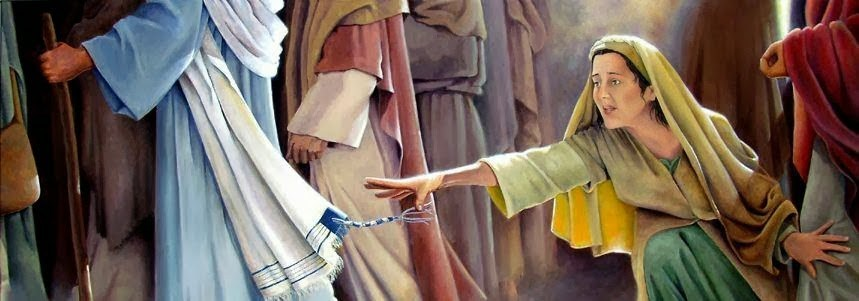
Perhaps Jesus had already passed by her? After all, He was on His way to a simple resurrection! But in her thinking, she could still touch Him, perhaps she just stretch out and grab the tassel of His robe. And guess what; she was healed, completely. A lightening strike!
We don’t bleed, but we sin all the time.
All of us are like this woman. We don’t bleed, but we sin all the time. Romans states, “we all have sinned, we all have fallen short of the glory of God.” Isaiah graphically describes all of us “to be like and unclean thing.” The Hebrew word for those two words is “menstrual cloth.” All the good we do amounts to something less than zero.
Each of us have definitely sinned. We’re very much ‘defiled’ even at our very best. Sin has completely ruined us. We are foul.
We must reach out, and keep reaching out, grabbing a hold of Jesus. We must seize Him, even if it’s a tiny tassel of His robe. We must snatch it and never let go; until He heals us and restores our lives. We know He can.
“Christ is the Good Physician. There is no disease He cannot heal; no sin He cannot remove; no trouble He cannot help. He is the Balm of Gilead, the Great Physician who has never yet failed to heal all the spiritual maladies of every soul that has come unto Him in faith and prayer.”
He said to them, “Why are you so afraid? Have you still no faith?”
Mark 4:40 (context vv. 35-41)
Often fear rules the human heart. Quite suddenly the waves seem too high, and the wind starts to really howl. We look at our circumstances and we freak out by what we see. Things look grim, and often we imagine the worse is going to happen. Fear has its sharp hooks in us; and everything is starting to get really crazy.
Jesus often zaps us at times like this. When our boat is pitching violently in open seas, we’ve lost our anchor and the sails are useless, it’s then we start looking around to find where we put our life-jackets. We choose this approach rather than calling out to Him.
It seems that becomes our last option–to beg Him to come and save us. (We can get so stiff-necked sometimes. I think it really is a pride/humility issue.)
Faith is probably the most significant part of this verse. It’s faith in Him that screams out of our storm. When faith shows up, fear leaves. We get one or another. I suppose it’s always going to come to this–will it be fear or faith? We must grasp this lesson, hopefully sooner rather than later. The storm is how the Kingdom of God gets worked into the human heart.
“Faith expects from God what is beyond all expectation.”
-Andrew Murray
“Have you no faith?” That’s Jesus’ interesting question to His believers who are about die. Crazy! But know this, these tempests will never be random or capricious. His love has absolute control over each of them. All He wants is that His disciples will see a truly powerful love, that really does save.
Calling on Him must become our first reaction, and not the fifteenth.
We’ll learn to do this first eventually, even if it means repeating the lesson over and over and over, until faith becomes our first response. Jesus often uses a bad storm to put the Kingdom even deeper inside of people. “Have you no faith” isn’t so much as an indictment of you, as it’s a deep and concerned observation. And only the storm can reveal your faith.
“The Son of Man came eating and drinking, and they say, ‘Look at him! A glutton and a drunkard, a friend of tax collectors and sinners!’ Yet wisdom is justified by her deeds.”
Matthew 11:19, (context, vv. 16-19)
What part does excessive “eating and drinking” don’t we understand? It doesn’t seem entirely ‘religious,’ especially in the thinking of us who observe the life of a pastor or a shepherd. We demand a certain restraint, a standard of separateness from common sinners. That’s seems to be our personal view anyway.
Is gluttony wrong? Is getting a bit tipsy also unacceptable, especially when it comes to “true” religion? Quite often it seems, we have a pious approach toward what we think is ‘true’ faith. We often believe that truth equates to being an ascetic, separate from common sinners. We believe if we are truly holy we will segregate from the ungodly.
It seems that Jesus doesn’t relate to, or accept this viewpoint. He’s single-mindedly serving the Father, in perfect holiness and in true connection with Him. And yet we see Him cavorting with tax-collectors and sinners. We observe Him actually sitting with those we reject as ungodly or unholy.
I must say this before you start looking for rocks to stone me with!
Scripture clearly tells us that we’re to live holy lives. We’re to be wise and have self-control in everything. We should always remember our own ‘black hole’, and begin to see our new life as really incredible. We must allow the “fruits of the Spirit” to grow inside us. And lived rightly, it’s a place of real holiness; and certainly not the ‘pretend’ righteousness of the Pharisee.
Listen very carefully: The Pharisees reject and label those who seem to flaunt the religious norms, but broken believers will truly forgive others, like those who have been radically forgiven themselves. There is a stark difference.
But think about it, aren’t we all a tiny bit ungodly?
Don’t we somehow grade people by their outward appearance and the level of their attainment? It absolutely astounds me that Jesus seems far more comfortable with the outcasts than He does with the Pharisees of His day. He sits with them, and eats and drinks in a fashion that we would regard objectionable.
Jesus loves every person. He loves the unmade, and the unvarnished. He loves being with the ungodly. Yes, He does understand the awful nature of sin; the horrible damage it inflicts on a person’s soul. And yet I’ve come to the conclusion that all my righteous and holy religion is nothing but a very bad smell in God’s nostrils.
Jesus isn’t afraid that we will somehow taint Him by our words, conduct or behavior. He passionately loves those who we deem as outside the norm of our religion. Jesus loves being with ‘nasty’ people. I think He purposefully seeks out the wrong ones!
It fascinates me that Jesus is never afraid that the leper will corrupt or defile Him. He isn’t fearful that somehow He will be contaminated. That’s exactly what the Pharisees thought. But instead it’s the reverse with Jesus. He heals us, and it’s always a one-way current. He touches us, but we’ll never ‘poison’ Him!
Just maybe our awful failure in evangelism is due to our inability to really relate with the lost. We withdraw and then wonder why the unsaved don’t understand the things of God. Have we become so religious that sinners don’t feel comfortable with us, or Him? Could it be that we’re a bit off course? Are we really filled with His Spirit?
“The greatest form of praise is the sound of consecrated feet seeking out the lost and helpless.”
“And blessed is the one who is not offended by me.”
Matthew 11:6, (context, vv. 2-6)
Being “blessed” is much more than having lots of money, a nice home or a fancy new car. First and foremost being blessed must be a spiritual word–it seems sometimes we have to rescue the true definition and then bring back its real meaning. The old hymn exhorts the enriched Christian to “count your many blessings, name them one by one.” Singing this will work something inside us.
We become spiritually prosperous when we begin to embrace the reality of Jesus–His words, actions, even His very person becomes the dearest thing we could ever dream of possessing. We’re also blessed when we receive deep inside us the many challenging things He says. We really must absorb these harder words without any reservations. It seems that He doles these things out very carefully.
We have to admit that being scandalized over Him is always a possibility. It can happened to a pastor, or a ‘newbie’ in the faith. No matter who we are, we’re always in the arena, being watched, and our faith in Jesus will be tested. Is it real? Will we be insulted or affronted by the presence of the Lord Jesus Christ? That dear one, it a very real possibility.
Jesus still offends people. There were those who embraced Him, and yet it seems to me that most ended up resisting and rejecting Him. He was a ‘wrench in their machinery,’ an obstacle in their theology. He was constantly doing things that didn’t seem right or proper.
Does Jesus offend you?
“When Jesus came to earth, demons recognized him, the sick flocked to him, and sinners doused his feet and head with perfume. Meanwhile he offended pious Jews with their strict preconceptions of what God should be like. Their rejection makes me wonder, could religious types be doing just the reverse now? Could we be perpetuating an image of Jesus that fits our pious expectations but does not match the person portrayed so vividly in the Gospels?”








 The Red Letters of Jesus