It’s the Lord, #108

“Just as day was breaking, Jesus stood on the shore; yet the disciples did not know that it was Jesus. Jesus said to them, “Children, do you have any fish?” They answered him, “No.” He said to them, “Cast the net on the right side of the boat, and you will find some.” 

“So they cast it, and now they were not able to haul it in, because of the quantity of fish. That disciple whom Jesus loved therefore said to Peter, “It is the Lord!” 

John 21:4-7 (context, vv. 3-8)

Perhaps this is the way Jesus comes to us. Every time he comes to the 12, it’s unexpectedly. Three times he visits them, and he never comes with a rebuke, or a harsh word of correction. In my mind at least, I certainly wouldn’t have let them off-the-hook that easy. I would’ve pounced on them.

They’re out fishing, following Peter’s decision. Peter again is blowing it. And Jesus, rather than a word of correction, shouts to them that they need to cast their net to the other side of their boat. He tells them, if they do that, they’ll catch more than they can handle.

This has come before, when they were first called to follow. It’s appropriate that what happened at the beginning, has now occurred at the end. Later, when they counted fish, they had a 153. And the nets, had not been torn.

John is the first to recognize Jesus, but Peter will be the first to the shore.

Peter instantly knows that this man is Jesus. He strips down to his underwear and jumps in. He must be with Jesus, the others are pulling in the net, and the boat is moving too slow. (Maybe Peter thought he would walk on water a second time?)

“When they got out on land, they saw a charcoal fire in place, with fish laid out on it, and bread. 10 Jesus said to them, “Bring some of the fish that you have just caught.”

John 21:9-10

The passage points out that they worked till morning, and they probably were hungry. The Lord is aware, and he’s built a campfire for them. It’ll be fried fish and bread for breakfast.

There’s a sensitivity here, and a proactive kind of love that is really concerned about others. He’s aware of what others might need, and he finds a way to serve them. That’s precisely the way love works. (1 Cor. 13.)

“Do nothing from selfish ambition or conceit, but in humility count others more significant than yourselves. Let each of you look not only to his own interests, but also to the interests of others.”

Philippians 2:3-4

The resurrected Jesus is still the humble servant. The disciples could’ve fallen on their faces, and that would’ve been entirely appropriate. This after all, is the risen Savior of the world. Perhaps Jesus is more approachable than we think? Perhaps?

 “They ate the bread and fish that morning, I doubt not, in silent self- humiliation. Peter looked with tears in his eyes at that fire of coals, remembering how he stood and warmed himself when he denied his Master. Thomas stood there, wondering that he should have dared to ask such proofs of a fact most clear. All of them felt that they could shrink into nothing in his divine presence, since they had behaved so ill.”

C.H. Spurgeon

Oh, how he loves you.

Go to My Brothers, #105

“Don’t cling to me,” Jesus told her, “since I have not yet ascended to the Father. But go to my brothers and tell them that I am ascending to my Father and your Father, to my God and your God.”

“Mary Magdalene went and announced to the disciples, “I have seen the Lord!”

John 20:17-18, (context, vv. 11-18)

Some believe that somehow this ties into the holiness of Jesus and his need to ascend with God. This thought is that somehow Mary would defile him. I don’t believe this for a second. A much better idea is that Mary was so excited to see Jesus alive that she grabbed a hold of him and simply wouldn’t let go.

The risen Jesus was not a ghost, or a spirit.

He was solid, just like you and me. And he wasn’t Mary’s hallucination, delusion or some sort of wish-fulfillment. It was him–it’s Jesus. Yes, he was buried, everyone knew that. But now he was actually standing before her–very much alive.

“Go to my brothers” is quite profound when you think about it. There’s no superiority or condescending attitude to speak of. Rather he’s relating to his cowering and foolish followers who are hiding out as his brothers. They maybe in hiding, but he’s telling them that they needn’t be afraid.

“My Father and your Father, to my God and your God,” is wonderfully aware.

It’s funny, but this is the first time that he refers to them as his brothers, and the resurrection from the dead has changed everything. It’s interesting, but a brother relationship is even closer than a friend relationship. The disciple are now relating to Jesus in a new capacity. They’re now brothers–family.

Mary has been “commissioned” by Jesus.

She is now the first one to carry the Good News that the Lord has risen from the dead. The Jews didn’t recognize the testimony of a woman in their courts, but Jesus chose her. She’s been given the responsibility to carry the news to his followers. This is no small thing.

We see Mary announcing this to the disciples. The word “announcing” means she simply declared to them what she had just experienced. Perhaps that’s the essence of witnessing to others–we simply communicate what Jesus has done for us. Our testimony is a very powerful thing, (Rev. 12:11).

“Christ the Lord is risen today, Sons of men and angels say. Raise your joys and triumphs high; Sing, ye heavens, and earth reply.”

    Charles Wesley

We belong to Faithful Bloggers

The Passover Code, #95

“And He took bread, gave thanks and broke it, and gave it to them, saying, “This is My body which is given for you; do this in remembrance of Me.””

Likewise He also took the cup after supper, saying, “This cup is the new covenant in My blood, which is shed for you.”

Luke 22:19-29

In 1838, the telegraph was invented by Samuel Morse. For the first time messages could be relayed from one place to another quickly and accurately. You didn’t need carrier pigeons, flags or a fast horse anymore, but electric impulses could be sent by trained operators over wires dedicated for that purpose. In its day, it was revolutionary; state-of-the-art stuff.

Jesus encodes spiritual lessons to his followers, and although the analogy isn’t perfect, he communicates what’s spiritual to the physical. He uses images–bread and wine, to explain salvation in ways that would’ve meant something to those who followed.

The lessons come from the feast of the Passover, Exodus 12 and Leviticus 23. Jesus reinterpreted them in Himself, and the focus was no longer on the suffering of Israel in Egypt, but on the ‘sin-bearing’ suffering of Jesus on their behalf. He was the “Lamb of God, who takes away the sin of the world! (John 1:29.)

The code is now fulfilled by Jesus.

The elements are tweaked (a great ‘theological” term, btw) and they mesh together quite well between the O.T. and the N.T. This meal was clearly communicated to Jesus’ followers–they knew exactly what he was saying–there would’ve been no ambiguity or confusion.

Jesus shares his imminent crucifixion, in common code–the bread and wine of the supper, to describe what was coming. From that point on, they would never forget that bread was now his “body,” and the wine had now become his “blood,” both broken, and shed respectively.

He explained that he was becoming their sacrifice–what he was going to do in a short span of a few hours was going to open up eternal life. Since then, a lot of theology has been discussed–transubstantiation, consubstantiation, or a memorial. You can toss in the idea of eucharistic prayer too. Books and books of each have been written. My library is loaded with them.

There seem to be merits for each concept, and I know that my own viewpoint won’t satisfy anyone at all. I’m sorry. But the critical issue for me is that the deed has been done. The code has been given, and eternal life has been given to us.

 “What is certain is that Jesus bids us commemorate, not his birth, nor his life, nor his miracles, but his death.”

D.A. Carson

To Seek and to Save, #87

9 “And Jesus said to him, “Today salvation has come to this house, since he also is a son of Abraham. 10 For the Son of Man came to seek and to save the lost.””

Luke 19:9-10 (context, vv. 1-10)

The Jewish people regarded salvation simply as being a child of Abraham. Faith was not necessary, but being saved was simply genealogical. It was the exclusive privilege of every Jewish man and woman. It was the sole position of anyone who was descended from Abraham.

There were exceptions however. If an Israelite lived outside of the Law, they forfeited their salvation. If they cooperated with the Gentiles, or if they committed some heinous crime, they couldn’t be a true Israelite. You were saved, just because you had descended from Abraham.

Zacchaeus couldn’t be saved. He had essentially had renounced his salvation when he cooperated with the Romans as a tax-collector. He had made the choice of a living his life outside of what was acceptable to the religious norms. In short he chose to be damned. He had decided to walk the highway to hell, but that was his decision.

When Jesus called up the tree to Zacchaeus, and invited himself to dinner, Jesus was committing a forbidden act. You must understand that Zacchaeus was unclean, a sinner, and any contact with was regarded as a grossly evil action. In short, Jesus had allied himself with an unclean man. Thus Jesus must be unclean as well.

The “righteous” Jew would never ever have anything to do with Zacchaeus. That is why they had such an issue with Jesus’ decision to eat with him. And that’s why Zacchaeus was thrilled to have such an eminent teacher as his guest.

Jesus was seeking to save the lost.

Zacchaeus invited all of his “evil” friends to come and come to join in the feast. It’s funny, when it came to “evangelism,” he did all the work!

Zacchaeus would prove himself as a “child of Abraham” by his amazing repentance. The presence of Jesus in his home sparked life in his heart. Zachaeus’ repentance was remarkable and truly spontaneous. And probably more astonishing was Jesus declaring that Zacchaeus was now a true child of Abraham.

When we finally decide we can mingle with the lost, just like Jesus did, we can expect to see miraculous things. We won’t contaminate ourselves–it doesn’t work that way. When we reach out, we can count on the “Jesus” who now lives inside of us to touch the outcast. He wants to, and all he needs is for us to find the lost, and be with them.

I must implore you to “seek and save” those who are outside the norm. Ask Jesus to lead you to them–and quit worrying about what other Christians might say and think.

“The church is not a select circle of the immaculate, but a home where the outcast may come in. It is not a palace with gate attendants and challenging sentinels along the entrance-ways holding off at arm’s-length the stranger, but rather a hospital where the broken-hearted may be healed, and where all the weary and troubled may find rest and take counsel together.”

   James H. Aughey

Being Short of Stature, #86

“When Jesus reached the spot, he looked up and said to him, “Zacchaeus, come down immediately. I must stay at your house today.” So he came down at once and welcomed him gladly.”

Luke 19:5-6, (context, vv. 1-9)

I see no problem with assigning this story to a Sunday school lesson. It’s imaginative, witty and seriously funny. Kids enjoy the story, especially when the teacher decides to use flannelgraphs. If the teacher is any good at all it can verge on the hilarious. I must admit I enjoy it far more than Leviticus or Numbers.

Just moments before, Jesus–who was travelling the road from Jericho to Jerusalem, had just healed a blind man (Luke 18:35-43), who was wildly enthusiastic about receiving his sight–a crowd had stopped to watch and wonder. The road was a busy one to begin with, so the clog of people was definitely unusual.

Then there was Zacchaeus, “a head tax man and quite rich. He wanted desperately to see Jesus, but the crowd was in his way—he was a short man and couldn’t see over the crowd. So he ran on ahead and climbed up in a sycamore tree so he could see Jesus when he came by.” (Luke 19:2-4, Message).

There something funny here. First–he’s so short that he looks for a way to see Jesus. That tells me that he’s a true seeker, and he’s resourceful. Second–he climbs the tree in a robe, which is a bit challenging I suppose. It does seem he’s lacking in the dignity department. But he really doesn’t care what others think of him.

For years I’ve thought about this story. I’ve come to see some things that have blessed me, and I hope they will somehow help you to climb the tree of discipleship.

There are many branches on a sycamore tree, which made it easy to climb. I would suggest something to you. I’d like to think of these as the ways we see Jesus. The different disciplines are attached to a singular trunk, perhaps that’s obvious.

Perhaps that trunk is our prayer life. It seems that each of the list below will have that in common. In all of these branches that make-up our discipleship, prayer is truly our definite beginning point. Below are the branches we can climb out on, but remember, they’re all attached to prayer:

  • Meditation
  • Fasting
  • Fellowship
  • Chastity
  • Submission/Obedience
  • Evangelism
  • Solitude
  • Self-Examination
  • Silence

Let’s be very clear. Zacchaeus climbed the tree only to see Jesus. These disciplines are not the Christian’s life. Zacc. only climbed to see Jesus; he didn’t get attached, or find a comfortable spot up there. He didn’t build a tree fort. He only used the branches to see Jesus.

Fasting, or prayer or meditation are incredibly useful. But they’re only ways that we can see him. There comes a point where we come down to be with Jesus, and have a feast with our Lord. When he calls our name, it’s time to climb down. (Luke 19:5-6).

“I wish there were more of us who did not mind being laughed at if only what we did helped us to see Jesus.”

(Maclaren’s comments)

Blind and Desperate, #85

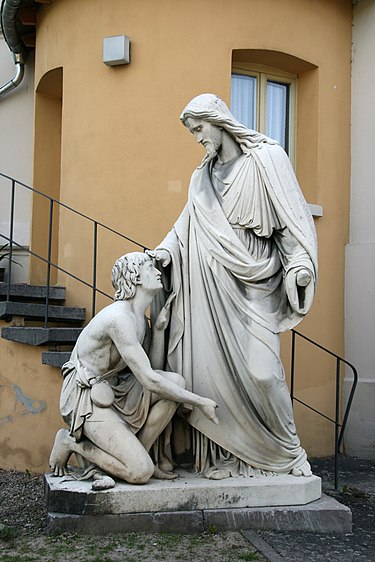
Jesus healing blind Bartimaeus, by Johann Heinrich Stöver, 1861

“Jesus stopped and ordered the man to be brought to him. When he came near, Jesus asked him, 41 “What do you want me to do for you?”

“Lord, I want to see,” he replied.”

42 “Jesus said to him, “Receive your sight; your faith has healed you.” 43 Immediately he received his sight and followed Jesus, praising God. When all the people saw it, they also praised God.”

Luke 18:40-43

Tradition tells us that his name is Bartimaeus. This man, led by others, plopped on a mat by a curb, that’s where he will hold out a basket to collect coins. Hopefully, he would do well, and if not–well there will always be tomorrow–another black and meaningless day. Is this is as good as it’ll ever get?

The crowd around him starts to get more and more excited, and this man, who is very much attuned to the noise of the things around him, tries to pick out conversations, he wants to understand. He keeps listening, and the voices get louder and louder, and he finally pieces together what’s happening.

He finally hears one of them shout out, “It’s the Messiah! It’s him–he has come!” At that moment he too stands up, and begins to shout himself. But his shouting gets louder, and it turns into screams. Within seconds he’s out-of-control, and wild and insane. He releases years of pent up anger and frustration.

The crowd, who was once preoccupied by Jesus’ interesting entourage, now tries hard to quiet this wild dervish down. But he quite mad by now, completely out-of-control. His deranged screams are those of man pushed totally beyond reason.

The original Greek text describes two different words in the New Testament.

The first word used by the crowd is used as a cry for assistance, and deliverance. It’s basically a “respectable” kind of a shout for help. Loud, but still within reason. Earsplitting maybe, but still aware of itself and yet somewhat respectable.

But the second kind of scream, isn’t the regular ‘run-of-the-mill’ kind, rather it’s the scream of someone extremely disturbed. It is wild, primal–something animalistic, shrieking, unearthly, something that’s very disturbing. It’s the cry when an animal goes berserk and in pain, chews off its leg that’s caught in a steel trap. It’s much more than loud, it’s a scream from someone that’s completely out of control.

Dear friend, this is not a human scream. He’s far, far past that point.

Jesus is completely in control. He’s not disturbed, shocked or offended–he’s not fazed by this awful darkness of this desperate man. He orders that he be brought to him. At that moment, all eyes are glued to Jesus and this blind man. I have to believe a hush fell over everyone, quiet enough for them to hear the conversation.

“What do you want me to do for you?”

Jesus asks that question, and it seems an unreal thing to ask. And yet Jesus speaks it into this man’s wild, raving, out-of-control pain. It was Jesus who calmed the turbulent seas; he is now reaching into this man’s incredible darkness. “What do you want?” It’s a question that must be asked.

“Lord, I want to see,” he replied.”

Jesus calmly announces to the man that his faith has saved him. At that instant Bartimaeus sees. That’s all that was needed.

I really need to ask you this–How far will you go, how loud will you get? How many people will you ignore to reach your Savior and your Healer? How insistent will you become? How outrageous will you get to see Jesus reach in and touch your need?

“Heartache forces us to embrace God out of desperate, urgent need. God is never closer than when your heart is aching.”

Joni Eareckson Tada

Impossibilities, #84

“Jesus looked at them and said, “With man this is impossible, but not with God; all things are possible with God.”

Mark 10:27 (context, vv. 23-31)

We’re pretty much like the twelve, sometimes it’s hard for us to connect the dots, and to see truth and love develop in our hearts. I suppose that this subject of possessions might be divisive–especially for Americans who live far above the world’s standard. I mean no harm, but maybe we can pray about this.

The issue in this passage is a disciple’s wealth. And if you really want to stir up a hornet’s nest, this is a terrific way to start (politics comes in a close second). The verse we’re looking at can be really confusing to us in different ways, and sometimes we’ll miss the point, and maybe at times we’ll even misapply this.

This passage is like the last one we looked at–they’re like puzzle pieces that fit with each other. I really must encourage you to look back at the last post, #83, to understand this one.

I must start out by saying I’m no expert in these matters.

But I’m really afraid for the church in the United States. My family and I worked for three years with several evangelical groups in Mexico–most of the time serving in the migrant camps. We learned Spanish, which was hard (especially for me). And when we crossed the border, we entered a world that was nothing like the life we had in the U.S,

It could get surreal at times.

We learned to live without electricity, or running water. Our water supply was a rusty 55 gallon drum, we had to boil the water to kill the mosquito larva. We fought with tarantulas, poisonous beetles, and an occasional rattlesnake. We managed for almost three years, and it was hard, but we learned an awful lot from other believers who had very little.

Some memories stick out.

Showing the Jesus film at night in the camps, with a white sheet for a screen and an old (and noisy) generator; Lynn and I packed in a little shack with 200 kids, fighting the heat and the flies, her beat-up guitar strumming out children’s songs. Converting our old van into an ambulance; fighting a fire that spread through a group of shacks; seeing my wife with her hands raw from the lye soap–scrubbing our clothes on a concrete washboard.

Perhaps I’m not the right person to write this post.

One of the things that absolutely stunned me though, was the heresy of the “Word of Faith” movement. I always thought it was confined to the U.S., but it’s not. It too spread like wildfire through the shacks of the poorest of the poor. In its extreme form it hurt many brothers and sisters.

There was this belief that having enough faith would set a person free from the grinding poverty. That somehow their positive confessions would somehow translate into material wealth. (It didn’t, and won’t–and I’m sorry). Sometimes people came to Christ to “escape” the destitution and the hopelessness, and I certainly don’t blame them. But it really did become a grief to me.

Some would come to Christ with the idea that he would meet all their material needs.

The 12 were astonished by Jesus’ declaration. (And they often were.) Jesus made it crystal clear that following him through the minefield of a believer’s wealth and service, was going to be really hard–actually he uses the word, “impossible.” But, if God got involved, it became possible.

Sometimes, something quite miraculous really did happen.

And quite often, it seemed like it was a miracle that ranked right up there with healing a leper, or raising the dead! Our Father met us time after time, and we really did know his hand of grace and kindness.

I’m very sorry if I offended anyone out there, that certainly wasn’t my intention.

“The words of Jesus amazed the disciples because they assumed that wealth was always a sign of God’s blessing and favor. They thought that the rich were especially saved.”

David Guzik

I’m His Unworthy Servant, #81

Born to Serve Others

“So you also, when you have done everything you were told to do, should say, ‘We are unworthy servants; we have only done our duty.’”

Luke 17:10, (context, vv. 7-10)

After many years of ministry— this particular passage has become one of my favorites. The path I’ve walked has been challenging, and it seems to me that I haven’t done it very well at all. I’ve been a fool much of the time, and yet, if anything, God has held me firmly in place. I haven’t always been faithful:

“Through many dangers, toils and snares

I have already come

T’was Grace that brought me safe thus far

And Grace will lead me home.”

Amazing Grace, Third Stanza

There should be a humility in doing the work that we begin to learn, and I really hope I’m communicating that to you. I sometimes see it in myself, and more often see it in others. I used to kill rattlesnakes when I lived in Mexico. It demanded a certain cautiousness, and lesson #1 was this–you never, ever take your eyes off of the snake–no matter what. We must approach ourselves that carefully.

The Lord Jesus tells us one of those stories of his. This, IMHO, it’s one of his best. It makes a lot of sense, and it resonates within me. And I must watch myself, lest I forget the idea behind this passage.

We live in a society of equals–having a servant today is frowned upon. (I really could use 2 or 3 myself.) But in Jesus’ time, it was the norm–some people were regarded as property. It was more common than we think, as 30-40% of the general population were slaves. Early Christians condemned this, and regarded all men as equals, and as a result, many slaves became believers.

Jesus uses the concept very well. It seems that after a hard day’s work, a slave still needed to prepare his master’s dinner. No matter how much he toiled out in the fields, he had a duty to serve his master in this way; and it does seem unfair–we live in a land “where all men are created equal.”

But this is how the Kingdom works. Yes, it’s a foreign concept, and we can’t relate–we can only imagine it. Jesus uses it quite adroitly. The servant works for his master; completely, exclusively.

“Pray as though everything depended on God. Work as though everything depended on you.”

St. Augustine

Most of us work the “fields” pretty hard. We get dirty, we toil hard, and we sweat under the hot sun. We dream of a glass of cold lemonade (with ice), and a cool shower when we quit the fields. But that isn’t the way it works. Yes, Jesus gives his laborers rest–but the work continues.

Someone once said, “the work goes on, even when God buries his workers.” Hopefully, the next generation will continue my humble efforts, and his work in his fields will continue. But, in the meantime I must “watch” myself carefully, and do his will out in his fields.

“What have we done for him compared with what he has done for us? Our service put beside Christ’s is like one single grain of dust put in comparison with the mighty orb of the sun.”

C.H. Spurgeon

The Other Nine, #80

Jesus asked, “Were not all ten cleansed? Where are the other nine? 18 Has no one returned to give praise to God except this foreigner?” 19 Then he said to him, “Rise and go; your faith has made you well.”

Luke 17:17-19, (context, vv. 11-19)

He was the unlikely one. Samaritans were at the bottom of the spiritual “food chain.” He was only included in the group because he also was a leper–a person’s religion meant nothing. He was a leper first and foremost, and after all, they do say that “misery loves company.”

The group of ten stood far away, so they had to yell. They “called out in a loud voice, “Jesus, Master, have pity on us!” (verse 13).

The text implies that Jesus never touched them, which is somewhat unusual because Jesus usually did. Their healing was a bit odd as well, as they were healed as they traveled to see the priest. That was one of the many duties the priest had to do, Leviticus 14:2-32.

So it seems that this particular healing wasn’t exactly instantaneous, but something gradual. But still, it required faith, but I have to believe that these guys may have expected something a little more. (But having faith sometimes, isn’t what we expect.)

The ex-leper, a.k.a. the Samaritan, returns and comes back to the One who healed him. The previous verses tell us that he fell at Jesus’ feet. Now tell me–was he “disobeying” the Lord’s command to go to the priest? I’m not so sure. When we consider that he was a Samaritan, and not really part of the Jewish religion or rites, it might make some sense.

He’s not rebuked by Jesus. Instead Jesus turns and in a way, lavishes praise on him. Maybe there is an application here to those we consider to be “outside” of our faith. Sometimes rules get broken by those who we consider on the margins–they seem to be external to our religious sensibilities.

“Your faith has made you well,” is Jesus’ evaluation; he recognizes the essentials that are necessary. Jesus understands the reality of this man’s faith in him–and it’s that faith which has becomes the conduit for his healing.

“Christ will always accept the faith the puts its trust in Him.”

    Andrew Murray

The Father, #76

“If I am not doing the works of my Father, then do not believe me; 38 but if I do them, even though you do not believe me, believe the works, that you may know and understand that the Father is in me and I am in the Father.”

John 10:37-38

The Father is in me.” This is one of the clearest passages Jesus uses to explain his ministry. His listeners are doubters. They have decided that he must be executed for blasphemy. In verse 31 we read of their deep, deep anger–“The Jews picked up stones again to stone him.”

It’s crazy how “bad religion” affects people. The Pharisees thought for certain that they were defending God’s honor. They really believed that they were doing exactly what they needed to do. Their religion demanded it.

“I and the Father are one” (v. 30), really disturbed them. Leviticus 24:16 delineated their duty. They must defend God from blasphemers, it was their duty as religious leaders. And Jesus was one of the most egregious offenders that they had ever seen.

This confrontation between them and Jesus was quite intense, and yet Jesus, (instead of backing off) presses the issue. The Father has sent him–Jesus must speak the truth, and there is absolutely no sugarcoating his message. He very clearly states what is real. It has to be believed.

“Believe” is mentioned three times. “Know and understand” are thrown out there for good measure. All explain the necessary components that must be present in a saving faith. And yet, all it did was make them angrier.

I believe that Jesus speaks softly, and with wisdom and compassion–but what is real and true, must be spoken. I really don’t think he “returned” their anger. That would’ve been wrong. And John doesn’t mention it.

“A hot-tempered person stirs up conflict, but one slow to anger calms strife.”

(Prov. 15:8)

“The Father is in me and I am in the Father” explains his ministry, and Jesus can’t, or won’t, compromise his message, or the truth. It is a fact. It’s something you can hang your hat on.

“He is not ‘making himself God’; he is not ‘making himself’ anything, but in word and work he is showing himself to be what he truly is – the Son sent by the Father to bring life and light to mankind.”

Bruce’s Commentary

When they looked at Jesus–they saw the face of God. The Father was living in him–and he resided in the Father. This is the truth, and it blew out their religious circuits. It was something they simply couldn’t accept.