“Foxes have holes, and birds of the air have nests, but the Son of Man has nowhere to lay his head.”
Matthew 8:20 (context, vv. 18-22)
A scribe wants to become a disciple–but he really hasn’t the slightest of what following means. This passage (vv. 18-22) is radical. We find a perspective that stretches and corrects our understanding of life itself. We’re forced to see things from a completely different point of view.
“I wonder if this man thought, ‘Well, now, I am a scribe. If I join that company, I shall be a leader. I perceive that they are only fishermen, the bulk of them; and if I come in amongst them, I shall be a great acquisition to that little band. I shall no doubt be the secretary.’ Perhaps he may have thought that there was something to be made out of such a position; there was one who thought so.”
-Charles Spurgeon
We find something disturbing here. Jesus and the twelve are living day-to-day without the security of a home. They are homeless. And if we seriously think about the ramifications of following, we are left with this strange idea of a radical renunciation. The Lord Jesus makes it very clear that this is His plan for everyone who asks permission to follow.
“Jesus didn’t tell the man “No, you can’t follow Me.” But He told him the truth, without painting a glamorized version of what it was like to follow Him. This is the opposite of techniques used by many evangelists today, but Jesus wanted the man to know what it would really be like.”
-David Guzik
Sometimes we try hard to understand exactly what this means in the 21st century. But we can never reduce or minimize scripture. If we discover that something grates us the wrong way, that typically means that the scripture has special meaning for us. I have learned that the truth is almost always negative when we first hear it–and I don’t know why this is so.
“All that is gold does not glitter, Not all those who wander are lost.”
30 “They went on from there and passed through Galilee. And he did not want anyone to know, 31 for he was teaching his disciples, saying to them,”
“The Son of Man is going to be delivered into the hands of men, and they will kill him. And when he is killed, after three days he will rise.”
32 But they did not understand the saying, and were afraid to ask him.”
Mark 9:30-32
There are no illusions found in these verses. This passage is painfully practical, and whenever I read it I’m forced to take another slug of reality–Jesus will die. Evil men will kill Him. I don’t want to see His ministry end like this. Deep inside, I want to His ministry to continue. I need to hear more parables, and see more miracles.
But thinking squarely isn’t always my best point. I sometimes like illusions. They seem like necessary padding for the stark rigors of living. They’re nice to have around. But I do know that gripping reality is needed. It’s harsh and rude, and some of us avoid it like vampires dodge picnics.
The disciples must get real and extend their thinking about the Kingdom. They’ve been witnesses to all those supernatural things that the Messiah is doing. It’s all been very good. But now they must think deeper, and even more redemptively. Jesus will-must die, and He will rise. Why?
The Holy Spirit is always pouring love on us. I know that all that He does is done by love. Whether it’s touching a leper or feeding 5000, it’s love that is Jesus’ reason and clearest motive. Easily seen in these amazing miracles, and somewhat harder to picture when it comes as betrayal and murder. (God help us adjust.)
Jesus will (must) die. That is His accurate prediction. The disciples must clear the decks and assimilate this fresh information. They’re needed to grab this and make it part of their understanding. They are now witnesses, completely and wholly grasping the deepest realities of the Kingdom.
The gospel of the Kingdom up to this point is indeed a wonder. Teachings and healings, miracles and resurrections are becoming the norm. We all want to see them continue. We are shocked when Jesus takes this morbid perspective! How perfectly awful. (NOT the way to win disciples!)
The death of Jesus Christ, and His resurrection, is the next necessary miracle. It is needed to redeem and ‘heal’ the entire world. Oh yes, Jesus touched a leper, forgave the whore and raised the dead–but these are miracles that primarily touched individuals. He intends to kick it up a notch.
Jesus is going to die for us all. Isn’t that outrageous?
“This is my beloved Son, with whom I am well pleased; listen to him.”
Matthew 17:5, (context, vv. 1-8)
Sometimes God uses a megaphone. At least whenever I read this account I always have that impression. Perhaps, like these three disciples, we are being led into these situations were the voice of God becomes extremely audible. When we do hear Him it occasionally freaks us out.
The disciples collided with God’s glory and it altered them permanently. Peter recalled these many years later in 2 Peter 1:17-18–
“…when he received honor and glory from God the Father. The voice from the majestic glory of God said to him, “This is my dearly loved Son, who brings me great joy.” 18 We ourselves heard that voice from heaven when we were with him on the holy mountain.”
Peter remembers the voice. At the end of his life that is what amazed him–Peter couldn’t forget, it was something he couldn’t shake. He had seen astonishing things that afternoon, profound things; but at the end he recalls that voice. When we read this, we realize that it wasn’t the visuals so much as it that voice that terrified the three of them.
*****
“Rise, and have no fear.”
Matthew 17:7
Peter is not penalized for his distressing behavior on the mountain. I’ve read this passage over the years, and every time (without fail) I’m totally embarrassed by Peter. He is completely out of mesh here–he acts like clown. He hasn’t a clue.
When the three hear the voice they fold–they are terrified to the point of collapse. The Greek word is “phobos,” the root of our word phobia. This is intense, knee-shaking, face-falling fear. (“Loose bowels” is just slightly more intense.)
Jesus steps right into this situation. He understands completely. He may have even smiled? He reaches to His own and lifts them up. “Don’t be afraid anymore” can be very comforting to hear, especially coming Jesus.
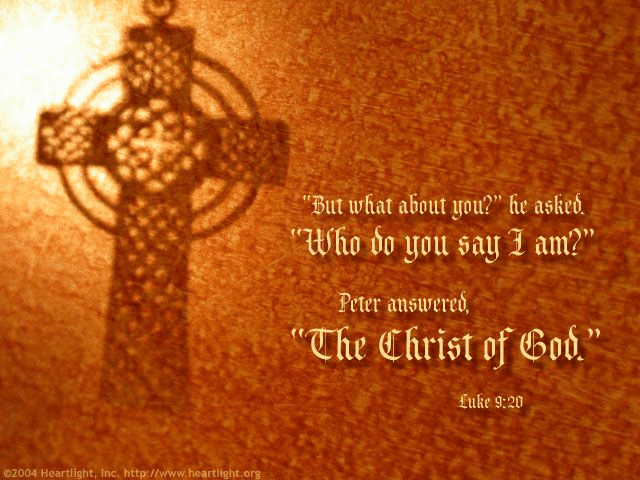
The question is significant; and it’s never been fully answered. Perhaps each of us must be asked this exact same thing. And perhaps it’s the crucial question that every human being who has ever drawn breath must ask themselves. Who is Jesus? Who is He really?
The crowds had witnessed Jesus feed them with a little boy’s lunch. They saw miracles and heard teaching, and yet maybe they were a bit confused. They could only put Jesus in the context of what they knew was “allowable” by the Pharisees. He definitely was some kind of prophet. Jesus was being evaluated by a very curious crowd.
Jesus isn’t distressed by this, He’s not full of self-doubt or second thoughts. He’s not looking around for our support–or accolades, palms or laurels. He knows exactly who He is. He is the only Son of God, the second person of the Trinity. He is fully and completely God; and He is now wearing a robe and walking around in sandals.
There exists a “crowd faith,” something more or less aware that God cares, and miracles do happen in this life. This is all well and good. But it seems there is a “personal faith,” which Peter now announces out loud. “You’re the Messiah, come from God.”
What Peter declares in front of everyone changes everything.
We must always draw our own conclusions, of course. We must look at Him, and decide for ourselves what He claims to be. There is no question it’s scary, and it’s hard. But you, and you alone, must decide. Crowd faith is almost always good, I suppose; but Peter’s bold declaration is what He really is waiting for. Are you convinced yet?
“I have compassion on the crowd, because they have been with me now three days and have nothing to eat. And if I send them away hungry to their homes, they will faint on the way. And some of them have come from far away.”
Mark 8:2-3, (context, vv. 1-8)
This one differs from the other miracle of feeding found in entry#42, “The Feeding of the Five Thousand,” (Luke 9.)
In that first instance, (see my most very humble entry, #42) the miracle comes as a surprise, more of a reaction to the moment. This second one though, is a tad more ‘contrived’–it’s designed by the Maker to be a lesson for all prospective disciples. It’s not that the first is a complete surprise, rather, it seems anyway, the other is more expected.
He watches over me, and He does keep me. He’s aware of my every need. This must be understood.
I believe everything he does, he does it out of compassion. That’s how His mind operates, that’s what makes him tick, He always acts this way. He is predictable, and you can trust Him, He will never intentionally hurt you. He will lead you through all this crap.
“No matter how low down you are; no matter what your disposition has been; you may be low in your thoughts, words, and actions; you may be selfish; your heart may be overflowing with corruption and wickedness; yet Jesus will have compassion upon you. He will speak comforting words to you; not treat you coldly or spurn you, as perhaps those of earth would, but will speak tender words, and words of love and affection and kindness. Just come at once. He is a faithful friend – a friend that sticketh closer than a brother.”
“Then Jesus answered her, “O woman, great is your faith! Be it done for you as you desire.”
And her daughter was healed instantly.”
Matthew 15:28, (context, vv. 21-28)
Negotiating with God is not for the timid. It takes spiritual guts, and very few do it right. This chapter begins with a strong teaching on Jewish tradition and moral purity. The scribes and the Pharisee’s have cornered the market on social and religious correctness, and they have a solid grip on the Jewish faith. You must do what they say.
Suddenly there’s a noisy commotion, up jumps a Gentile woman who is terribly loud and terribly desperate, she’s caught somewhere between rudeness and hysteria. She has a disturbing need for her daughter to be released from a demon’s control–there’s a satanic oppression that wants to destroy her. Only Jesus can stop it.
The Judaism of Jesus’ day was not doing its job. Israel was meant to be a “light to the Gentiles,” and a source of healing and truth to the nations of the earth. Clearly it had become confused–its traditions and ceremonies that had nothing to do with the salvation of the world.
Perhaps the failure of the Jewish people to reach the world parallels the failure of the Church to carry out Jesus’ Great Commission? Religion has always stood in the way of God’s heart and His plan to bring salvation to everyone. I think this is the main reason Jesus hated it so.
This woman has a need that only Jesus could meet. She embarrasses herself insisting that Jesus take action. She seems almost rude to the point of being obnoxious. She is repeatedly told to be quiet, that her daughter’s deliverance was not in the plan of God. But that’s an answer she will not accept.
How honest are my conversations with God? Do I say what I really think? Do I intercede for others?
This is one of more unsettling verses in the New Testament–at least for me anyway. Everyone in this passage seems somewhat rude, even a bit boorish to me–even Jesus seems off, which really does unsettle me. There’s a stilted awkwardness in this passage that makes me want to apologize about Jesus’ attitude to all my unbelieving friends. I just don’t get all the national, racial, and social issues that are involved here.
An addendum though: Not every scripture is ever grasped once, and for all time understood. I’ve learned there are verses that reveal their layers years later. Onion-like. I think that this is probably true–for me anyway. The same verse will speak to me over and over again.
“Let them alone; they are blind guides. And if the blind lead the blind, both will fall into a pit.”
Matthew 15:14, (context, vv. 1-20)
One of the most descriptive issues of a cult is how much emphasis is based on conforming to the teachings and example of the leader. They’re to be obeyed, without any question or reservation. There can only be following, and how well you do that determines your “faithfulness” to what they are teaching as truth.
A religious walk will often emphasize conformity to a certain leader. He is the one who now directs our path. When we follow him we think we’re walking in truth. But Jesus warns us that there is a blindness that becomes dangerous to our spirits.
Jesus didn’t come to make you conform, He came to “transform.” We follow Him with our eyes wide open–we’re seeing for the first time. We’re finally perceive things as they really are, we no longer are wearing blindfolds, we no longer stumble over the bumps and pits in our path.
He makes us see. Jesus gives us spiritual sight that transforms us. We’re no longer following blind men, who only guide us into deep ditches, rather we now see where we’re going. We now walk in the day, and not in the dark night. This new sight is His gift to you.
Even when it’s dark out, we understand our path and where it’s leading us. The believer relies on the Word, it’s now his real source of understanding, it is now his light. We have the Holy Spirit which is our guide–He leads us into all truth. We no longer follow men, we follow Jesus!
“For at one time you were darkness, but now you are light in the Lord. Walk as children of light.”
28 And Peter answered him, “Lord, if it is you, command me to come to you on the water.” 29 He said, “Come.” So Peter got out of the boat and walked on the water and came to Jesus.”
Matthew 14:27-29, (context, vv. 22-33)
Jesus is full of surprises! You can never guess the things He will do next. He is Lord after all. To walk on water is totally impossible. But Jesus does it. He walks on it as if it were a concrete sidewalk. He totally scares His disciples sitting in the boat. When they see Him they freak out. They couldn’t believe their eyes.
Jesus wants to reveal to His disciples His true nature. They had just seen Him multiply fish and loaves, He fed five thousand plus just a few hours ago. Wasn’t that a miracle enough? It seems that Jesus doesn’t think so. We now see Him strolling on the water like it was solid ground.
For some inexplicable reason, Peter wants to insert himself into Jesus’ miracle. Oddly, he has decided he’ll join Jesus, and leave behind the security of the boat–for the insecurity of the impossible! He truly believes that Jesus can hold him up somehow. Perhaps this alone is the most amazing part of this passage. Can a man duplicate the walk of Jesus? Can we walk like Him?
Peter really wants to leave the security of the boat, for the insecurity of the impossible.
It seems to me that we’re constantly doing the “Peter thing.” It’s true our walk of faith really is intensely supernatural, and yet we somehow forget this. Face it, we will never generate the “fruits of the Holy Spirit” on our own. Our most sincere effort simply will never turn water into something solid. We will never walk the disciple’s path without a faith in the Master who calls us to come to Him.
I think Jesus wants us to join Him. Our faith in Him is the key. We believe that we can walk with Him, we believe we will see the impossible. Without question it’s Jesus’ power that holds us up. Our faith in Him is the ignition point in all of this. Our mustard seed faith, combined with Jesus’ power. becomes the true walk of the disciple.
We must bravely launch ourselves into the purposes of God. To merely sit in the boat is hardly faith. When Peter steps over the gunwales, he steps into the world of the amazing. The water holds him, and his trust in Jesus solidifies like the water he walks on. He is now doing the impossible. He is now becoming very much like Jesus.
Our walk seems terribly weak at times, we can easily list our sin and weaknesses, our spiritual ugliness. We’re not quite convinced that the blood of Jesus covers all our sin–and we can’t step out of the boat. I think it’s Peter’s faith in Jesus’ power that holds him up. When his faith falters, he does the “rock thing,” There is something about his circumstances–the wind, and the waves that begin to frighten him. (But I must believe Jesus was pleased.)
Just let him sink, and teach the 11 who sit in the boat about the perils of unbelief? Nope.
Fear trumps faith. Adversity always frightens. We sink when our flawed faith can no longer hold us up. The amazing thing though, Jesus doesn’t change His mind or heart, He is still in the business of doing miracles. He calls His disciples to believe in Him–to have faith in His power. To really understand, to step out in faith, and to see miracles happen.
“Christ will always accept the faith the puts its trust in Him.”
“They need not go away; you give them something to eat.”
17 They said to him, “We have only five loaves here and two fish.”
Matthew 14:16-17, (context, vv. 14-21)
The people are hungry. The disciples are worried. A very large number had come to listen to Jesus speak/heal. Earlier that day (in verse 14,) He responds and heals all that were sick, ministering to everyone out of deep, deep compassion (also found in verse 14.)
The crowds wanted to see some healings, (which was pretty much their ‘entertainment,’ breaking up a fairly dull existence,) And perhaps some of them scoured the streets to find the really hard cases–just to see if Jesus could pull it off. (“Let’s get ‘Joshua,’ he’s blind, and crippled and a leper besides–he’ll be a real challenge!”)
The dusty day was done (v.15.) The surroundings were “desolate,” and the crowds were getting antsy. But the merchants were happy, they’d sellout and make a bundle! And the disciples–well they were concerned about the crowd dispersing. They hoped that Jesus would dismiss everyone before it got too dark. (Apparently, not only did they forget to bring food, but they left their flashlights at home.)
It’s interesting to note that Jesus seems to look for new ways to teach His disciples. (They need to learn the Kingdom.) Jesus wants them to become involved in this particular miracle. They would distribute the food, and perhaps mingle a bit. (No sidelining for you, Thaddeus.)
And could it be this is how He operates with all of His disciples? Could it be our response all these crazy-life thingees we have to deal with are revealing to us–and to everyone–how deep, and wide, and far our discipleship really does go?
Jesus throws out a challenge, but in order to make this happen, the disciples had to shake down a kid, and take away the lunch mom had packed. All this for two fish, and five loaves of bread. Apparently no one else thought to bring bring any food. Perhaps no one expected it to be a long day, and packing a dinner basket around was a hassle. Who knows?
Five loaves, two fishes.
The official count was 5000, plus the women and children. I imagine that the disciples were a little confused. Maybe intimidated too. Perhaps there was an effort among them to discourage Jesus from keeping the crowd hanging around? “Surely Jesus wasn’t serious, He just needed to understand these things.”
The disciples think taking away the boy’s dinner was completely idiotic in the light of the situation. Then maybe Jesus would then understand all this silliness, and make an announcement that the day was done. The crowd was milling around, perhaps ‘catching up’ with friends and distant relatives–the kids were playing tag nicely for a change. And maybe they stuck around to see if Jesus would heal (or teach) again. They certainly didn’t want to miss the show.
The disciples had already seen a ton of miracles. They had heard tremendous teachings. (Those parables were mystifying though.) But everything about Jesus as the real Messiah seemed to click (at times.) And I do think they understood–at least to a degree. And yet Jesus is stretching His disciples even further into this whole idea of discipleship.
I think Jesus wanted them to learn about the two tools they should use:
One–for each one to understand God’s amazing love for people.
Two–for them to grasp God’s almighty power in every situation they will face..
The disciples must learn to use these. In order to pull off this idea of making disciples throughout the big blue earth–they’ll definitely need lots and lots of compassion, and a really strong confidence in God’s power. After all they merely had to break through every bit of darkness they came across; and carry in the light. Just like Jesus! Easy, right? (“Holy Spirit, we need all the strength you can spare.”)
The twelve really have to become aware, and snatch up these two–they’re not trivial. They seem to be the very steady heartbeat of discipleship. Understanding these two principles causes the deep nature of the Kingdom to enter these hard human hearts. (Some of us need a ‘transplant.’) We have to apply His compassion again, like a bandage on the wounds. We need to wield His power once more, cutting away the lies.
Both dear one–are really, really needed right now.
“God’s work done in God’s way will never lack God’s supplies.”
“A prophet has little honor in his hometown, among his relatives, on the streets he played in as a child.”
Jesus wasn’t able to do much of anything there—he laid hands on a few sick people and healed them, that’s all.”
Mark 6:4, the Message
“For some reason, they hate me.” There’s a real pain that we give each other, especially when it’s on the level of friends and our close family. It seems those relationships are vulnerable, and have the most exposure. When somebody close to us has an issue with us, that pain is deep and lasting. Others well, not so much.
Those closest to us have seen our issues. They’ve seen us at our best, and definitely at our worst. Other relationships are briefer, and they see us, and only subjectively. The salacious details never come out into the open, and we certainly won’t reveal them.
Jesus, the sinless one, faces the same problem in His hometown, the village of Nazareth where He was raised. He has already worked incredible miracles, things that absolutely stagger the imagination. He has raised the dead, healed lepers and cured the paralyzed. He has walked in the light of God unlike anyone who preceded him.
And His teaching? Oh my, no one was ever listen to such marvelous words that describe the Father’s kingdom so well. His words do astonish, and bring absolute light into some pretty dark darkness. The things He says, are astonishing. There has never been anyone like Him.
When Jesus returns to His hometown He discovers an insidious resistance to His words and miracles. People think they ‘know’ Him. A few remember Him playing with their own children–kicking the can, or riding around on the neighbor’s donkey. They ‘think’ they know Him. They really do. But they’re very much mistaken.
But what about our own misconceptions?
There are lessons in this passage we need to learn. Does my idea of Jesus limit or restrict His work? Perhaps we should realize that His miracles often stop when our unbelief begins. Since we think we know Him so well, we think we determine what He can, and cannot do. But seriously, do we truly grasp who Jesus really is?
“Unbelief is not a misfortune to be pitied; it is a sin to be deplored. It’s sinfulness lies in the fact that it contradicts the word of the one true God and thus attributes falsehood to Him.”












 The Red Letters of Jesus