“Lord,” Peter asked, “Why can’t I follow you now? I will lay down my life for you.
38 Jesus replied, “Will you lay down your life for me? Truly I tell you, a rooster will not crow until you have denied me three times.”
John 13:37-38, CSV
He knew. And he still loved him anyway. Can you really quantify the depth of this? Verse 37 claimed Peter’s willingness to follow, and even die if he had to. I believe with all my heart that Peter was sincere. He would follow, and Peter was willing to die.
But Jesus bought none of it, he knew. He poses a question to Peter–the type of question that penetrated Peter’s interior bravado. It’s said that “the spirit is willing, but the flesh is weak.” Perhaps this is true here. Maybe Jesus knew?
What about you? And me? Does he really know us to this degree and depth? When he looks at us, I believe he knows the weakness and faltering steps we take, and yet his love for us is unconditional. It doesn’t hinge on our misplaced zeal or faltering commitment. His love for us overrides our weakness. That comforts and disturbs me, and I don’t really understand how he does it.
Have you heard the rooster? Maybe that’s his way to teach us the depths of his love.
“God has paid us the intolerable compliment of loving us, in the deepest, most tragic, most inexorable sense.”
Who wants to fall? Not me. This very blunt declaration has to be understood by that which immediately proceeds it: the “Parable of the Vineyard Owner.” This isn’t one of your nice ‘run-of-the-mill’ parables either. It’s got some real teeth.
It really is a potent stuff. The authorities–over, and over have rejected God’s prophets–everyone that he has sent. They do this continuously–history really does repeat itself. Finally, God finally sends his Son, and they decide (quite coldly) to kill him, and take the vineyard over for themselves.
Disobeying the voice of the Holy Spirit is a terrible thing.
And I’m afraid it’s done fairly consistently. He speaks over and over to us, but we’ve disobeyed him so often we can’t hear him anymore. His voice is often a quiet one, and we no longer really look or listen for it. Dear one, I’ve been in ministry for over 35 years, I’ve seen it up close, I’ve seen it in myself.
When we repeatedly ignore his voice, we’ll find ourselves in spiritual silence. We’ve now become spiritually deaf.
And guess what, we won’t even know it. We think we’re doing okay spiritually. But we really don’t hear him anymore. And that’s precisely what the leadership of Israel has done. They no longer hear him. Read their response. They don’t believe this parable, (maybe they think it’s funny?)
“When the chief priests, the scribes, and the elders heard this, they said, “May it never be!”
(verse 16b)
That really should disturb us–and it’s frightening. But you must understand, it’s not confined to them–it’s launched at us as well. His parable travels through the centuries, and nails us. The translation of that particular “promise” in verse 18 might help clarify any ambiguity we might have:
“Anyone falling over that stone will break every bone in his body; if the stone falls on anyone, he’ll be smashed to smithereens.”
(v. 18, the Message)
It’s a promise. We’ve got this tendency to think of God’s promises as wonderfully positive. But this promise is scary. The price of ignoring Jesus has consequences, and these “chosen” people are about to discover judgement. They have ignored him for the last time.
The nation of Israel will be destroyed by the emperor Titus. The ancient historian Josephus wrote that he killed 1,100,000 Jews and they carried 97,000 as slaves to Rome.
At this particular moment in time, it’s critical that you learn to hear what the Spirit is speaking to you.
You’ll need to learn to distinguish his voice through the world’s static. But we much rather keep the status quo, and simply ignore this dark moment. We don’t want to listen that close. Maybe we’ll become “weird.”
Perhaps you’re afraid of what he might say. Maybe you’ll need to turn away from something that is causing you to go deaf? But I must tell you, hearing him is a joy. I guarantee it’s worth it. It’s what you were created for!
“One of two things you must do; you must either receive Him or reject Him. You receive Him here and He will receive you there; you reject Him here and He will reject you there.”
23 “Jesus replied, “The hour has come for the Son of Man to be glorified. 24 Very truly I tell you, unless a kernel of wheat falls to the ground and dies, it remains only a single seed. But if it dies, it produces many seeds.”
Almost 1/2 of John’s gospel is dedicated to Jesus’ last week. Verse 24 seems to sum up Jesus’ understanding of things, which he now communicates to his disciples. The issue at the center seems to hit on the very core of God’s incredible idea of the Kingdom–death and resurrection.
Perhaps that’s the solid principle behind his way of conducting business. He doesn’t want us to be afraid, and honestly, isn’t the fear of death the most frightening and darkest terror of all? Jesus now turns it around and proceeds to pound it to pieces, and we shouldn’t pick it up and try to glue it back together. Let’s leave it there, and walk away.
Death becomes life. Crazy, huh? And yet he’s explaining how the Father does it. Jesus completely understands this, and it’s his death that will bring life to millions and millions. Oh my, the pain will be real for him. But it’s not really the end of it all. “It’s Friday, but Sunday’s Coming!”
Grasping this becomes the incredible idea that energizes the obedient disciple. It isn’t a ‘Jesus-only’ concept. It’s not exclusively unique to him. I suppose to a degree it is–but isn’t it really part of the economy of God? Isn’t it his particular way of doing things–to extract life out of dead things? (I think he gets a kick out of doing this?)
Brother, don’t be afraid. Sister, he does see your fear and misgivings about dying. In our natural way of thinking, dying is dark and perhaps it might be painful. IDK. But to the person who was been given ‘spirit-eyes’ it now is the way we are to live and bring life. In a weird sense, we’re all Lazarus, and when we hear his voice calling us–we’ll get up and shake off our grave clothes.
“They, then, who are destined to die, need not be careful to inquire what death they are to die, but into what place death will usher them.”
45 And he entered the temple and began to drive out those who sold, 46 saying to them, “It is written, ‘My house shall be a house of prayer,’ but you have made it a den of robbers.”
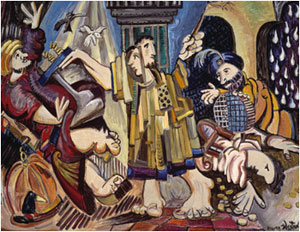
People detest hypocrisy. I’ve discovered that no matter who they are–pagan or devout believer, there is an awareness of this kind of religious evil. As I considered art for this post, I came across dozens, and dozens of different takes on this passage. One could open up a large gallery simply on “Jesus Cleansing the Temple.”
The priests and the merchants had a corner on the market. There was a need for pilgrim to have animals for sacrifices. But it was said that you could buy a pair of doves for 5 cents outside the temple, but once you entered they sold for 75 cents. The pilgrims also needed to change over their native currency to the temple money. That too, made a tidy little profit.
Jesus had visited the temple numerous times. He was dedicated there, and as a boy he taught the elders and priests. On his own pilgrimages 4 times a year, he witnessed the steady commerce that was done. Since the temple work went on 24 hours a day, the tables had to be constantly manned.
The issue here was authenticity. Keep in mind that this would be Jesus’ last visit. In a few days the authorities would publicly beat and then execute him. In some sense, Jesus was making a clear statement. Being fully God he had the right to declare the validity of what was going on. And it wasn’t good.
The temple was there for prayer. It was the place where God and man could meet each other. Every block laid, every pillar set, was a declaration of this idea. God and man reunited, with a sacrifice for sin. It was to be the official place where this would happen. And it would require a sacrifice for sin to open up a way to worship and pray.
Faith was hijacked by men who really didn’t believe. A flourishing industry had developed–religious language and ideas became the way to fleece those who really did believe. The greed of certain men had compromised real worship. Evil had worked its ugly way into the very core of the faith. It was an terrible thing.
The tables were located in the outer courts. These courts were as far as Gentiles could go–it was for them who wanted to pray. Jesus understood Isaiah, and quotes it in his rebuke, (Isa. 56:7). The religious evil that developed there was truly an abomination–and it had to stop.
We need to be aware that we’re definitely attracted to this kind of hypocrisy. We dare not point the finger too quickly –yes, we need to see it–not to pass judgement, but to understand the hatred God has for this sin. The temple of our bodies belong to him. He will enter our lives–he will flip our tables if he has to, he won’t tolerate our hypocrisy.
“Jesus said, “Let her alone. She’s anticipating and honoring the day of my burial. You always have the poor with you. You don’t always have me.”
John 12:7-8, (context vv. 1-8)
She came and poured perfumed oil on Jesus feet. She massaged it in with her hair. What she did was out of love, and maybe concern? She knew and understood. Many of us deeply understand with what she did–Mary has become a person that we identify and engage. She is doing what we would have done. (At least we hope.)
That perfume was a concentrate–it was the source for smaller vials. The oil Mary used was undiluted and not weakened in any way. It was not diminished or thinned, it was powerful stuff. What she did was an extremely costly act. Notice that it was a whole pound–and the text states that the entire house was filled with the scent.
When Jesus was being scourged and crucified, the odor of that perfume would’ve been present. That smell was still there, and most likely it sustained, and even encouraged him. Perhaps our acts of love–of sacrifice, of deep worship mean far more than we realize?
But there will always the ones who are practical.
All they see is the incredible waste. Judas had a pragmatic, reasonable and more sensible position. The other 11 felt the same. As they analyzed Mary’s actions all they could see was the terrible waste. There came a point when Judas, who controlled the finances, just had to speak:
“Judas Iscariot (who was about to betray him), said, 5 “Why wasn’t this perfume sold for three hundred denarii and given to the poor?” (vv. 4-5).
“He didn’t say this because he cared about the poor but because he was a thief. He was in charge of the money-bag and would steal part of what was put in it.” (v. 6).
So dear one, who was right? The other Gospel accounts tell us that the disciples also felt this way, (Matthew 26:6-13). The general consensus was that Mary was far too excessive. After all, 300 denarii was a lot of money–a denarii was a day’s wage. It was probably more money they had ever seen!
It’s interesting that Mary unbound her hair. That was anathema in Jewish culture. It was the clear evidence of an immoral woman, a prostitute. But yet she did it. Mary did not stop to calculate public reaction. She knew deep down that it was the only thing she could do for him.
What exactly is worship? What part of it do we not understand yet? Does it matter what is in our heart?
It is interesting that was immediately afterward this that Judas Iscariot left, and set up an agreement to betray Jesus.
“Is anything wasted which is all for Jesus? It might rather seem as if all would be wasted which was not given to him.”
“So many times I have longed to gather a wayward people, as a hen gathers her chicks under her wings—but you were too stubborn to let me.”
Matthew 23:37, TPT
Scripture tells us that Jesus only wept twice. The first at the tomb of Lazarus, when he cried over the evil and destructive power of death. The second is here–the night before he was crucified, where he stood on the Mount of Olives–and wept over the city of Jerusalem. The disciples saw (and noted) that his tears rolled down his face.
Mother hens do not provide milk for their chicks, they simply aren’t equipped for that. Instead they teach them by example–and occasionally hold food in their beaks until the little ones get the idea that they can scratch on their own. The yolk sack from their eggs they are hatched from will provide food for the first 72 hours–after that, they’re on their own.
Chicks will always return to their mother. She provides them with heat and shelter. You’ll see then snuggling up to mom, especially when the weather gets cold, wet–or for protection. The little chicks instinctively know that she has all that they need. They’ll always stay close to her.
There is no “magic force field” for the believer. We’ll face all the things that the unbeliever does–but he does cover, and lavishly provides the grace and peace that we need. Life can be brutal and nasty, there is no question about that.
“O God, have pity, for I am trusting you! I will hide beneath the shadow of your wings until this storm is past.”
Psalm 57:1
The Lord will always protect his people. He’s intensely aware of us–he shields and provides everything we need. He covers us, keeps us and protects us. We truly belong to him.
Do we really understand this? Do we really grasp the profound implications of his promises?
I have many questions (of course.) Why do we do the things our Father hates? Do we bring him tears by the way we behave? Will we come to him at the first sign of “danger?” The city of Jerusalem was stubborn, and unreceptive–can I also resist him?
“But let all who take refuge in You rejoice; let them shout for joy forever. May You shelter them, and may those who love Your name boast about You.”
“I told you that you would die in your sins, for unless you believe that I am he you will die in your sins.”
John 8:24, (context, vv. 21-30)
Death is defined in a very basic sense, as the cessation of life. You’ll simply stop breathing, and your heart will no longer beat. You’ll be brain dead in a matter of minutes. And perhaps it’s then you’ll suddenly realize that you really do have an expiration date. (Will it be a burial, or a cremation?)
I don’t want to sound morbid. That really isn’t my intention. I know I can be blunt–but please, don’t dismiss this ghoulishness as the prattlings of a really weird person. I sometimes think we really need a jolt; it teaches us to take life a wee bit carefully. Our days are numbered–whether we like it or not.
“Teach us how short our lives are so that we can become wise.”
Psalm 90:12
The words of Jesus can be somewhat stark and terribly pointed— It’s silly I know, but there’s something here that feels like you’ve got a pebble in your shoe. It annoys you, but you’ll try pretend its not a real problem, you’ll survive, you’ll do just about anything but sit down and shake it out, or else you’ll learn to walk funny. But he’s now speaking truth to us, and his words are crystal clear, they cut us like a scalpel.
There’s a militancy in verse 24, something that’s granite hard, and it doesn’t flex like we want it to. Spiritual honesty has never come easy to humans, and to be honest, we’ll choose varying intoxicants over what is real. “Truth. You can’t handle the truth”, is a line from a movie that somehow got stuck in my brain.
Experience has taught me that truth is almost always negative when it’s first encountered.
“Unless you believe that I am he you will die in your sins” can be chilling, and if we’re really, really honest it might feel like a steel-toed boot in our solar plexus. It somehow takes the breath right out of us. When Jesus rebukes the Pharisees, they begin to suffocate. They can’t handle what he’s saying, so of course they fall back, they resort to their carnal specialties–accusation and slander.
Believing–that seems like it’s the critical component. I think that Jesus spoke this truth with real compassion. He’s not like us. He’s not fighting back. He simply declares what’s true–and believe it or not, he desperately wants them to believe him. He loves each one of these religious rascals, and because of that–truth has to be plainly spoken–he wants to save their souls.
“If you look for truth, you may find comfort in the end; if you look for comfort you will not get either comfort or truth only soft soap and wishful thinking to begin, and in the end, despair.”
“Truly, truly, I say to you, if anyone keeps my word, he will never see death.”
John 8:51, (context, vv. 48-51)
R.I.P. “Requiescat in pace”, was discovered etched on the walls of catacombs that dated 150 AD. It was done by early Christians and indicated that “they died in the peace of the Church, that is, united in Christ.” The abbreviation R.I.P., is now used today–“Rest in Peace.”
Death is inevitable, none of us are going to escape it. Exactly 100% of us will step out into this unknown, and as far as I know no one except Jesus has returned to tell us what to expect. But he completely understands our fear, and he will guide us through this moment. He will not let you face death frightened.
“Every man must do two things alone; he must do his own believing and his own dying.”
Martin Luther
Jesus promises eternal life to all those who keep His word. Our obedience is like a long (sometimes happy, sometimes dreary) hallway that we walk through. At the end of it there is a golden door–for the believer it immediately opens up, but for the non-believer it’s locked tight.
For the unforgiven and the unfaithful, death means doom. For those who want to follow Jesus, death isn’t any different than a graduation, or your wedding day. Rather than listen to the wickedness of the devil, we must grasp truth and not let go. And we really must encourage our frightened brothers. They need to know this.
“How strange this fear of death is! We are never frightened at a sunset.”
George Macdonald
When I was a young boy, I used to lie at night on my bed, crossing my arms, and pretend I was dead. I also went through an awful fear of being buried alive. I read about caskets that had a bell that could ring if I somehow was trapped inside. Somewhere I read they when they had to exhume a body they sometimes found scratch marks on the inside lid. Pretty heady stuff, for a ten year old.
Until I became a believer, I was haunted by this awful fear of death–I now realize that Satan was trying his best to ensnare me. Fear is his awesome tactic, and it destroys the human heart–but I also know that these moments the Holy Spirit always visits me, and along with him he brings his joy, comfort and calming peace.
“Even though I walk through the valley of the shadow of death, I will fear no evil, for you are with me; your rod and your staff, they comfort me.”
Psalm 23:4
“Death may be the King of terrors… but Jesus is the King of kings!”
“You are of your father the devil, and your will is to do your father’s desires. He was a murderer from the beginning, and does not stand in the truth, because there is no truth in him. When he lies, he speaks out of his own character, for he is a liar and the father of lies.”
John 8:44 (context, vv. 42-47)
Satan, Lucifer, Adversary, Prince of Darkness, Beelzebub, Accuser of the Brethren, slanderer, Antichrist, father of lies, troubling spirit, angel of death, the serpent and the Great Red Dragon in the book of Revelation. He has lots of names and titles, all pretty descriptive of his character; and the extensive empire of evil and hate.
Beelzebub means, “Lord of the Flies,” which is really descriptive when you think about it. All that he does is a big pile of caca.
Jesus starts this particular passage with the stark issue of the Pharisees–Jesus said point-blank that they were in league with Satan, that they are only serving up evil. It seems that there something spiritually dark in everything they touch–often it’s hidden. They are Satan’s emissaries to the lost sheep of Israel.
The second part of this verse deals plainly with the devil and his character, Key ideas express his twisted ministry–murder, falseness and a father of lies–a terrible litany of death. This satanic trickery from the Pharisees was two-fold: The first attack was directed at the divinity of Jesus. The second is a bit unsavory; it points at his illegitimate birth. They’re calling him a bastard.
“The religious leaders brought up the issue of parentage by insulting Jesus in John 8:41. Jesus replied by litany their spiritual parentage – they were the spiritual children of the devil. This was evident in that their desires matched the devil’s desires: the desire to kill and deceive.”
David Guzak, enduringword.com
We have to know these things as his disciples. Whether we like it or not.
“There is no neutral ground in the universe; every square inch, every split second, is claimed by God and counter-claimed by Satan.”
“I do not ask that you take them out of the world, but that you keep them from the evil one. They are not of the world, just as I am not of the world.”
John 17:15-16, (context, vv. 13-19)
What strikes me is the use “of the world” three times in this passage. Jesus seems to make a point to describe the system we’re all enmeshed in. It’s very clear to Him that we do belong somehow; the first phrase makes it awfully clear that we are part of this structure, and we must accept this.
Like father, like son–but in this case it’s “like savior, like disciple.” The religious apparatus couldn’t humble themselves to accept Jesus as the Messiah. Their dislike becomes hatred, which ended up in murder. And now they fix their dark gaze on us. We’re guilty by association, to a certain degree.
This is a prayer. And “the second person of the Trinity” happens to be interceding for us (Hebrews 7:25.) I don’t know, but there is some very heavy voltage packed into this prayer. Far more than I can even imagine. But He has covered you, don’t doubt it for a single second.
We belong–but yet we really don’t.
Our commitment to Him has completely blown away our chances to be friends with this world’s system. They see us as enemies (or at least, minor irritants) to their dark way of living. At best we’re tolerated, and at least they murder us; all they’ve done to Jesus is now suddenly turned on us.
“I tell you, my friends, don’t be terrified by those who can kill the body but after that can do nothing more.












 The Red Letters of Jesus